
A former manufacturing facility has a dense non-aqueous phase liquid (DNAPL) source zone of tetrachloroethene trapped in deep, low-permeability clay lenses where injected chemical oxidants cannot effectively contact the contaminant. Which remediation technology best overcomes low hydraulic conductivity to rapidly remove the source mass?
Select an answer to reveal the explanation.
Short Explanation
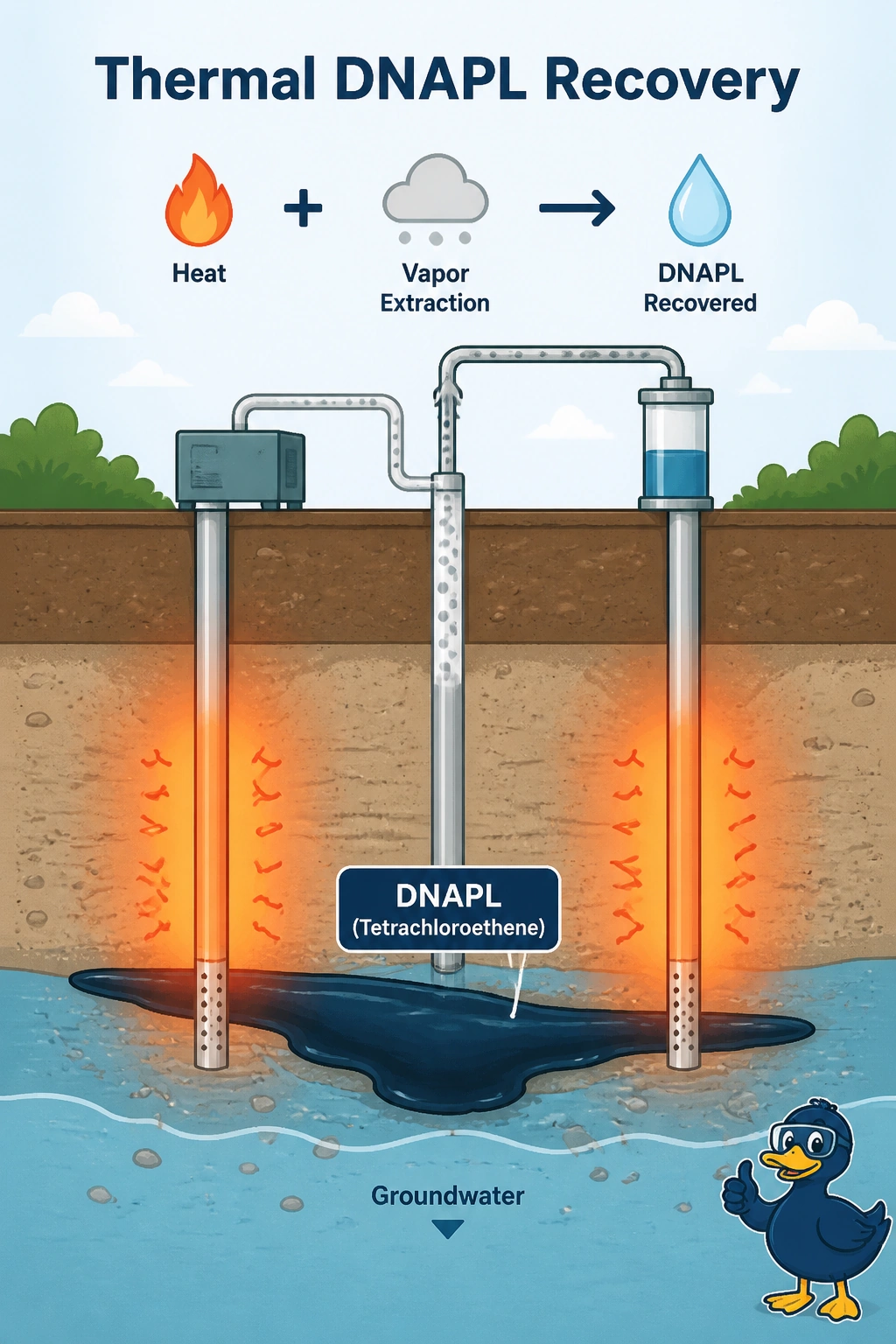
You’re right to focus on how tightly the clay holds the DNAPL: passive attenuation, air sparging, and shallow tree uptake cannot rapidly reach and remove this deep source. When low permeability limits fluid movement, in-situ thermal heating with vapor extraction can heat the clay, volatilize the tetrachloroethene, and capture it for recovery.
Full Explanation
Dense non-aqueous phase liquid (DNAPL) chlorinated solvents trapped in low-permeability clay resist hydraulic flushing because fluids bypass tight clay along higher-permeability pathways. In-situ thermal heating combined with vapor extraction is effective because heat conducts through the clay, raising vapor pressure and lowering viscosity so trapped tetrachloroethene volatilizes and can be captured by extraction wells. Monitored natural attenuation relying on passive groundwater dilution and native microbes is unsuitable for a high-mass DNAPL source zone because natural processes may take decades to centuries and cannot rapidly reduce pooled mass. Gravity-fed air sparging wells installed to strip volatile compounds from deep clay layers fail because air channels unpredictably through low-permeability clay and cannot effectively strip the trapped DNAPL. A shallow vegetative phytoremediation cover using hybrid poplar trees is ineffective because roots cannot reach deep clay lenses and may not tolerate concentrated DNAPL toxicity. A key design caveat is that thermal systems need robust vapor-capture vacuum and off-gas treatment to prevent upward vapor migration into buildings. As a practical check, monitor subsurface temperature sensors and vacuum-extraction mass-removal rates throughout operation.
Prefer to study offline? Printable PDF study book + test engine ($7.50, unofficial). These questions stay free here.