
A former battery-manufacturing site has shallow, unsaturated clay soil contaminated with high concentrations of non-volatile lead, and off-site hazardous waste landfilling is prohibitively expensive. Which remediation technology permanently reduces lead mobility and leachability in place without attempting to destroy the metal?
Select an answer to reveal the explanation.
Short Explanation
Heavy metals are elements, so you cannot vaporize or biodegrade lead the way you would an organic solvent. Your best in-place option is locking the lead into a solid matrix with binders so groundwater cannot leach it out. The trap is picking vapor extraction or bioremediation, which only work on volatile or biodegradable organics.
Full Explanation
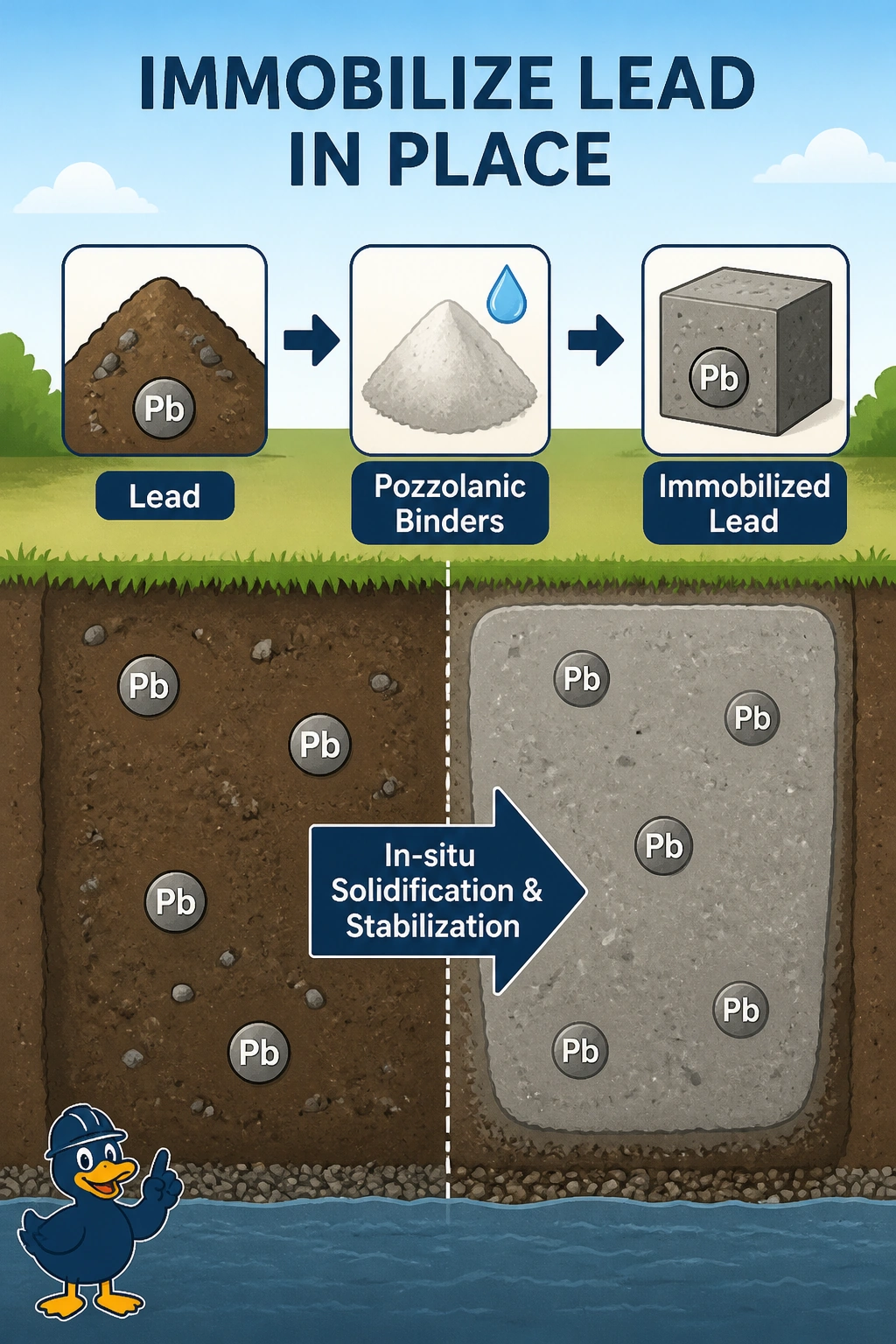
Unlike organic contaminants that can be volatilized or mineralized, elemental heavy metals such as lead cannot be destroyed by biological or thermal degradation at ambient conditions. Applying In-situ solidification and stabilization using pozzolanic binders to immobilize lead mixes reagents such as Portland cement, fly ash, or lime into the soil to chemically bind lead into low-solubility compounds and physically encapsulate it within a low-permeability monolith. Selecting Soil vapor extraction with activated carbon off-gas treatment to volatilize lead fails because elemental lead and inorganic lead salts have negligible vapor pressure and will not partition into soil gas. Attempting Enhanced aerobic bioremediation using nutrient injection to mineralize lead into harmless gas is ineffective because microorganisms cannot destroy heavy metal elements into harmless gases. Using Air sparging below the clay zone to strip dissolved lead into the overlying vadose zone fails both because lead is non-volatile and because low-permeability clay restricts air-channeling flow. As a caveat, solidification and stabilization increases treated soil volume and requires long-term institutional controls if total lead concentrations remain above unrestricted cleanup standards. For an operational check, perform bench-scale binder treatability testing followed by post-treatment Toxicity Characteristic Leaching Procedure sampling to verify immobilization.
Prefer to study offline? Printable PDF study book + test engine ($7.50, unofficial). These questions stay free here.