
After excavating leaking underground gasoline storage tanks and removing free-phase petroleum product, a consultant finds a low-concentration, shrinking dissolved BTEX plume in groundwater with active biodegradation indicators and no nearby drinking-water or surface-water receptors. Which remedial strategy relies on ongoing natural processes paired with structured groundwater monitoring to verify cleanup?
Select an answer to reveal the explanation.
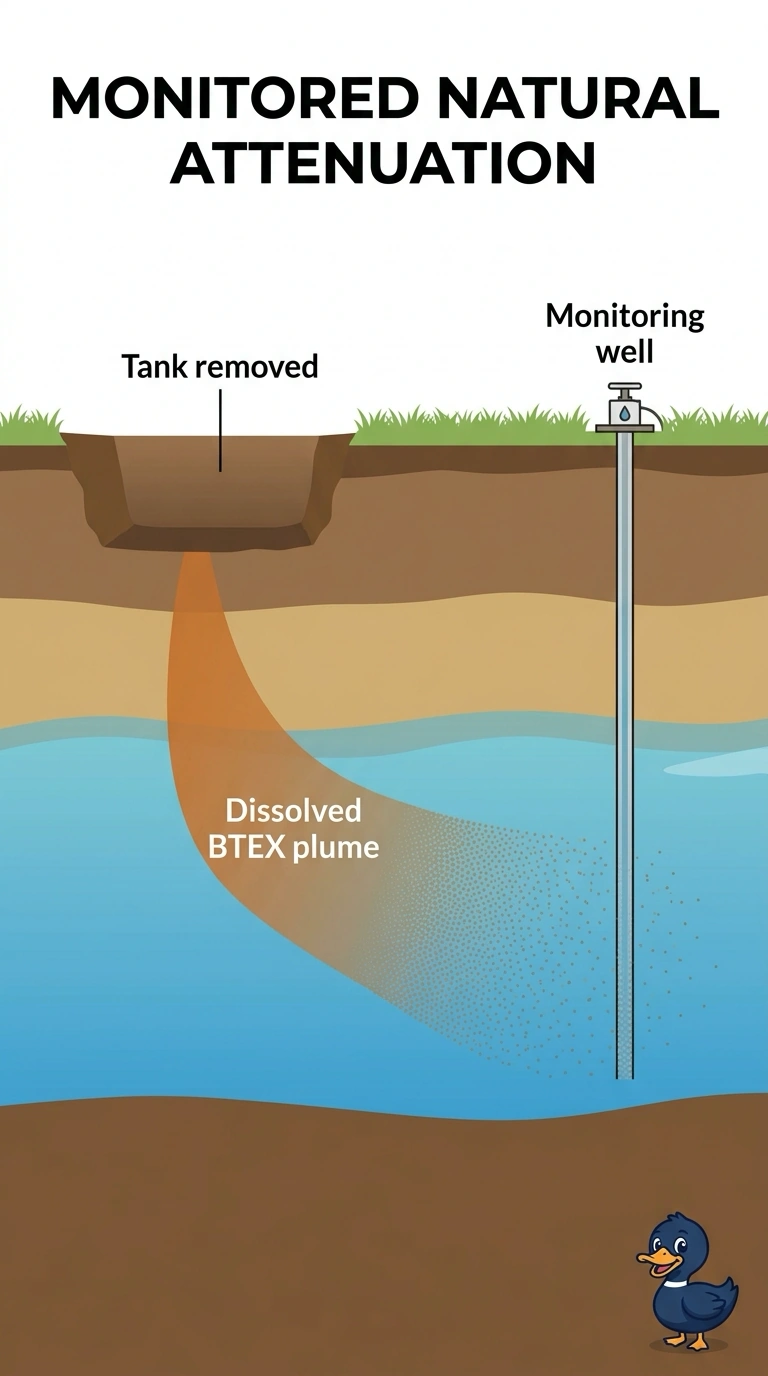
Short Explanation
When you have already pulled out the leaking tank and the remaining plume is shrinking on its own, nature can finish the job if you prove it with data. Monitored natural attenuation pairs intrinsic biodegradation with ongoing well sampling. Don't confuse it with active thermal or vacuum systems meant for heavy source zones.
Full Explanation
When source zones have been removed and a dissolved petroleum plume is stable or shrinking with no threatened receptors, active mechanical remediation is often unnecessary. Monitored natural attenuation relies on documented natural physical, chemical, and biological processes—such as aerobic and anaerobic biodegradation, dispersion, dilution, and sorption—paired with structured groundwater monitoring to verify that cleanup goals are achieved within a reasonable timeframe. In-situ thermal desorption heats subsurface soil or groundwater to volatilize contaminants and is an aggressive source-zone treatment rather than a passive monitoring strategy. Multi-phase vacuum extraction uses high-vacuum pumps to simultaneously recover free-phase product, contaminated groundwater, and soil vapor, making it suited for active source recovery rather than low-concentration residual plumes. Slurry-wall hydraulic containment constructs a physical low-permeability barrier underground to block groundwater flow rather than relying on natural degradation. As a caveat, regulators require multiple lines of geochemical and hydrological evidence—not merely declining concentrations—to approve monitored natural attenuation. For an operational check, track dissolved oxygen, nitrate, sulfate, ferrous iron, methane, and BTEX trends across sentinel wells on a regular schedule.
Prefer to study offline? Printable PDF study book + test engine ($7.50, unofficial). These questions stay free here.