
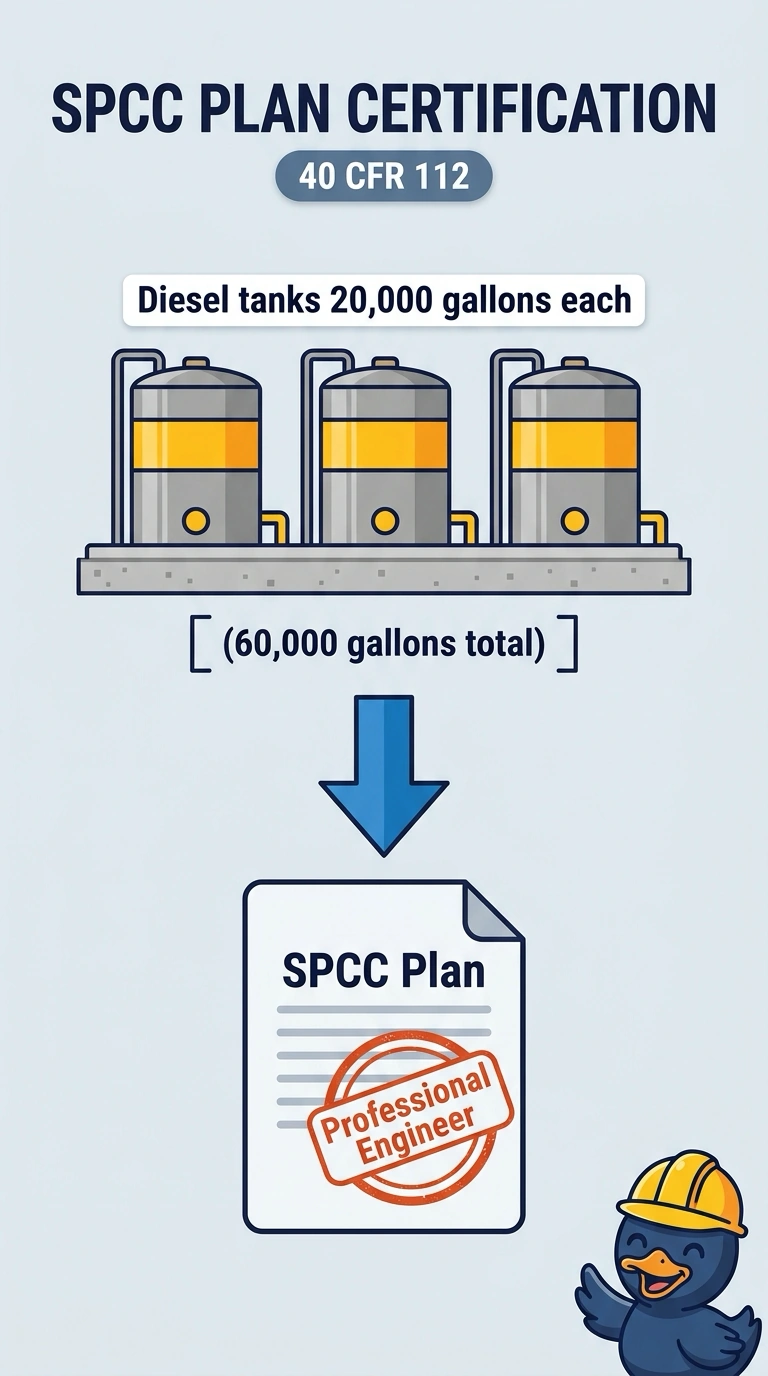
A logistics terminal is planning to install three 20,000-gallon aboveground diesel storage tanks (60,000 gallons total capacity) with no underground oil storage. Under EPA 40 CFR Part 112, who must certify the facility's Spill Prevention, Control, and Countermeasure (SPCC) Plan?
Select an answer to reveal the explanation.
Short Explanation
Once your total oil storage climbs into tens of thousands of gallons, self-certification is off the table and an independent engineer must sign off. The trap is thinking a supervisor or local fire marshal can certify a large-capacity SPCC Plan.
Full Explanation
Under EPA 40 CFR Part 112, Spill Prevention, Control, and Countermeasure Plans must be certified to ensure containment and prevention engineering meets good engineering practice. A licensed Professional Engineer after reviewing the facility must certify the SPCC Plan because 60,000 gallons of aboveground oil storage far exceeds the qualified-facility threshold that allows owner-operator self-certification. The terminal's warehouse shift supervisor using a self-certification form is ineligible because self-certification is restricted to smaller qualified facilities meeting strict aggregate capacity and spill-history limits. The local municipal fire marshal following a pre-startup inspection may enforce local fire codes, but fire officials do not perform federal SPCC Plan engineering certifications. An EPA regional enforcement inspector prior to tank construction conducts compliance inspections rather than designing or certifying a facility's SPCC Plan. As an exam caveat, even a smaller facility under the capacity threshold loses self-certification eligibility if it has experienced a reportable oil discharge exceeding regulatory spill-history limits within the prior three years. For an operational check, verify that the PE seal, signature, and five-year plan review date are current and accessible on site.
Prefer to study offline? Printable PDF study book + test engine ($7.50, unofficial). These questions stay free here.