
A specialty chemical company is evaluating two candidate parcels for a new bulk liquid raw-material tank farm during early facility planning. Why should the environmental planner assess depth to groundwater, soil permeability, and distance to nearby drinking-water wells before selecting the site?
Select an answer to reveal the explanation.
Short Explanation
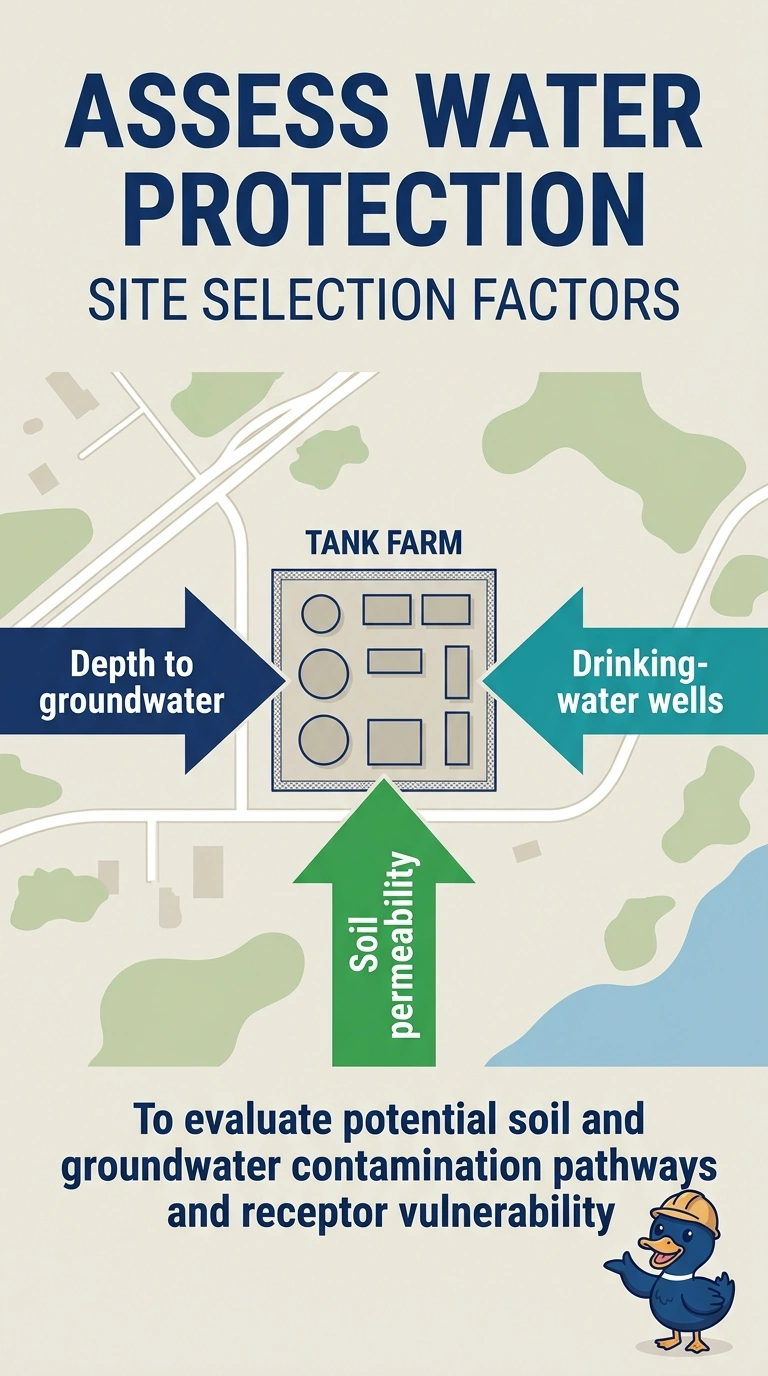
Where you put your tank farm matters just as much as how you build it. The trap is thinking hydrogeology data lets you skip engineered containment, when its real purpose is helping you gauge how fast a leak could reach groundwater and nearby wells.
Full Explanation
During pre-construction planning, evaluating site-specific environmental conditions is essential for minimizing long-term release liability. The planner must assess groundwater depth, soil permeability, and well locations To evaluate potential soil and groundwater contamination pathways and receptor vulnerability so the team can choose the lower-risk parcel and design appropriate liners, leak detection, and monitoring. Choosing To eliminate the need for secondary containment dikes around bulk liquid tanks is incorrect because favorable geology never waives regulatory containment requirements for hazardous chemicals or oil. Choosing To bypass Clean Water Act stormwater permitting regardless of site drainage confuses subsurface hydrogeology with surface runoff rules that govern industrial discharges to waters of the United States. Opting To waive federal Spill Prevention, Control, and Countermeasure Plan requirements is wrong because SPCC applicability depends on aggregate oil storage capacity and reasonable expectation of discharge to navigable waters, not deep groundwater alone. As a caveat, even a low-permeability clay site still requires engineered secondary containment because fractures, utility trenches, and surface drainage can rapidly transport spills. As an operational check, overlay local wellhead protection zones, floodplain maps, and geotechnical boring logs on the site plan before finalizing tank placement.
Prefer to study offline? Printable PDF study book + test engine ($7.50, unofficial). These questions stay free here.