
An electronics manufacturer is planning a new solder-stripping line that will generate a solid filter cake containing trace lead and cadmium. To determine during pre-startup planning whether the filter cake will exhibit the RCRA toxicity characteristic under 40 CFR 261.24, which laboratory test should the EHS engineer specify?
Select an answer to reveal the explanation.
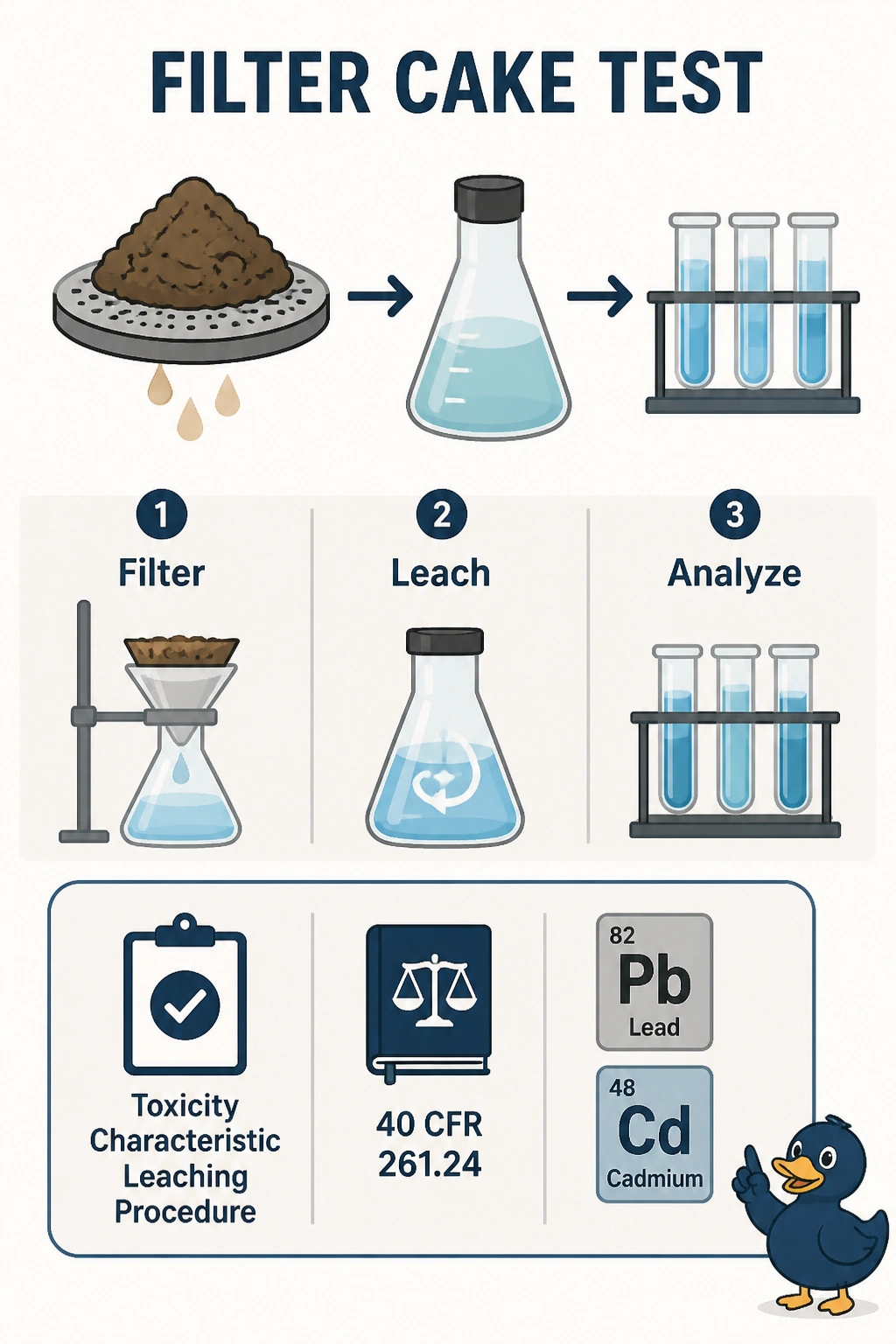
Short Explanation
Think of a landfill as a giant coffee maker where acidic rainwater slowly brews whatever can dissolve out of buried waste. When you evaluate solid waste for heavy metals under 40 CFR 261.24, the Toxicity Characteristic Leaching Procedure test measures what actually leaches out rather than what stays locked inside. The classic trap is ordering a total metals digestion instead, which measures everything in the solid and cannot prove compliance on its own.
Full Explanation
Under 40 CFR 261.24, a solid waste exhibits the toxicity characteristic for contaminants such as lead (D008) and cadmium (D006) when extract concentrations equal or exceed regulatory thresholds using the Toxicity Characteristic Leaching Procedure test, EPA Method 1311. This extraction uses a mildly acidic leaching fluid to simulate municipal landfill conditions and measure mobile metal concentrations in milligrams per liter. Total constituent metals concentration by acid digestion measures the entire mass of metals in milligrams per kilogram, so it cannot directly establish whether leachable concentrations exceed federal limits, even though a total result below twenty times the regulatory limit can screen a waste out. Paint Filter Liquids Test to detect free liquids (EPA Method 9095B) determines whether a waste releases free liquids before landfilling under 40 CFR 264.314, not whether metals leach. Closed-cup flash point test for liquid ignitability evaluates the D001 ignitability characteristic under 40 CFR 261.21 and does not apply to metal toxicity in a filter cake. As a planning caveat, always confirm with the laboratory whether the matrix requires specific sample preservation or holding times before extracting. Operationally, collect a representative composite sample of the expected filter cake during pilot runs and review the Method 1311 extract report against 40 CFR 261.24 Table 1 limits before finalizing waste storage and off-site disposal contracts.
Prefer to study offline? Printable PDF study book + test engine ($7.50, unofficial). These questions stay free here.