
An environmental professional is conducting a Phase I Environmental Site Assessment on an active manufacturing property to evaluate potential Recognized Environmental Conditions. Beyond reviewing historical records and government databases, which core activities must be completed?
Select an answer to reveal the explanation.
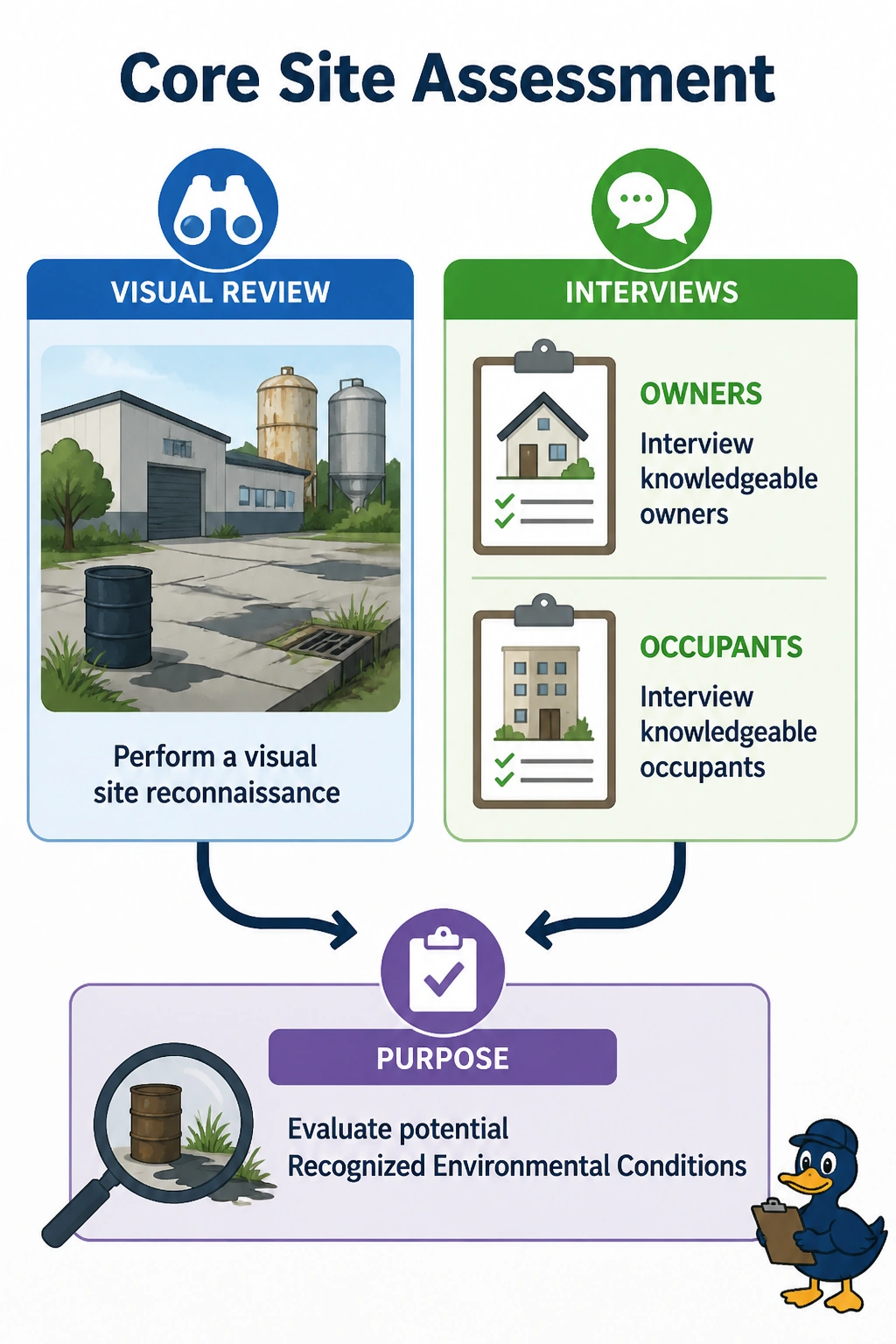
Short Explanation
An initial environmental site assessment is like a home inspection before you buy—you look, read the history, and ask questions without tearing open the drywall. The trap is jumping straight to drilling wells or sampling drains during a non-intrusive due-diligence study. Under ASTM E1527, you pair records review with a visual site reconnaissance and interviews of owners and occupants.
Full Explanation
Under ASTM E1527 and EPA All Appropriate Inquiries (40 CFR Part 312), a Phase I Environmental Site Assessment is a non-intrusive due-diligence investigation that evaluates a property for Recognized Environmental Conditions without disturbing soil or collecting physical samples. Selecting Performing a visual site reconnaissance and interviewing knowledgeable owners and occupants pairs directly with historical records and database reviews to verify current chemical handling, staining, and past site operations. By contrast, Installing three groundwater monitoring wells and collecting soil borings across the parcel is an intrusive subsurface investigation belonging to a Phase II Environmental Site Assessment, which is only warranted after Phase I findings identify potential contamination. Similarly, Excavating test pits around every loading dock to inspect subsurface utility corridors involves physical soil disturbance outside the non-intrusive Phase I scope. Choosing Running Toxicity Characteristic Leaching Procedure tests on all floor-drain sediments applies a RCRA waste-characterization laboratory method rather than Phase I property due diligence. As a practical caveat, if current owners or occupants decline interviews or restrict access to portions of the building, the environmental professional must document those data gaps and evaluate their significance in the final report. For an operational check, confirm that dated site-walk photographs, completed interview logs, and a field reconnaissance checklist are retained in the project file.
Prefer to study offline? Printable PDF study book + test engine ($7.50, unofficial). These questions stay free here.