
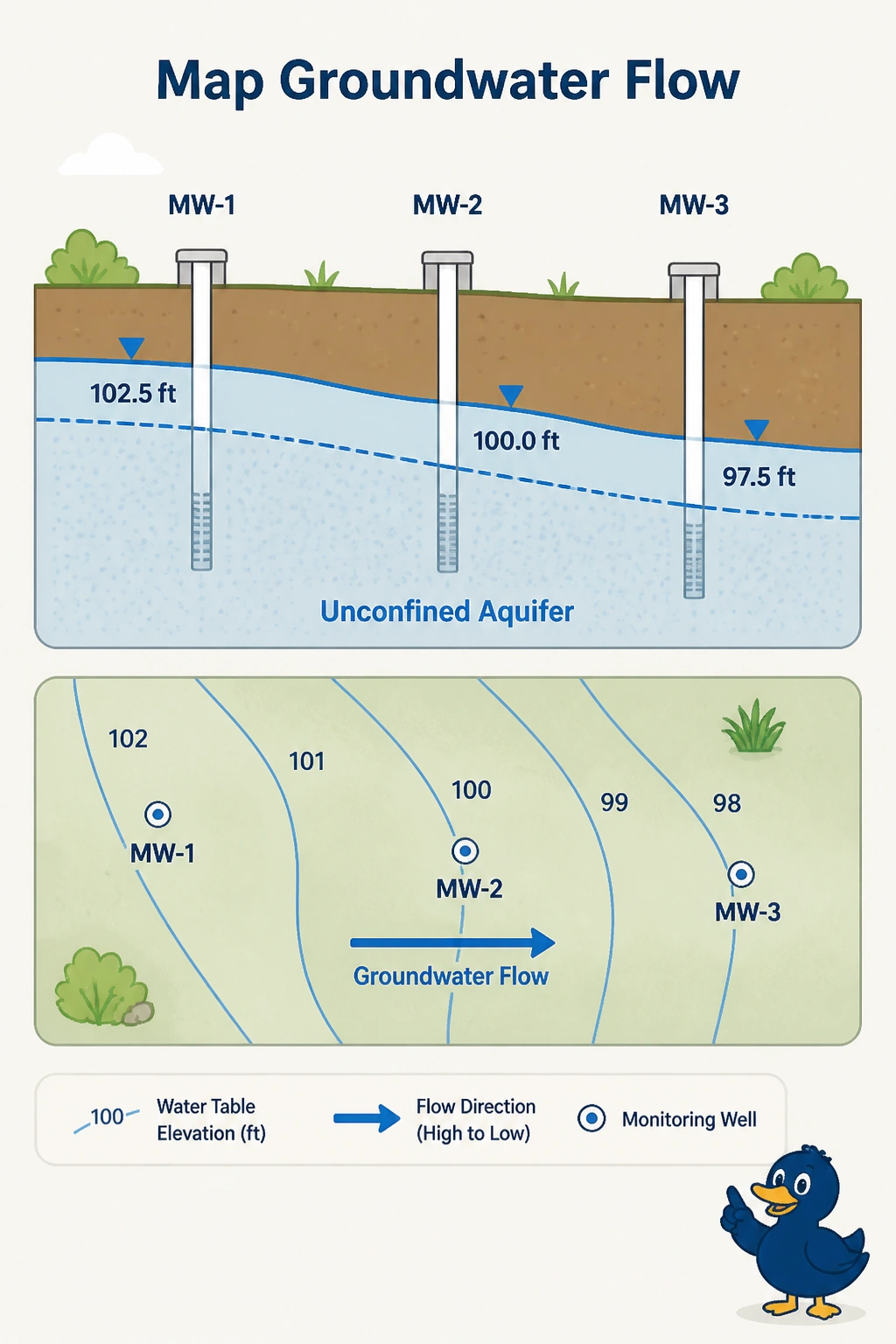
An environmental consultant installs three monitoring wells screened in the same unconfined aquifer around a former chemical storage pad and measures depth to water from surveyed top-of-casing elevations. How should the consultant use these measurements before interpreting groundwater analytical data?
Select an answer to reveal the explanation.
Short Explanation
Before you can tell whether a monitoring well shows incoming background water or a leak leaving your pad, you need to know which way the aquifer is flowing. The trap is guessing flow from surface roads or averaging concentrations without checking groundwater elevations first.
Full Explanation
Subtracting depth-to-water from each surveyed top-of-casing elevation allows the consultant to Calculate groundwater elevations to determine flow direction and upgradient wells, establishing which well represents background water entering the pad and which wells lie downgradient to intercept potential releases. Average the three contaminant concentrations together to represent site-wide background quality destroys spatial information and masks a localized plume in a downgradient well. Assume groundwater flows directly toward the nearest paved road regardless of elevation ignores subsurface hydrogeology; while water tables often roughly mimic topography, underground utilities, pumping wells, and geology frequently alter flow direction. Treat the well with the lowest water-table elevation as the upgradient background well reverses the gradient concept because groundwater flows from higher to lower hydraulic head, so the lowest-elevation well is downgradient and cannot represent incoming background water. Caveat: ensure all three wells are screened in the same hydrostratigraphic unit and measured during a single synoptic event before contouring. As an operational check, plot the three groundwater elevations on a scaled site map and draw equipotential lines to verify the hydraulic gradient.
Prefer to study offline? Printable PDF study book + test engine ($7.50, unofficial). These questions stay free here.