
A pharmaceutical plant discovers several unopened drums of an off-specification, unused commercial chemical product whose sole active ingredient is a listed toxic compound, and decides to send them off-site for disposal. How must the environmental specialist classify this waste under federal RCRA regulations?
Select an answer to reveal the explanation.
Short Explanation
An unused, off-spec chemical heading for disposal is like an unopened carton of spoiled milk—it never did its job, yet it still requires proper handling. When you discard an unused commercial chemical product, your classification starts with the RCRA P-list and U-list under 40 CFR 261.33. The trap is assuming only spent process wastes are regulated, or confusing unused products with F-listed spent solvents.
Full Explanation
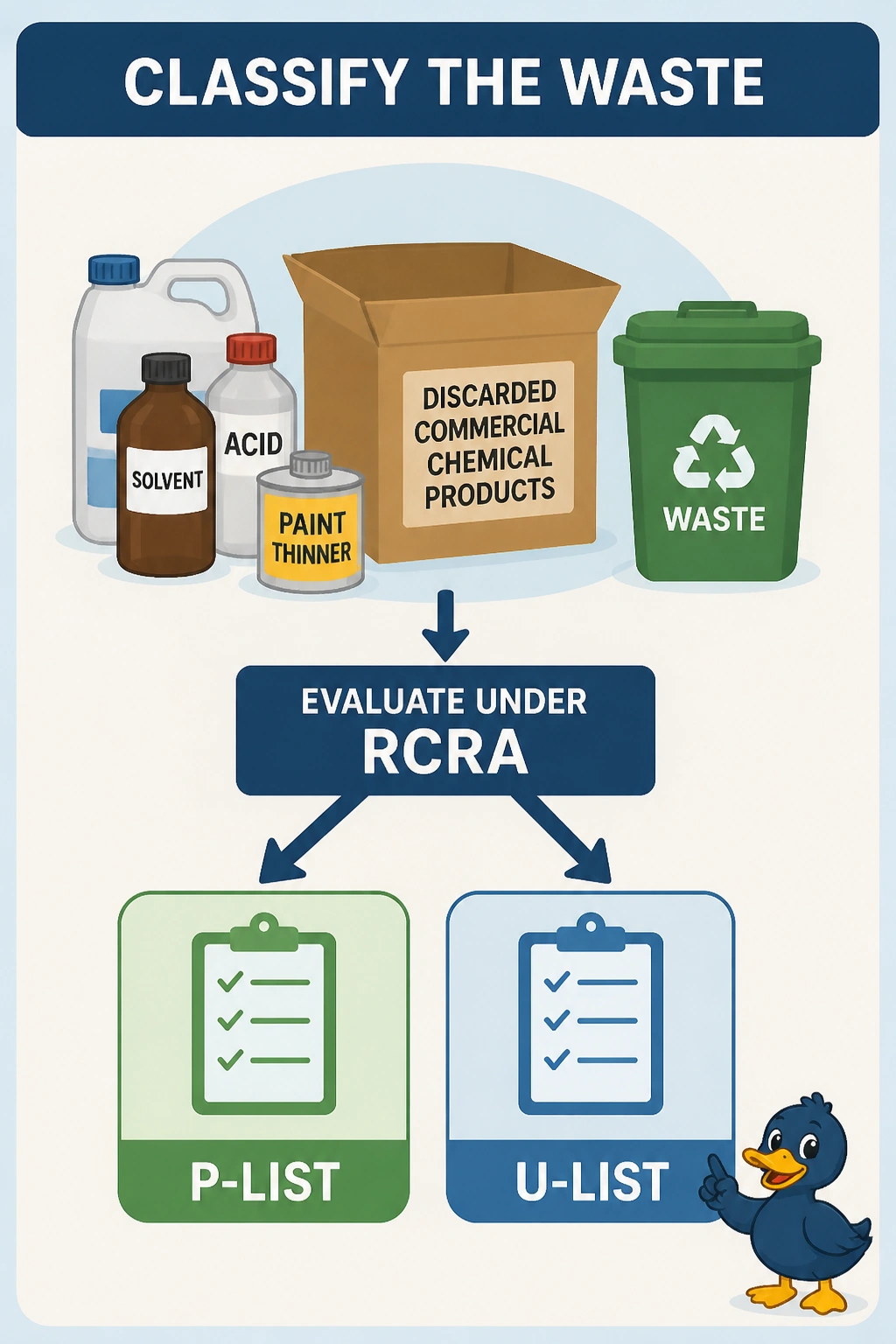
Under 40 CFR 261.33, unused commercial chemical products, off-specification species, container residues, and spill residues become solid and hazardous wastes when discarded, and they are regulated under the P-list (acute hazardous) or U-list (toxic) when the listed chemical is the sole active ingredient. Accordingly, the specialist must Evaluate the material under the RCRA P-list and U-list for discarded commercial chemical products before arranging disposal. The option to Classify the unused material as an F001 through F005 spent solvent waste regardless of whether it was ever used is incorrect because F001 through F005 apply to spent solvents that were already used for their solvent properties. Choosing to Manage the material as non-hazardous industrial trash because it remains sealed in its original vendor container fails because intent to discard triggers RCRA waste status regardless of packaging. Selecting to Wait until the container is opened and partially consumed before performing any RCRA waste determination violates 40 CFR 262.11, which requires determination at the point of generation. As a caveat, if the unused product is not P- or U-listed, it must still be evaluated for RCRA hazardous characteristics. As an operational check, review the Safety Data Sheet composition against 40 CFR 261.33 tables before generating a waste profile.
Prefer to study offline? Printable PDF study book + test engine ($7.50, unofficial). These questions stay free here.