
A systematic equity fund wants to build a signal from SEC Form 4 insider transaction filings. Their data science team is debating whether to use raw dollar transaction amounts or a normalized metric. Which approach to signal construction produces the most robust predictive alpha, and what confound must be controlled for?
Select an answer to reveal the explanation.
Short Explanation
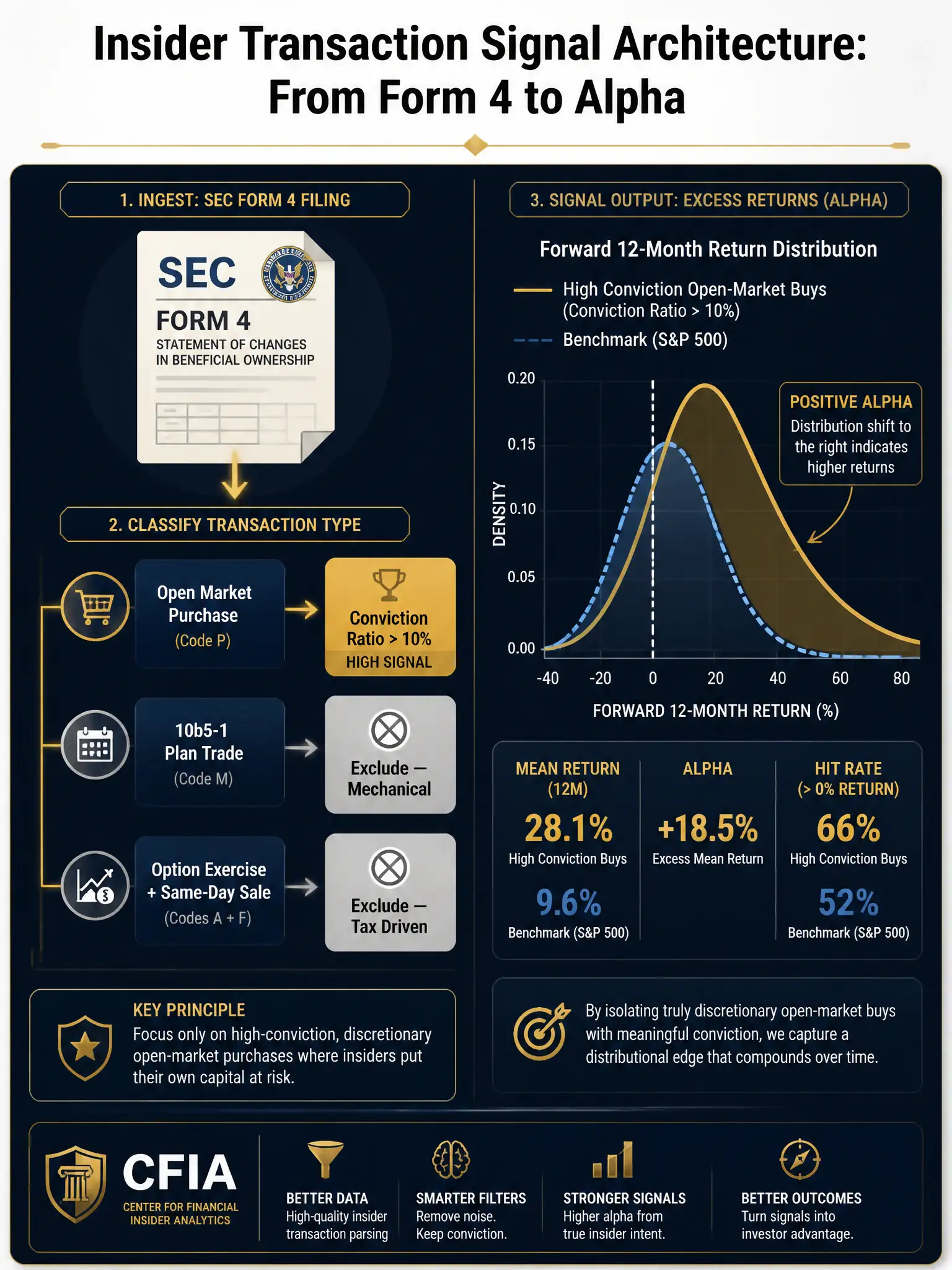
You want to normalize insider buys as a percentage of existing insider holdings, then separate open-market trades from 10b5-1 plan trades and strip out option-expiration sales. A $100,000 buy in a $2 trillion company is like buying a vending-machine snack, but doubling a personal stake with no pre-scheduled plan is real skin in the game.
Full Explanation
The most robust approach is to normalize insider purchases as a percentage of total insider holdings, often called the 'conviction ratio', cluster transactions by type, especially open-market purchases versus pre-scheduled 10b5-1 plan trades, and control for option expiration-driven sales so the signal isolates discretionary buying. Normalizing by existing holdings adjusts for the wealth effect: a $500,000 purchase means far more when it represents 15% of an insider's net worth in company stock than when it represents 0.1%. Academic research by Lakonishok and Lee (2001) and Jeng, Metrick, and Zeckhauser (2003) consistently finds that the most predictive insider transactions are those where the purchase represents a meaningful fraction of existing holdings. The 10b5-1 plan distinction is equally important. Pre-scheduled trading plans allow insiders to trade on a fixed schedule established months in advance during an open window, mechanically executing regardless of subsequent developments. These trades carry no informational content about current business conditions. In contrast, open-market discretionary purchases in the absence of an existing 10b5-1 plan represent genuine expressions of insider optimism and have significantly stronger predictive power for future returns. Option expiration-driven sales, meaning conversions of in-the-money options into shares and immediate sale, are mechanically motivated and should be excluded entirely from the signal. Failure to exclude them inflates the apparent sell-signal count and suppresses the historically observed asymmetry where purchases outperform sales as predictors. The raw-dollar approach that excludes purchases below $1 million is an imprecise proxy for conviction that penalizes legitimate high-conviction buys by insiders at small-cap companies. The breadth-count approach that counts distinct insiders buying in a month and excludes all sales has some validity in the literature but ignores the normalization problem: ten insiders each buying trivially small amounts in relative terms do not create the same signal as one insider making a concentrated open-market purchase. The shares-outstanding ratio approach that weights all transaction types equally is precisely what erodes the signal, as extensively documented in the insider trading literature.