
A hedge fund's newly formed AI team has identified 12 potential AI initiatives: NLP earnings call summarization, a portfolio risk attribution dashboard, an alternative data signal library, an automated regulatory filing parser, a client reporting generator, a real-time news sentiment feed, a quant backtesting accelerator, a trade execution optimizer, an ESG scoring model, a macro regime classifier, a counterparty credit monitor, and an AI-powered CRM. The CIO asks the AI team to prioritize the roadmap. Which prioritization framework is most appropriate?
Select an answer to reveal the explanation.
Short Explanation and Infographic
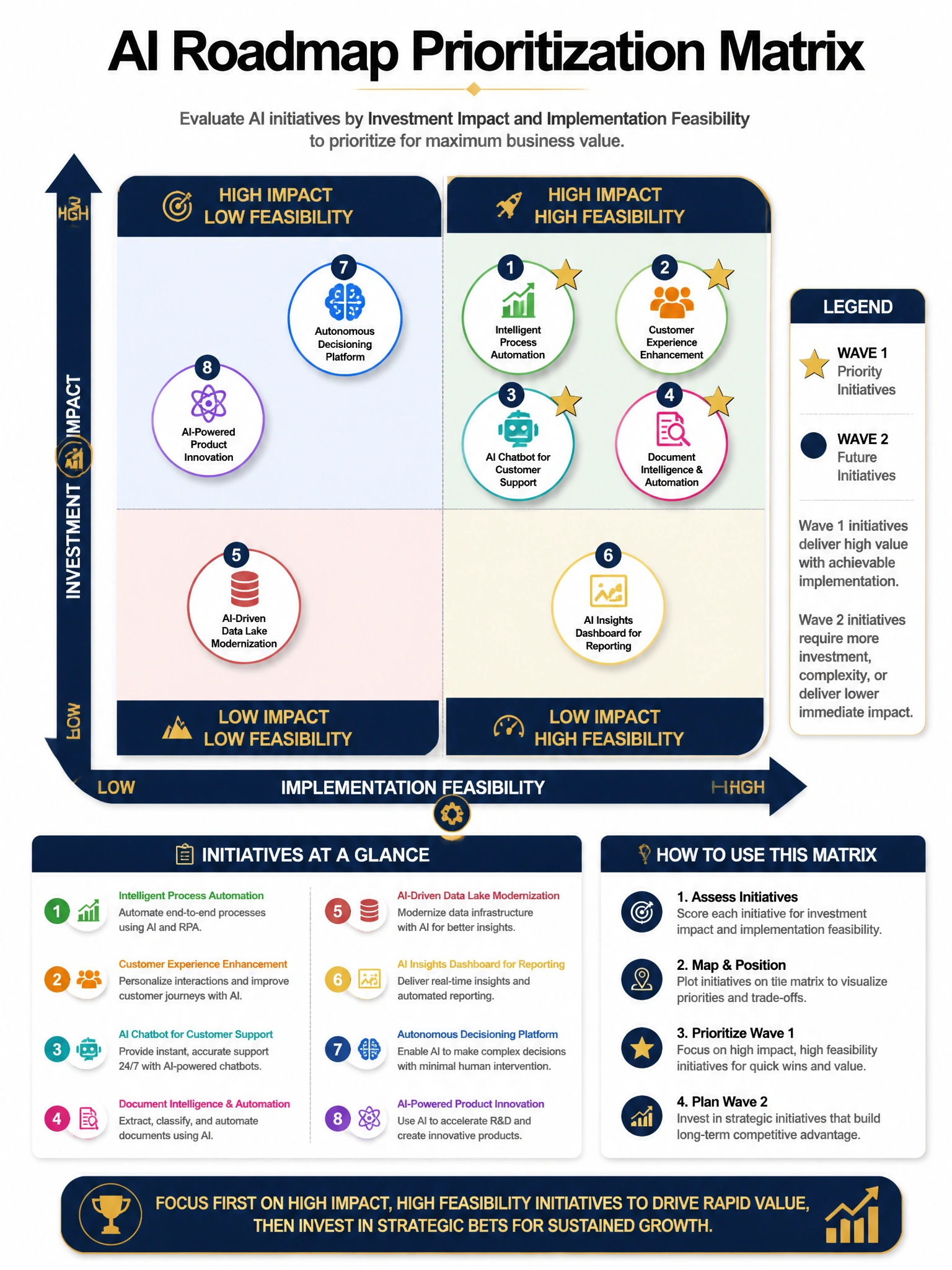
You wouldn't tackle the hardest mountain climb on your first expedition. Start where impact and feasibility intersect — the two-axis impact-versus-feasibility matrix lets you rank 12 initiatives so early wins build momentum and demonstrate ROI before tackling harder, longer-horizon projects.
Full explanation below image
Full Explanation
AI product roadmap prioritization in an investment firm context requires a structured framework that aligns technical delivery with investment value. The two-axis impact-versus-feasibility matrix is the industry-standard approach used by leading asset managers and is consistent with portfolio prioritization frameworks from product management disciplines adapted for financial services.
On the impact axis, each initiative is scored by its proximity to alpha generation or material risk reduction — core investment outcomes. NLP earnings call summarization and the alternative data signal library score high on alpha impact; the counterparty credit monitor and portfolio risk attribution dashboard score high on risk reduction. The regulatory filing parser and client reporting generator are operationally important but less directly linked to investment performance. On the feasibility axis, initiatives are scored by data availability, technical maturity, internal talent readiness, regulatory complexity, and time-to-deployment. Earnings call summarization, for example, benefits from widely available earnings transcript datasets and proven NLP models, making it high feasibility. The macro regime classifier requires complex labeling, longer backtests, and macroeconomic domain expertise, making it lower feasibility.
Quadrant mapping reveals the sequencing logic: high-impact, high-feasibility initiatives (earnings summarization, news sentiment, quant backtesting accelerator) form Wave 1 and deliver visible wins within 3-6 months. High-impact, lower-feasibility projects (alternative data signal library, macro regime classifier, trade execution optimizer) form Wave 2, developed in parallel but deployed later. Lower-impact projects are deferred or deprioritized. Option A (data volume) optimizes for infrastructure, not investment outcomes. Option C (PM popularity) introduces selection bias and misses strategically important tools that individual PMs may not recognize as valuable. Option D (technical complexity first) maximizes learning cost while deferring revenue impact — a poor allocation of finite organizational attention.