
A $40B long-only asset manager is hiring its first dedicated data science function. The COO must decide how to structure the team relative to existing investment and technology departments. Which organizational model best positions the data science function for long-term investment impact?
Select an answer to reveal the explanation.
Short Explanation and Infographic
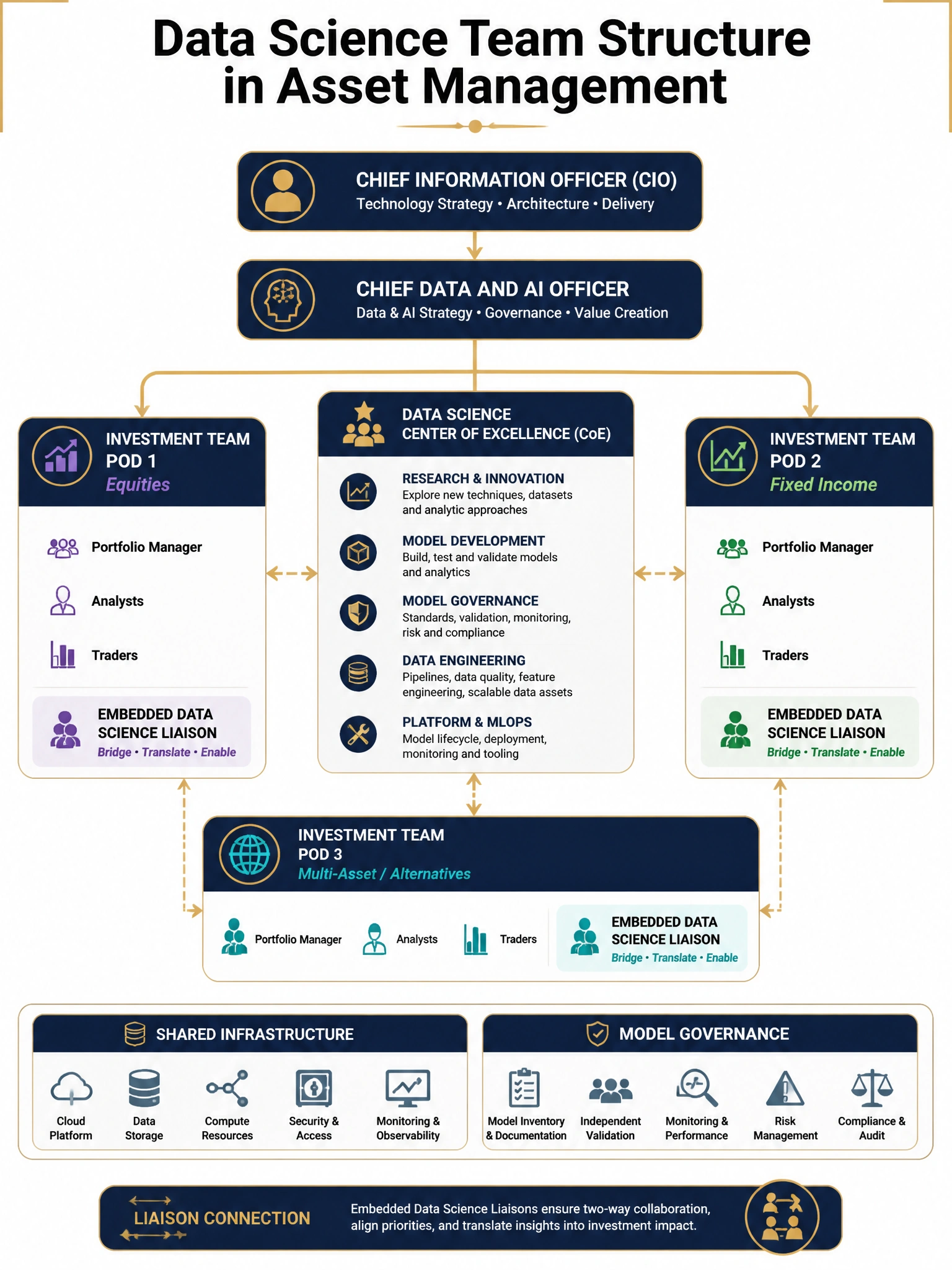
Think of it like a hospital's radiology department — centralized expertise with clinical liaisons on each floor. The data science center of excellence provides shared infrastructure and cross-pollination, while embedded liaisons keep the work grounded in what PMs actually need.
Full explanation below image
Full Explanation
Organizational placement of the data science function determines whether it generates investment alpha or becomes an expensive internal IT team. Reporting into the CIO's organization — ideally through a Chief Data and AI Officer (CDAO) — signals that data science is a first-class investment capability, not a technology support function. This reporting line ensures that model prioritization aligns with investment strategy rather than IT roadmaps, and that data scientists are evaluated on investment-relevant KPIs such as signal quality, model-driven P&L attribution, and analyst productivity lift.
The centralized center of excellence (CoE) model with embedded liaisons captures the best of both worlds. The CoE maintains shared compute infrastructure, model governance frameworks, data procurement relationships, and a common tooling stack — preventing the duplication and technical debt that arise when every investment pod builds its own data science capability independently. Liaison roles — data scientists who sit physically and organizationally adjacent to investment teams for rotating assignments — ensure that model development stays grounded in actual investment workflows rather than becoming an academic exercise.
Option A (IT reporting) embeds data science in a cost-center mindset focused on uptime and infrastructure, not alpha. Option B (fully decentralized pods) creates siloed, duplicated efforts, prevents knowledge sharing, and makes it difficult to recruit and retain strong data science talent who want to work with peers of comparable caliber. Option D (full outsourcing) sacrifices proprietary data advantages and creates dependency risk; vendors cannot develop the firm-specific institutional knowledge needed for durable edge. Industry benchmarks from Man Group, Two Sigma, and Acadian Asset Management consistently show that firms with centralized data science organizations reporting into investment leadership outperform those where data science is siloed in technology.