
An investment firm co-develops a custom large language model with an AI vendor under a joint development agreement (JDA). The firm provides proprietary trading data for fine-tuning; the vendor provides the base model architecture and engineering labor. The agreement is silent on IP ownership of the fine-tuned model weights. Under general U.S. intellectual property principles, what is the most likely default ownership outcome if the JDA is not clarified?
Select an answer to reveal the explanation.
Short Explanation
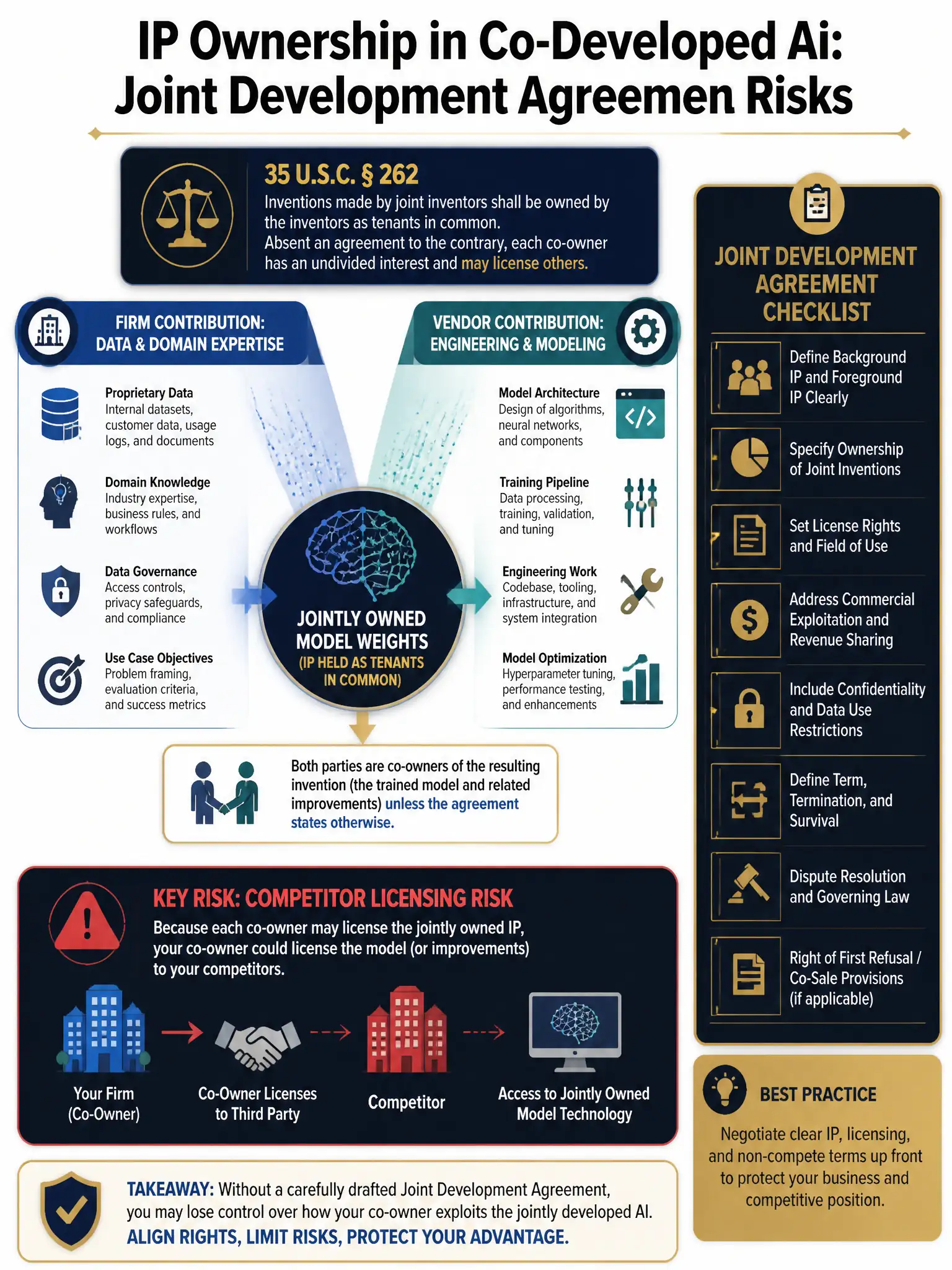
If a JDA is silent on IP, it's like a prenup that forgets the house: both contributors get keys. Under 35 U.S.C. § 262, either side can use or license jointly owned IP without asking the other, creating a huge commercial risk for your firm.
Full Explanation
When a joint development agreement is silent on intellectual property ownership, United States law defaults to principles that often produce uncomfortable outcomes for investment firms. Under 35 U.S.C. § 262, each co-owner of a jointly held patent, or analogously jointly developed intellectual property, may make, use, sell, or license the work without accounting to the other owner. Applied to AI model weights, this means the vendor could theoretically license the fine-tuned model, which encodes the firm's proprietary trading patterns, to a competitor. The conclusion that both parties likely hold joint ownership of the fine-tuned model weights, meaning either party may independently use or license them without the other's consent under 35 U.S.C. § 262, is most likely because both sides supplied material contributions: proprietary data and information from the firm, plus base architecture and engineering labor from the vendor. The view that the firm owns 100% because data contribution supersedes engineering contribution overstates data contribution. While the firm's proprietary data drove the fine-tuning, data itself is often not copyrightable; collections may be, under thin copyright doctrine, but providing data for training does not automatically transfer ownership of the trained artifact. The legal treatment of training data contributions in AI intellectual property is evolving, but silence in the contract does not resolve it in the data provider's favor. The view that the vendor owns the fine-tuned weights because they own the base model architecture and fine-tuning is a derivative work similarly overstates the vendor's position. Fine-tuned model weights are a transformation of the base model, but they also embody the engineering contribution of the training process and the informational contribution of the training data. Copyright derivative work doctrine applies to expressive works, and its application to neural network weights is legally contested. The view that neither party owns the fine-tuned weights because AI-generated artifacts are not patentable or copyrightable correctly identifies that AI-generated outputs face copyright barriers, as confirmed by the U.S. Copyright Office's 2023 guidance on AI-generated works, but the weights themselves, as a product of human-directed development, may qualify for trade secret protection or patent claims on novel architecture modifications. Omitting these protections from the joint development agreement is the error. CFIA candidates should know: always negotiate explicit intellectual property assignment or license-back provisions in joint development agreements before development begins. The WIPO AI and IP Policy guidance and the USPTO's 2024 AI Inventorship guidance are the relevant reference frameworks.