
A newly appointed Chief AI Officer at a $25B AUM multi-strategy hedge fund is tasked with developing a 3-year AI strategy roadmap. The fund's partners expect the roadmap to balance near-term alpha generation with longer-horizon infrastructure investment. Which sequencing framework best serves the fund's dual mandate?
Select an answer to reveal the explanation.
Short Explanation
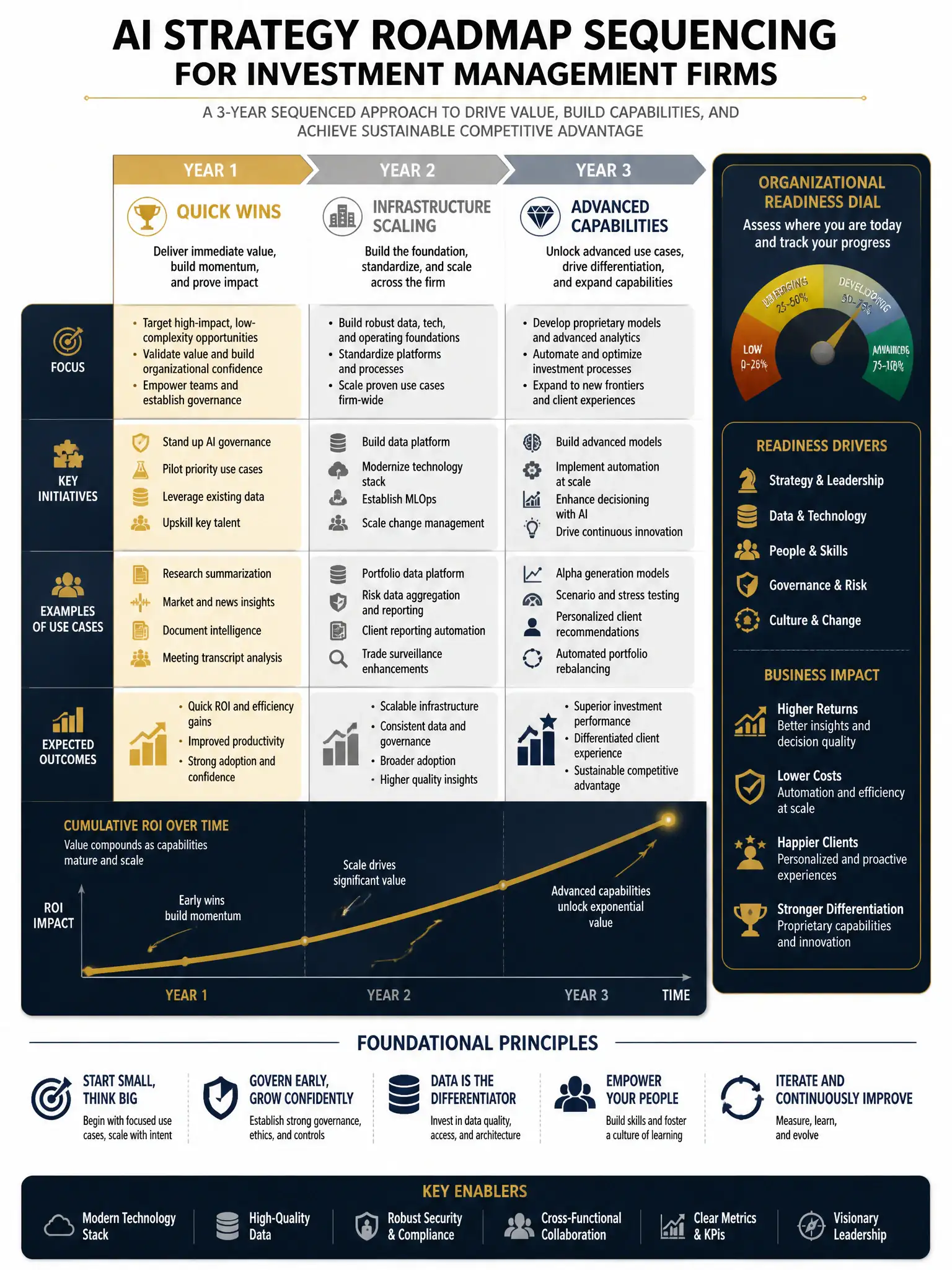
A great AI strategy roadmap is like compound interest — you start with high-ROI, low-complexity AI use cases in Year 1 to earn trust and fund political capital, then reinvest that credibility into bigger infrastructure bets. Those early wins generate measurable ROI and organizational buy-in, which fund the harder, longer infrastructure work in Years 2-3 without burning goodwill.
Full Explanation
Effective AI strategy roadmaps in investment management follow a value-sequenced architecture that mirrors how organizations actually absorb technological change. The sequencing framework that deploys high-ROI, low-complexity AI use cases in Year 1 to demonstrate value and fund political capital, then scales infrastructure and experimental capabilities in Years 2-3, is the best fit because it balances near-term alpha generation with longer-horizon infrastructure investment. Starting with high-ROI, low-complexity applications — such as NLP-driven earnings call summarization, portfolio attribution automation, or factor signal enrichment — generates measurable returns quickly, builds cross-functional credibility for the AI team, and creates the data pipelines and governance workflows that more advanced applications will later depend on.
The approach that begins with large-scale foundation model development in Year 1 to establish differentiated infrastructure before pursuing commercial applications in Years 2-3 reverses the risk-reward sequence. Proprietary foundation model training is capital-intensive ($5M-$50M+ depending on scale), multi-year in timeline, and highly uncertain in competitive differentiation for a mid-sized hedge fund competing against firms with 100x the ML research headcount. Year 1 foundation model development burns capital before establishing proof of concept.
The approach that outsources all AI development to three specialist vendors in Year 1 and evaluates build-vs-buy annually with no internal capability development creates structural dependency and inhibits the institutional learning that differentiates long-term AI competitors. Firms that outsource entirely typically find themselves unable to evaluate vendor claims, integrate signals into proprietary workflows, or pivot when vendor relationships deteriorate. Some vendor use is appropriate; complete reliance is a strategic vulnerability.
The approach that prioritizes hiring a 40-person data science team in Year 1 before deploying any production AI systems creates a talent accumulation without purpose problem. Large data science teams hired ahead of production systems frequently produce academic-quality research that does not translate to investment edge, experience morale deterioration from lack of meaningful production work, and depart before the infrastructure is ready to absorb their capabilities.
The CFIA framework references McKinsey's AI Adoption Maturity Model and the CFA Institute's 2023 Future of Finance report on AI adoption sequencing in investment management.