
A pension fund's investment technology committee is conducting due diligence on an AI vendor providing real-time risk scoring. The vendor is a Series B startup with $40M ARR and 18 months of runway. Which financial stability indicator should most concern the committee when assessing vendor viability for a 5-year production dependency?
Select an answer to reveal the explanation.
Short Explanation and Infographic
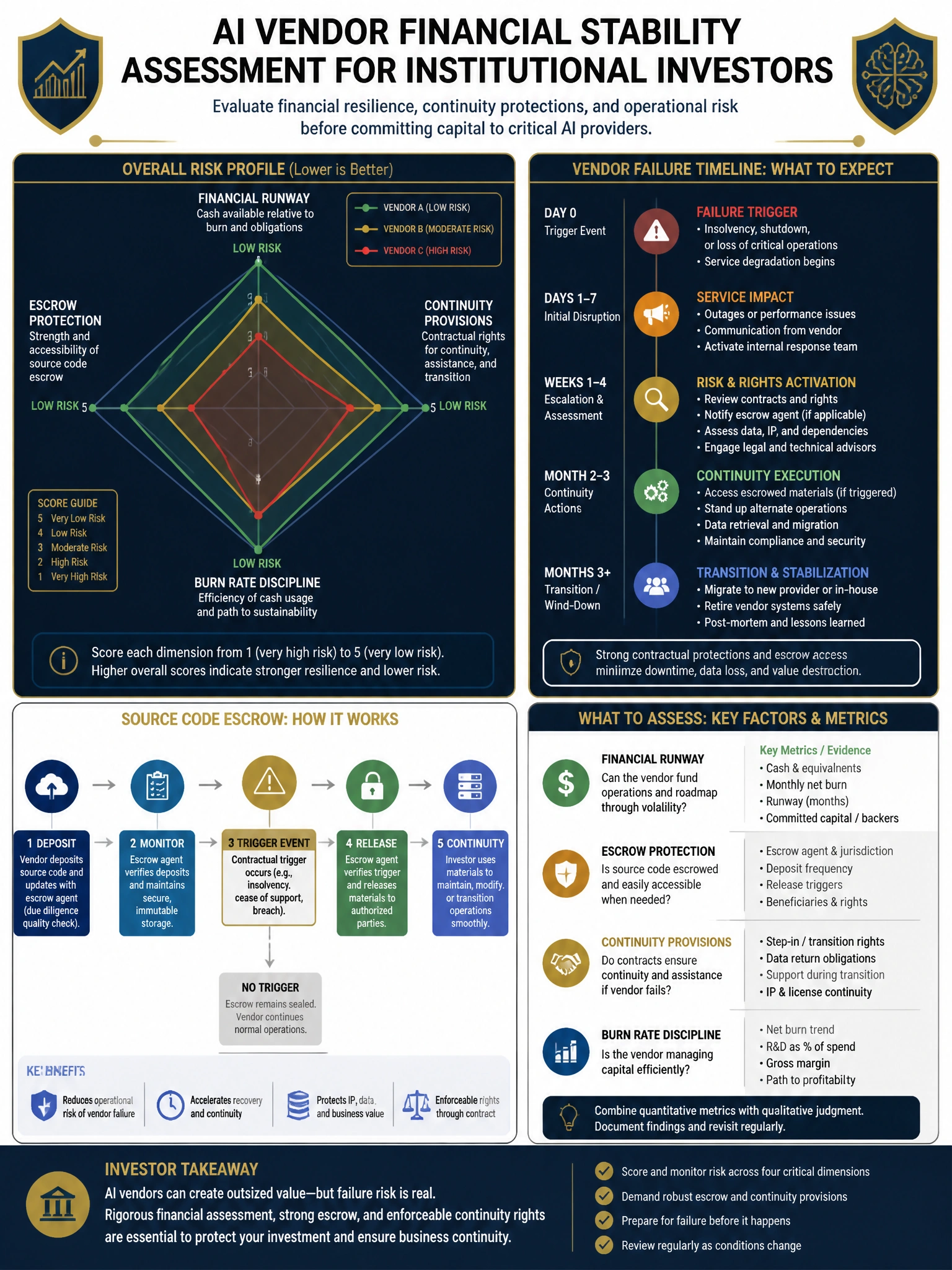
Todd Lammle: Runway without an escape hatch is like flying a plane with 18 months of fuel and no parachute — when the fuel runs out, the fund crashes too. The real risk isn't the startup's burn rate; it's the absence of source code escrow that would let the fund keep running if the vendor disappears. Option B names both problems together.
Full explanation below image
Full Explanation
When a regulated institutional investor builds a 5-year operational dependency on an AI vendor, the key financial stability risk is not current profitability but survivability and continuity planning. Eighteen months of runway is a yellow flag for a company without a clear path to profitability or Series C commitment, but it becomes a critical red flag when no contractual protections exist to protect the fund if the vendor fails.
Source code escrow agreements — in which the vendor deposits their codebase with a neutral third party (e.g., Iron Mountain, NCC Group) that releases it to customers upon defined trigger events such as insolvency — are standard risk mitigation in enterprise technology procurement. Similarly, business continuity clauses should require vendors to maintain 30–90 day operational bridges and notify customers of material financial deterioration. Without these provisions, the fund faces operational disruption with no legal recourse at the worst possible moment.
Option A (gross margin) is a secondary benchmark concern. A 72% gross margin in a growth-stage AI company often reflects appropriate infrastructure investment, not mismanagement. Option C (pricing model) is a commercial negotiation point, not a stability indicator. Option D (founder exit history) is a weak signal at best; acquisition exits are common, respected outcomes in venture-backed technology and do not predict abandonment behavior.
The CFA Institute's Operational Due Diligence framework and ILPA's Operational Due Diligence Best Practices both emphasize contractual continuity provisions as primary considerations when evaluating technology vendors. CFIA candidates should memorize the escrow-plus-continuity combination as the institutional standard for vendor risk mitigation.