
A global hedge fund with operations in the US, EU, and Singapore is designing a hybrid cloud architecture for its AI-driven portfolio optimization suite. The data science team wants all model training on public cloud for elastic compute, while the risk committee insists certain MNPI-adjacent datasets cannot leave on-premises infrastructure. Which hybrid deployment architecture best satisfies both requirements?
Select an answer to reveal the explanation.
Short Explanation and Infographic
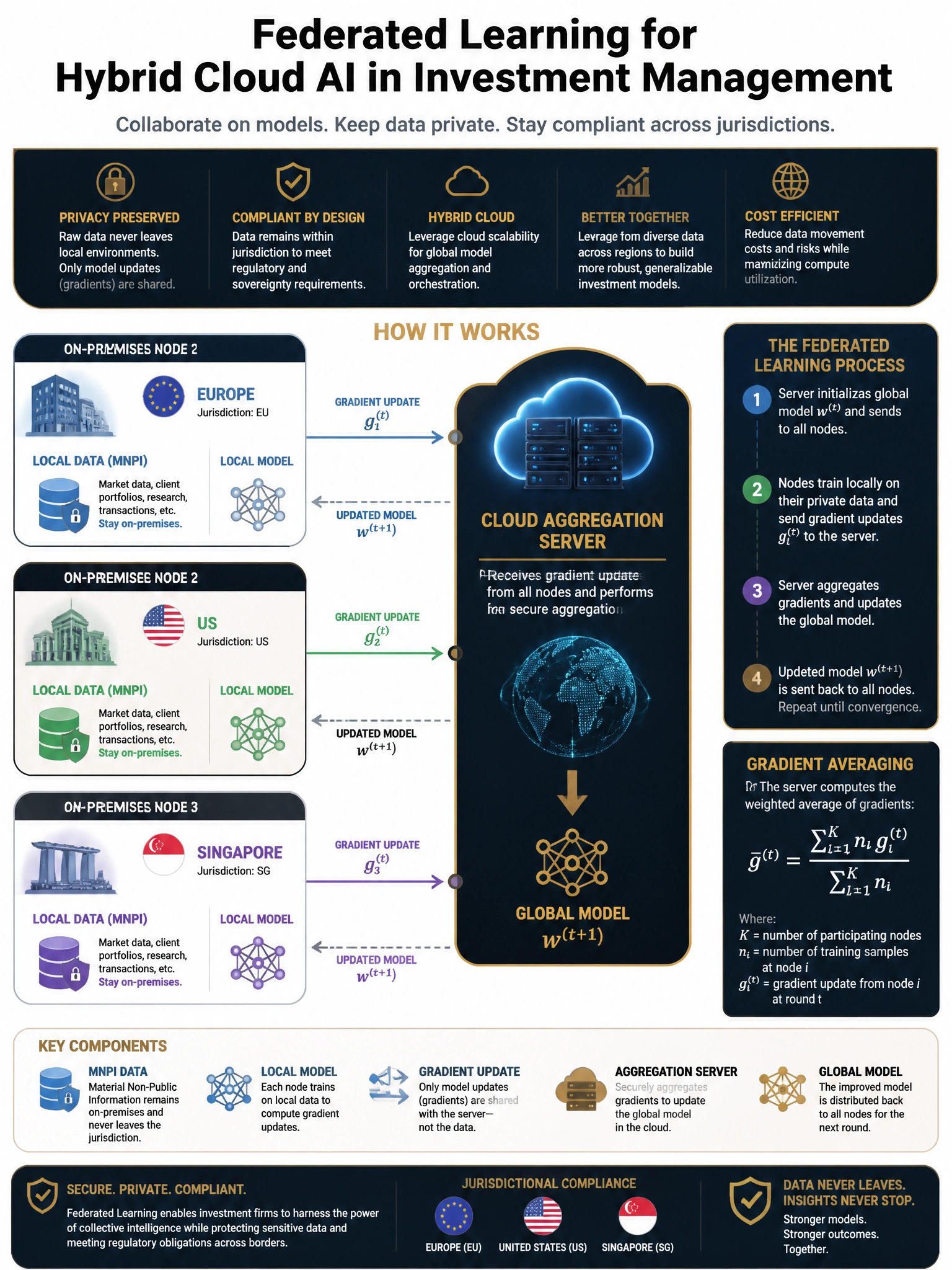
Todd Lammle: Federated learning is like letting each branch office do its own homework and only sending the teacher the test scores — the raw work never leaves the room. Option B keeps MNPI-adjacent data on-premises in strict compliance, while still letting the cloud do the heavy compute lifting for aggregation. That's the hybrid sweet spot.
Full explanation below image
Full Explanation
Federated learning solves the hybrid cloud dilemma by separating the physical location of sensitive data from the computational location of model training. In a federated architecture, each on-premises data node computes gradient updates locally and transmits only those cryptographically secured gradients — never raw data — to a cloud aggregation server. The aggregation server combines gradient updates (typically via federated averaging) to update global model weights, which are then redistributed to each node. Raw data satisfying MNPI-adjacency constraints never traverses the network perimeter.
Option A (on-premises training, cloud inference) inverts the problem. It sacrifices elastic compute for training — the most resource-intensive phase — while also creating latency and synchronization risks in the inference pipeline. Nightly batch weight transfers are operationally fragile for funds requiring intraday model updates.
Option C (tokenization as anonymization) is a dangerous mischaracterization. Tokenization is a reversible pseudonymization technique — the original data can be recovered with the token map. It does not constitute anonymization under GDPR Article 4(1) or Singapore's PDPA, and would not satisfy a regulator's inquiry about MNPI data residency. The firm retains liability for the original data.
Option D (dedicated cloud instance without legal review) is a compliance shortcut that regularly fails regulatory scrutiny. Physical data residency and legal jurisdiction are distinct concepts. Most regulators require documented legal analysis — not just vendor assurances — before treating hosted infrastructure as jurisdictionally equivalent to on-premises.
The CFIA framework references NIST SP 800-188 on federated learning architectures and the IOSCO Principles on AI in Capital Markets for cross-border data governance.