
A multi-asset fund's AI system must classify the current macroeconomic regime in real-time to dynamically adjust factor exposures. The system needs to be robust to regime transitions, which historically occur without clear inflection points. Which modeling approach best handles this challenge?
Select an answer to reveal the explanation.
Short Explanation
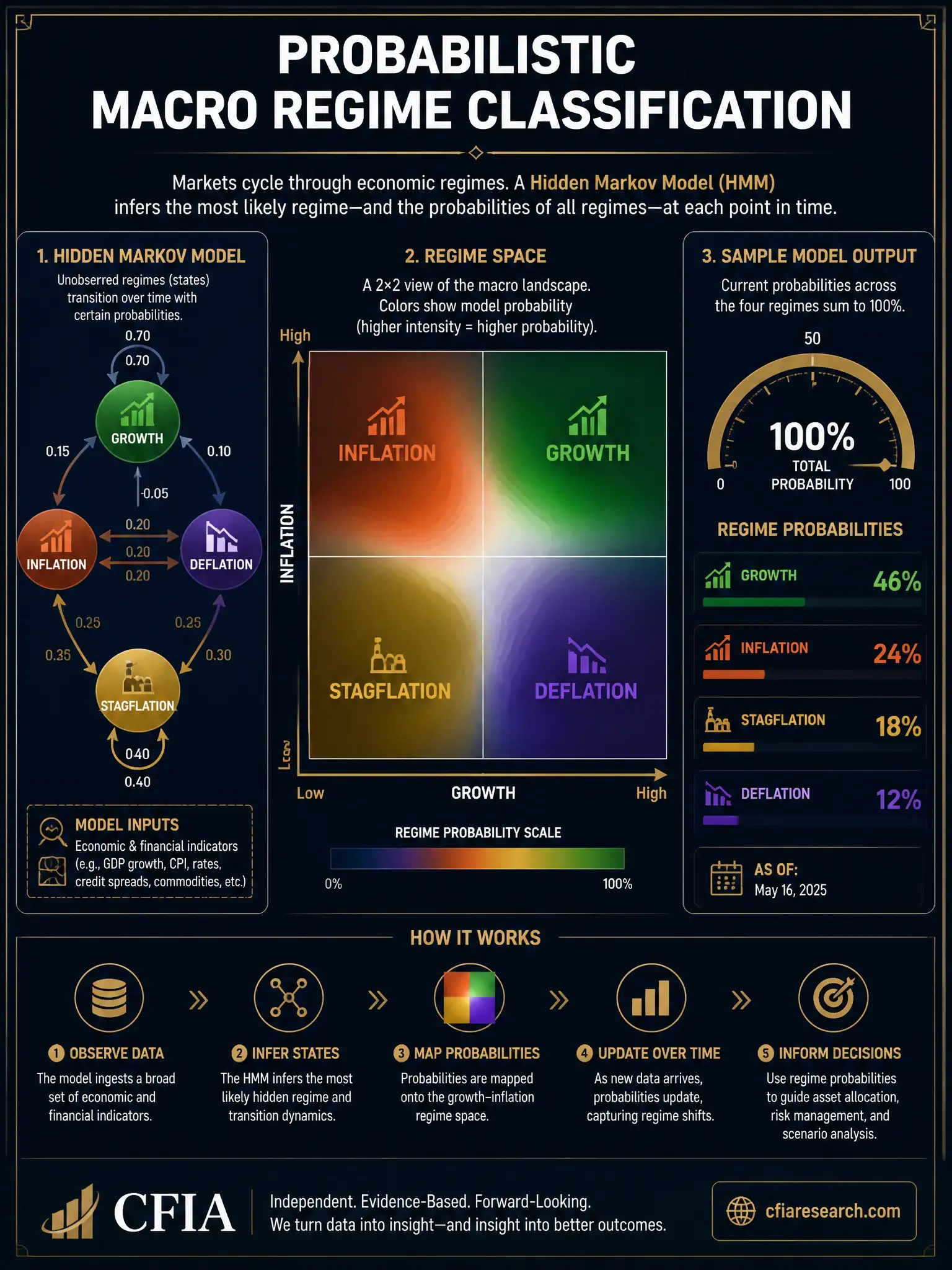
Macro regimes don't flip like a light switch — they fade in and out like a weather system crossing a region. You need a Hidden Markov Model or regime-switching model that gives probabilistic regime membership across multiple states and updates as new macro data arrives. That blended view is far more useful than a binary flag that stays wrong until the recession is already underway.
Full Explanation
Macroeconomic regime classification is one of the most consequential modeling tasks in multi-asset investment management because factor returns — value, momentum, carry, quality, low volatility — vary dramatically across regimes. The challenge is that the best regimes for portfolio construction are not discrete states but probability distributions over continuous macro conditions.
The binary recession/expansion classifier trained on NBER recession dates and used to mechanically rotate between defensive and cyclical equity factors suffers from two critical defects. First, NBER recession dating is retrospective and released with significant lag — the 2008 recession was not officially declared until December 2008, well after the peak. Second, binary classification forces the system to make a discrete call at transition points precisely when uncertainty is highest, producing the worst possible trade timing.
The yield-curve-only approach, designating a positive slope as a growth regime and an inverted curve as a pre-recession regime for factor allocation, has merit as a single predictive variable but is insufficient as a sole regime classifier. Inversions have historically preceded recessions by 12 to 24 months with wide variance, and the relationship has weakened in the era of central bank QE programs that artificially suppress long-end yields. Furthermore, a pure growth/pre-recession binary ignores inflationary dynamics, which are the dominant factor driver in stagflationary environments.
The trailing 12-month equity index return approach, rotating into momentum factors during positive-return regimes and into low-volatility factors during negative-return regimes, is circular: using trailing equity returns to define regimes and then allocating to equity factors creates a look-back bias and is essentially a momentum-on-momentum strategy. It also confuses the output (equity returns) with the input (macro conditions) in the causal chain.
The Hidden Markov Model or regime-switching model that outputs probabilistic regime membership across multiple states (e.g., growth/inflation/stagflation/deflation), updating continuously as new macro data arrives, implements the probabilistic framework appropriate for this problem. Hidden Markov Models (Hamilton 1989; Ang and Bekaert 2002) and related regime-switching specifications (Markov Switching VAR) model the economy as transitioning between latent states with observable macro variables as emissions. Critically, they output state probabilities rather than hard classifications, allowing the portfolio to hold a blended exposure consistent with regime uncertainty. The four-regime framework (growth, inflation, stagflation, deflation) popularized by Bridgewater and used in the institutional risk parity community captures the relevant economic dimensions for factor allocation in a tractable structure.