
An investment firm wants to deploy an LLM to summarize sell-side analyst research reports at scale, enabling PMs to consume coverage from 50+ brokers simultaneously. Which design consideration is most critical to ensuring the summaries generate differentiated insight rather than undifferentiated noise?
Select an answer to reveal the explanation.
Short Explanation
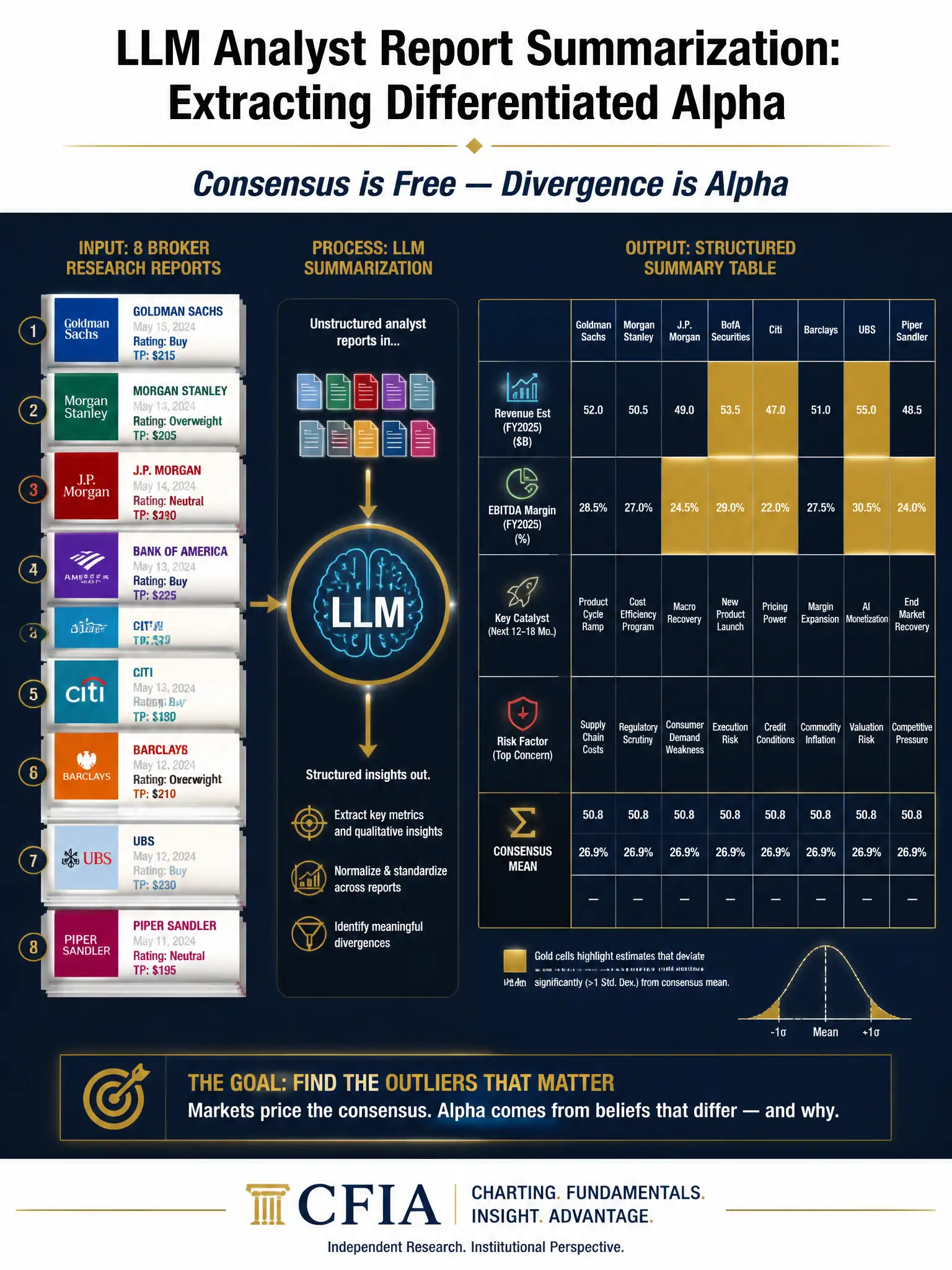
If your LLM summarizer just averages away the disagreements between analysts, you've built a very expensive consensus service that market data terminals already provide. The gold is in the differences — the one analyst with a wildly different revenue assumption or a catalyst nobody else modeled. That's where the alpha lives, and your pipeline needs to surface those divergences explicitly.
Full Explanation
Sell-side analyst research summarization at scale is an extremely high-value LLM application, but the design must be carefully aligned with what investment managers actually need from research: not a restatement of consensus, but identification of where informed practitioners disagree and why. The consensus price target and rating are freely available through Bloomberg or FactSet; a summarization pipeline that only extracts those adds near-zero value.
The approach that instructs the LLM to extract and average price targets across all analyst reports, using consensus deviation as the primary signal for position sizing, is precisely the wrong objective function. Average price targets reflect consensus, not differentiated insight. Moreover, price targets are notoriously backward-looking and anchored to recent trading ranges, making them one of the lowest-information elements in a research report.
The approach that has the LLM produce a single synthesized research memo resolving conflicting analyst views into one unified investment thesis, presenting only the most likely scenario, actively destroys information. The intellectual value of reading multiple analyst reports lies in understanding where and why professionals with access to the same public information reach different conclusions — a disagreement in revenue assumptions, a different view on pricing power, or a contrarian catalyst thesis. Collapsing these into a single view eliminates the very signal the fund is paying to extract.
The approach that prioritizes summarizing reports from the highest-ranked analysts by Institutional Investor All-Star survey placement, filtering out all other broker research as low-signal noise, introduces severe survivorship and popularity bias. Institutional Investor All-Star rankings lag analytical quality and are influenced by sales relationships and client voting, not just research accuracy. Many boutique and sector-specialist analysts generate superior differentiated research without All-Star recognition.
The correct approach configures the summarization pipeline to flag where specific analyst estimates, assumptions, and catalysts diverge from consensus, with structured extraction of proprietary research elements unique to each broker's model. This design is around divergence detection. Structured extraction (using LLM function-calling or JSON-mode output) parses each report for its specific revenue estimates, EBITDA assumptions, key risk factors, and named catalysts. Then a comparison layer flags which of these elements differ from the consensus model by more than a threshold amount, and which catalysts appear in only one or two reports (potential undiscovered ideas). This pipeline design is consistent with how leading investment research aggregators like Visible Alpha have approached artificial-intelligence-assisted research synthesis.