
A private equity firm's data engineering team is building a standardized performance reporting system across their portfolio of 85 private companies. They are encountering significant data collection friction. Which of the following represents the most fundamental structural challenge unique to private market data collection that cannot be solved by technology alone?
Select an answer to reveal the explanation.
Short Explanation and Infographic
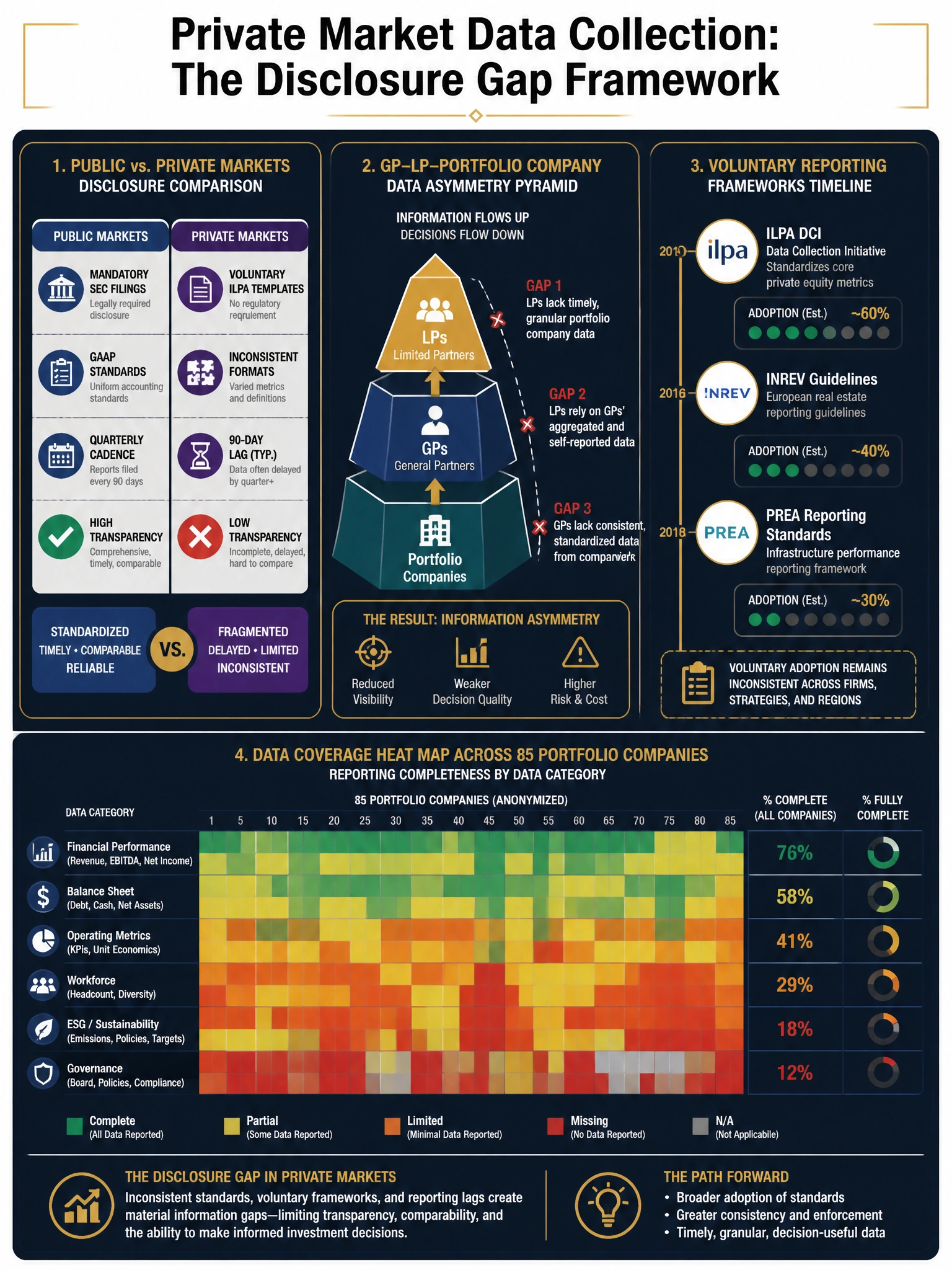
Imagine trying to document a private party compared to a public event — the public event has published schedules, press coverage, and official records, while the private party only shares what the host decides to reveal. No amount of better recording equipment solves the problem when people simply haven't agreed to be recorded. In private markets, the equivalent of 'being recorded' is voluntary disclosure — and without a regulatory mandate compelling it, technology can only process the data that portfolio companies choose to provide, which is often inconsistent, delayed, or strategically curated.
Full explanation below image
Full Explanation
The private equity data problem is fundamentally a governance and incentive problem, not an engineering one. Unlike public markets, where securities regulation mandates quarterly and annual disclosures under uniform accounting standards (GAAP, IFRS), private companies have no legal obligation to report performance metrics to any standardized format or timeline. This creates what practitioners call the 'disclosure gap' — a structural asymmetry where GPs have far more information about portfolio company performance than LPs, and portfolio companies have far more information than their GPs need to report to LPs. Technology can facilitate data collection workflows, but it cannot enforce disclosure where no legal obligation exists.
The Institutional Limited Partners Association (ILPA) developed voluntary reporting templates — the ILPA Reporting Template and the ILPA Data Convergence Initiative (DCI) — to address this gap, but adoption remains incomplete precisely because participation is voluntary. As of recent surveys, DCI adoption by GPs covers only a fraction of AUM in private equity, and even participating GPs often report incomplete datasets. Similar voluntary frameworks exist in real estate (INREV in Europe, PREA in North America) and private credit, with the same adoption challenges. The pattern is consistent: voluntary standardization frameworks help but cannot fully close coverage gaps because they rely on willing participation rather than regulatory compulsion.
Option A (lack of APIs) is a technical problem, not a structural one. It is solvable: data collection portals, automated template submissions, and third-party portfolio monitoring platforms (e.g., iLevel, Allvue, Cobalt) provide structured data ingestion workflows. The problem is not that technology cannot extract data from portfolio companies — the problem is that portfolio companies may not have the resources to report, may not prioritize reporting to GP data requests, or may strategically delay reporting of negative performance. A better API does not change a portfolio company's willingness or capacity to disclose.
Option C (volume and velocity) is factually incorrect. Private market data is the opposite of high-velocity — it is typically quarterly, low-volume, and lagged by 60-90 days. The scaling challenges of private market data infrastructure relate to heterogeneity and inconsistency of formats, not throughput. Modern cloud data warehouses handle private market data volumes trivially; the engineering challenge is schema reconciliation across 85 companies reporting in different formats, not computational capacity.
Option D (encryption requirements) conflates data security with disclosure prohibition. No regulatory framework prohibits GPs from sharing aggregated portfolio data with their own internal reporting systems, nor does encryption prevent third-party aggregation when the GP has consented to data sharing. The legal and structural barriers in private markets relate to disclosure obligations and LP agreements, not encryption law. The correct answer (B) identifies the only challenge in this set that is intrinsically non-technical: you cannot engineer your way to a reporting obligation that does not exist.