
A sustainable investment fund manager is constructing an ESG scoring model for a portfolio of 200 global equities. She discovers that ESG ratings from MSCI, Sustainalytics, and Bloomberg ESG diverge by more than 40 points on the same company in some cases. What is the most technically sound approach to address this inter-rater disagreement in her data pipeline?
Select an answer to reveal the explanation.
Short Explanation and Infographic
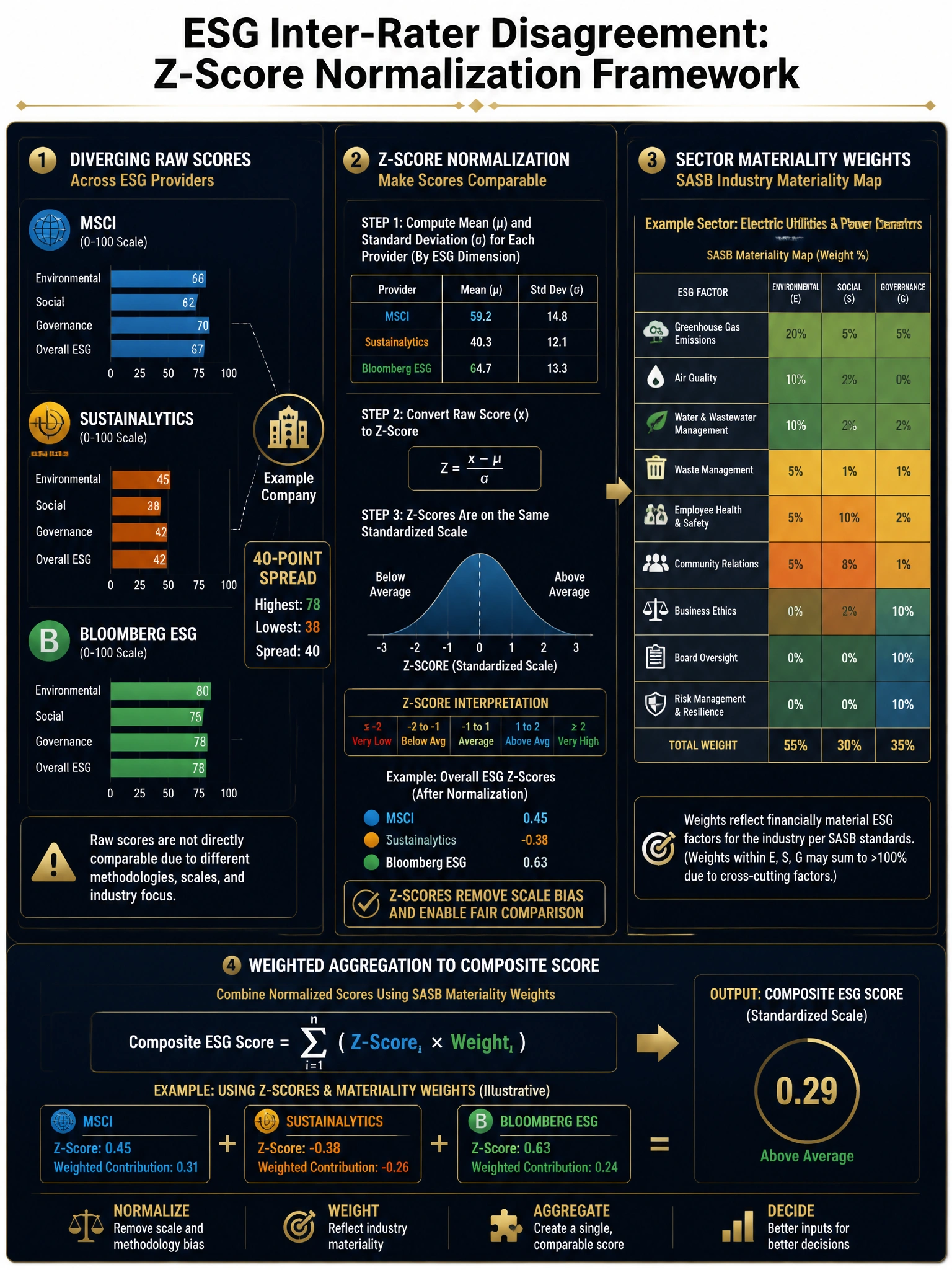
Think of ESG inter-rater disagreement like getting three different appraisals on the same house — they all used different methods and prioritized different features. Rather than picking just one appraiser or walking away from the property, a smart buyer averages and weights the estimates based on what matters most in that neighborhood. Z-score normalization lets you put all three providers on the same scale, and SASB materiality tells you which ESG factors actually matter for each sector — so your aggregated score reflects real-world risk, not just one vendor's opinion.
Full explanation below image
Full Explanation
ESG inter-rater disagreement is one of the most documented challenges in sustainable investing. Berg, Koelbel, and Rigobon (2022) found average pairwise correlations between major ESG rating providers of only 0.54 — far lower than credit rating correlations above 0.90. The divergence stems from three sources: scope disagreement (which indicators to measure), measurement disagreement (how to measure the same indicator), and weight disagreement (how much each factor matters). A single-provider approach (option A) eliminates these conflicts only by ignoring them, introducing systematic vendor bias and concentration risk in the data layer.
The correct approach — Z-score normalization with SASB-anchored sector weighting — addresses all three sources of divergence systematically. Z-score normalization converts each provider's raw scores to a common distribution (mean 0, standard deviation 1), making them directly comparable regardless of underlying scale differences. Weighted aggregation then combines these normalized scores, with weights informed by the SASB Materiality Map, which identifies which ESG issues are financially material for each of 77 industry categories. For example, water management is highly material for beverages but not for software; weighting accordingly ensures the composite score reflects economically relevant risk rather than uniform averaging.
Excluding divergent companies (option C) is operationally blunt and would likely eliminate exactly the companies where ESG risk is most contested and potentially most material — a significant signal loss. It also creates survivorship bias in the eligible universe and undermines the fund's ability to engage with companies on improvement. This approach confuses data uncertainty with investment risk.
Relying solely on GRI self-disclosures (option D) introduces a fundamental assurance problem. GRI is a voluntary disclosure framework; companies select which standards to report against and are not required to have third-party verification for all disclosures. Self-reported data is subject to greenwashing risk, selective reporting, and inconsistent boundary definitions across companies, making cross-sectional comparisons unreliable without significant normalization work. GRI disclosures can be a valuable input into a provider's underlying data, but replacing independent third-party ratings with unverified corporate disclosures degrades rather than improves data quality.
From an infrastructure standpoint, the fund manager should build this as a configurable aggregation layer in the ESG data pipeline, with provider weights, normalization parameters, and materiality mappings stored as versioned configuration rather than hard-coded logic. This enables backtesting of weighting methodologies and audit trails for regulatory purposes — increasingly important under SFDR (Sustainable Finance Disclosure Regulation) in Europe and SEC climate disclosure rules in the US.