
An investment firm's technology team is designing an ingestion pipeline to process 10,000 earnings call transcripts, SEC filings, and analyst reports per month. They need to extract structured financial entities — revenue figures, guidance statements, and risk factors — and store them for downstream LLM querying and quantitative model consumption. Which pipeline architecture is most appropriate for this scale and use case?
Select an answer to reveal the explanation.
Short Explanation and Infographic
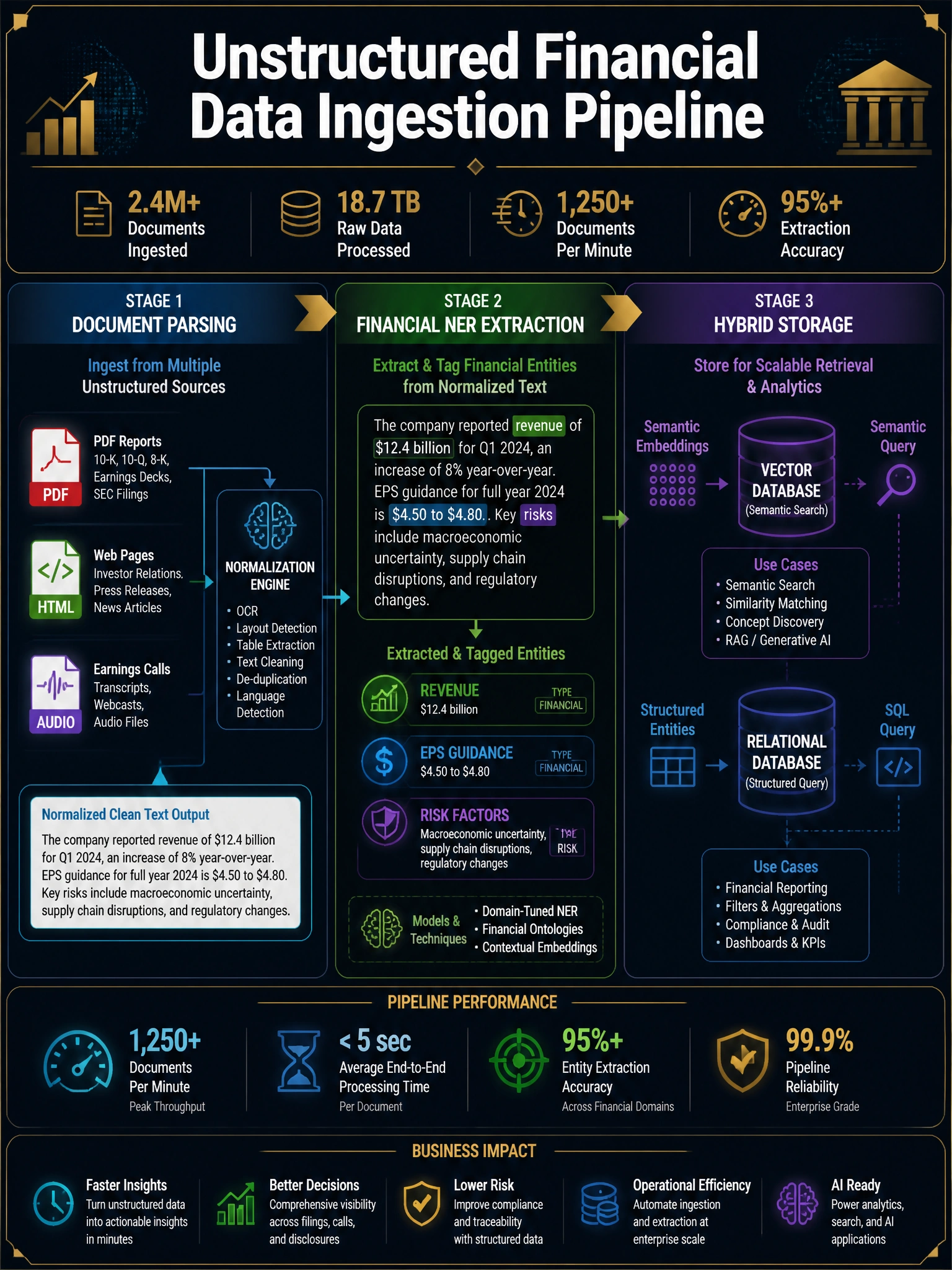
Think of this like processing raw ore through a refinery before it becomes usable metal — you need distinct stages to transform messy raw materials into a pure, structured form. The three-stage pipeline handles each transformation cleanly: format normalization, entity extraction, then optimized storage. Option B is correct because it separates concerns properly and uses the right tool at each stage, making the downstream LLM queries far cheaper and more reliable.
Full explanation below image
Full Explanation
Unstructured financial documents arrive in heterogeneous formats — PDFs with complex tables, HTML filings, audio transcripts, and scanned images — each requiring different parsing logic. Attempting to send raw documents directly to a general-purpose LLM (Option A) is prohibitively expensive at 10,000 documents per month, produces inconsistent entity extraction across formats, and wastes context window capacity on boilerplate content that should have been stripped in preprocessing. The three-stage architecture in Option B is the industry-validated approach.
In Stage 1, tools like Unstructured.io or LlamaIndex's document loaders normalize diverse formats into consistent text chunks with preserved metadata (page numbers, section headers, document type). PyMuPDF handles PDF table extraction while preserving numeric formatting critical for financial data. This normalization layer is what separates professional-grade pipelines from ad-hoc implementations.
Stage 2 applies financial domain-specific NER models rather than general NLP models. FinBERT and its derivatives are fine-tuned on financial corpora to recognize entities like revenue figures, EPS guidance, risk factor classifications, and management sentiment with far higher precision than general-purpose models. This structured extraction step is what enables downstream quantitative analysis — converting unstructured text into queryable financial signals.
Stage 3 uses hybrid storage because different query patterns require different storage paradigms. Vector databases (Pinecone, Weaviate, pgvector) support semantic similarity search for analyst-style research queries. Relational databases (PostgreSQL, Snowflake) support structured aggregation — 'show all Q3 guidance revisions above 10%.' Option C's keyword-only approach destroys semantic meaning. Option D's manual process cannot scale to 10,000 monthly documents and introduces human latency. The three-stage approach treats each concern separately and uses purpose-built tools at each layer.