
A quantitative investment firm is building a RAG-based research assistant that must index 500,000 proprietary research documents, enable fast semantic search across the full corpus, and integrate with structured Bloomberg terminal data as a secondary source. The engineering team is choosing between LangChain and LlamaIndex as the core orchestration framework. What is the primary differentiator that would make LlamaIndex the superior choice for this specific use case?
Select an answer to reveal the explanation.
Short Explanation and Infographic
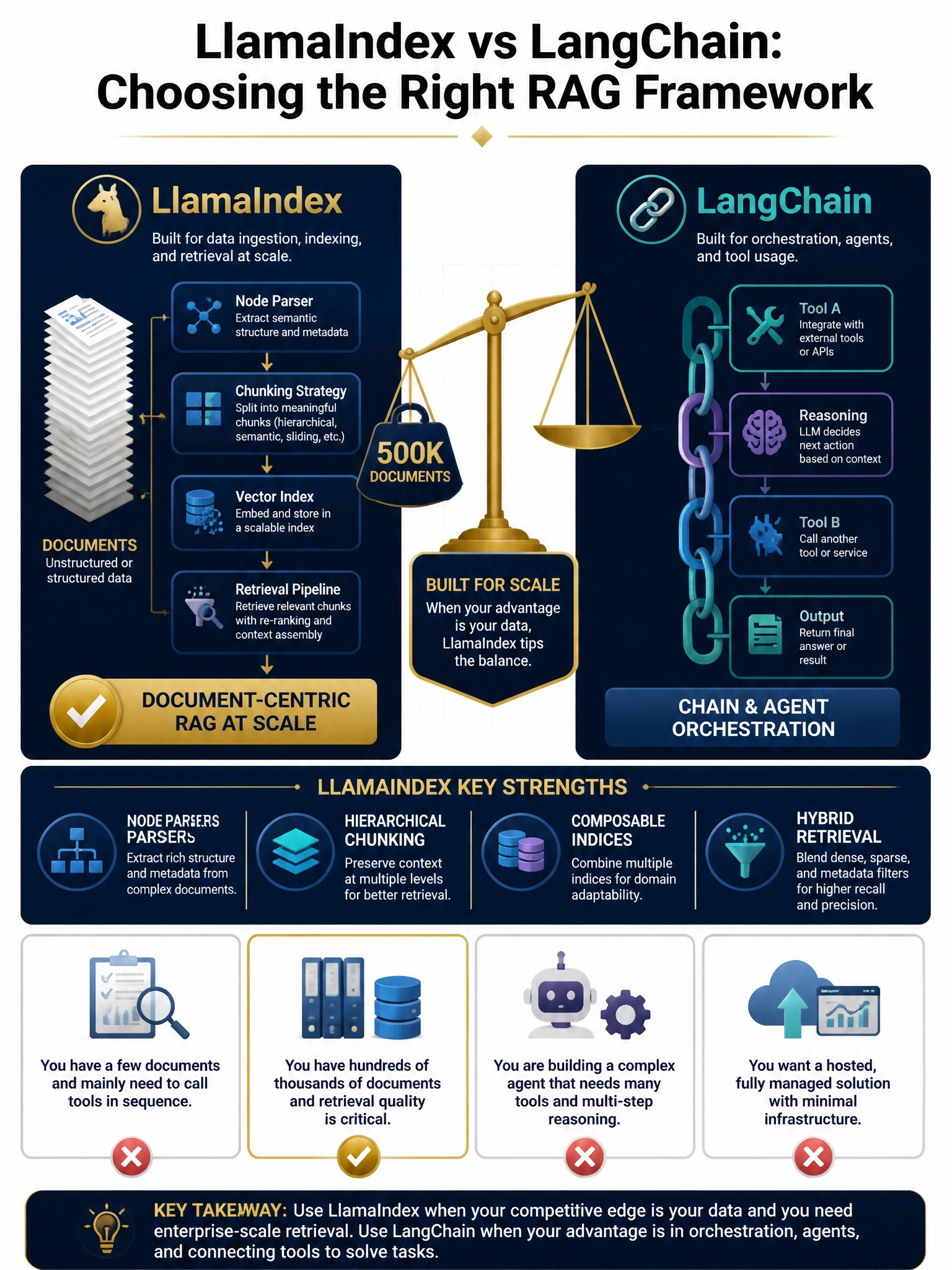
Imagine you're staffing a research department: LlamaIndex is the master librarian who has spent a career designing filing systems, indexing taxonomies, and retrieval workflows for enormous document collections. LangChain is the brilliant project manager who knows how to chain tasks together and direct people. For a 500,000-document corpus where the core challenge is finding the right material fast and accurately, you hire the librarian. LlamaIndex's entire architecture is built around that problem — from how it parses and chunks documents to how it stores and retrieves node embeddings — making it the clear winner when document-centric RAG at scale is the mission.
Full explanation below image
Full Explanation
LlamaIndex (formerly GPT Index) was designed from the ground up with a document-first philosophy. Its core data abstractions — Documents, Nodes, and Indices — are purpose-built for the pipeline of ingesting heterogeneous text, splitting it into semantically coherent chunks, embedding those chunks, and executing retrieval that goes beyond simple vector similarity. For a 500,000-document corpus of proprietary research, the firm immediately benefits from LlamaIndex's node parsers (which handle PDFs, markdown, structured tables, and slide decks out of the box), its sentence-window and hierarchical chunking strategies (which preserve context around retrieved passages), and its composable index types (VectorStoreIndex, SummaryIndex, KnowledgeGraphIndex) that can be mixed and matched for different retrieval needs across the corpus.
Option A is misleading on the facts. Both LangChain and LlamaIndex integrate with the same major LLM providers (OpenAI, Anthropic, Cohere, local models via Ollama, etc.) through a shared ecosystem of provider adapters. LLM provider flexibility is not a meaningful differentiator between the two frameworks in 2024; the gap has narrowed to near parity. Selecting a framework on this basis alone would be a category error — it confuses the LLM integration layer (a commodity) with the data orchestration layer (where the real differentiation lies).
Option C contains a kernel of truth that makes it an effective distractor. LangChain does have a mature, well-documented agent execution loop (AgentExecutor) and the LCEL (LangChain Expression Language) chain composition API, which are genuinely useful for complex multi-step workflows. However, LlamaIndex has closed this gap substantially with its own QueryPipeline abstraction and agent capabilities, and the scenario specifies that the core challenge is indexing and retrieval across a massive document corpus — not chain orchestration. Even if LangChain had a superior agent loop, it would not overcome LlamaIndex's structural advantage in the retrieval layer, which is the bottleneck for this use case.
Option D is a deliberate distractor testing whether candidates conflate "data connectors" with "native integration." LlamaIndex does ship a large library of data connectors (via LlamaHub), including connectors for web scrapers, cloud storage, and various structured data sources. However, Bloomberg's terminal data is proprietary and access-controlled; no open-source framework ships a production-ready Bloomberg connector out of the box. Both frameworks would require a custom connector or third-party adapter for Bloomberg data. Any answer claiming either framework has native Bloomberg support should be treated as a red flag.
For the CFIA candidate, the key principle is framework-task alignment: LlamaIndex owns the document-centric RAG space because its index abstractions, retrieval strategies (including hybrid dense/sparse retrieval, re-ranking pipelines, and sub-question query decomposition) are first-class features rather than bolt-ons. When the primary workload is ingesting, indexing, and retrieving across a large, heterogeneous document corpus, LlamaIndex's architecture is the stronger foundation. LangChain remains the preferred choice when the primary workload is complex multi-tool agent orchestration with document retrieval as a secondary concern — a distinction the CFIA exam tests directly.