
A large buy-side firm is establishing an AI Center of Excellence (AI CoE) to govern machine learning initiatives across 12 investment desks. The CIO must decide on the CoE's operating structure. Which structural model best balances innovation velocity with enterprise-wide governance and model risk standards in an investment management context?
Select an answer to reveal the explanation.
Short Explanation and Infographic
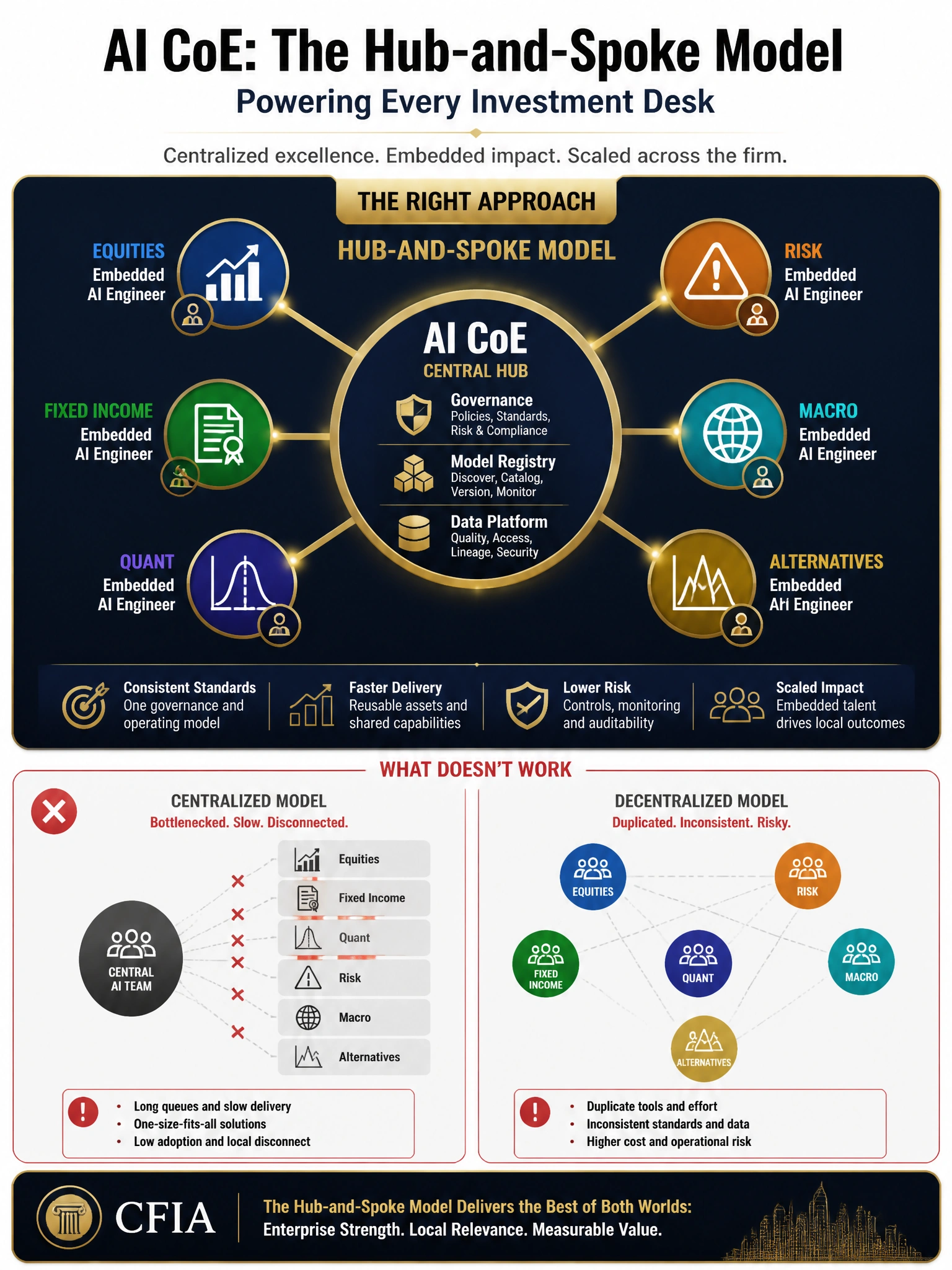
Building an AI CoE is like designing a franchise: the hub sets the brand standards, quality controls, and supply chain, while individual locations run their own kitchens with local expertise. The federated hub-and-spoke model gives each desk the autonomy to innovate on alpha strategies while the CoE enforces model risk, compliance, and infrastructure standards that protect the whole enterprise.
Full explanation below image
Full Explanation
AI Centers of Excellence in financial services must resolve a fundamental tension: investment desks need fast, domain-specific iteration cycles to capture alpha, while enterprise risk and compliance demand rigorous model validation, audit trails, and governance. Industry frameworks from BCG, Deloitte, and the OFR (Office of Financial Research) consistently endorse federated CoE structures for buy-side firms for this reason.
The Centralized Command model creates bottlenecks that kill innovation velocity — quant teams waiting months for CoE delivery can't compete with firms that iterate weekly. More critically, centralized teams often lack the domain knowledge of specific asset classes, producing models that are technically sound but strategically misaligned.
Decentralized Autonomous structures create model risk nightmares: no consistent backtesting standards, no firm-wide model inventory, no ability to detect correlated risks when multiple desks deploy similar factor exposures. Regulatory bodies including the SEC and FCA increasingly scrutinize model risk governance, making uncontrolled decentralization a compliance liability.
Outsourcing AI governance introduces IP risk, data security concerns, and vendor dependency that are incompatible with competitive alpha strategies in institutional investment management.
The hub-and-spoke model's practical implementation includes: a centralized MLOps platform and data lake, a model risk management function within the CoE aligned to SR 11-7 guidance, embedded AI engineers co-located with portfolio management teams, and a Center-defined approval process for production deployment. This structure appears in leading implementations at firms such as BlackRock's Aladdin AI division and Two Sigma's research infrastructure.