
A $50B asset manager wants to benchmark their AI capabilities against industry peers. Their quant team has deployed three factor models using ML, their compliance team uses NLP for document review, but different business units operate AI tools in isolation with no shared data infrastructure. Which AI maturity framework assessment would most accurately characterize this firm's current state?
Select an answer to reveal the explanation.
Short Explanation and Infographic
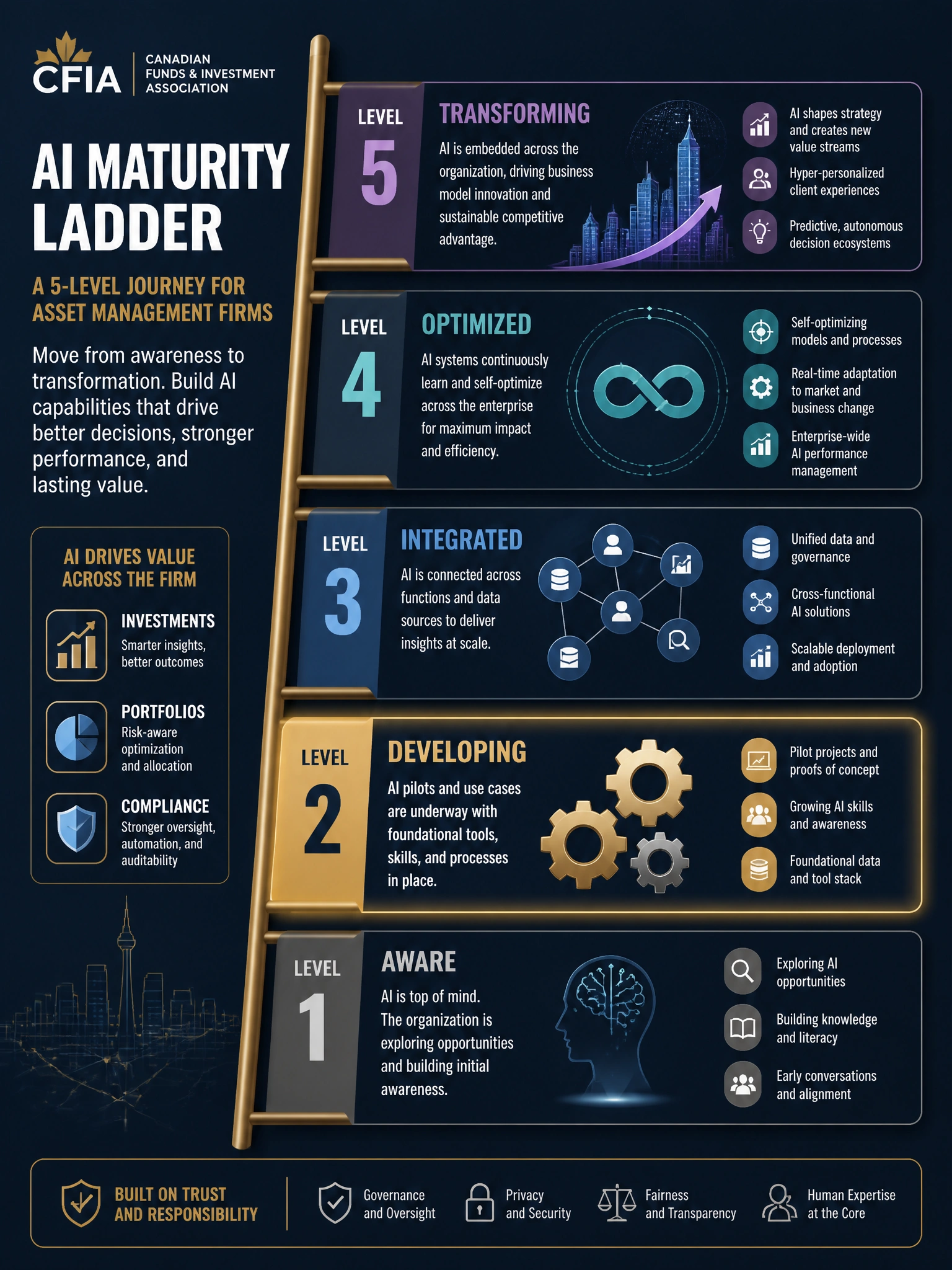
Think of AI maturity like building a highway system — having roads in three separate cities doesn't mean you have a connected interstate network. This firm has paved local roads (isolated AI tools) but hasn't built the on-ramps connecting them. Level 2 is exactly right: real deployments exist, but they're siloed, making enterprise value nearly impossible to capture.
Full explanation below image
Full Explanation
AI maturity models such as Gartner's AI Maturity Model and the McKinsey AI Frontier Framework distinguish between isolated AI experimentation and enterprise-wide AI integration. The firm in this scenario has cleared Level 1 (awareness and pilots) because it has production ML and NLP deployments generating real business value. However, the absence of shared data infrastructure and cross-unit coordination is the defining characteristic of Level 2 — fragmented adoption without an enterprise backbone.
Level 3 (AI-Integrated) requires that AI systems share data pipelines, common platforms, and that outputs feed into connected decision loops across business functions. The firm's siloed operation explicitly fails this criterion. Level 4 (AI-Optimized) implies closed-loop feedback systems where AI continuously improves itself through organizational learning — far beyond the current state.
Practically, a Level 2 firm faces compounding costs: duplicated vendor contracts, inconsistent model governance, data quality gaps between units, and an inability to build cross-asset signal libraries. The path to Level 3 typically requires a unified data lake or lakehouse, a central model registry, and an AI Center of Excellence to set standards.
For CFIA candidates: maturity assessments inform capital allocation decisions. A board-level AI investment thesis must be calibrated to the firm's current maturity — Level 2 firms should prioritize data infrastructure investment before scaling model complexity. Misdiagnosing maturity as Level 3 often leads to failed enterprise AI programs because the foundational plumbing isn't in place.