
A $200B multi-asset buy-side firm is redesigning its AI operating model after two high-profile model failures — one generating erroneous trade signals and another producing non-compliant client communications. Which operating model component most directly addresses the root cause of systematic model failures in production buy-side AI systems?
Select an answer to reveal the explanation.
Short Explanation and Infographic
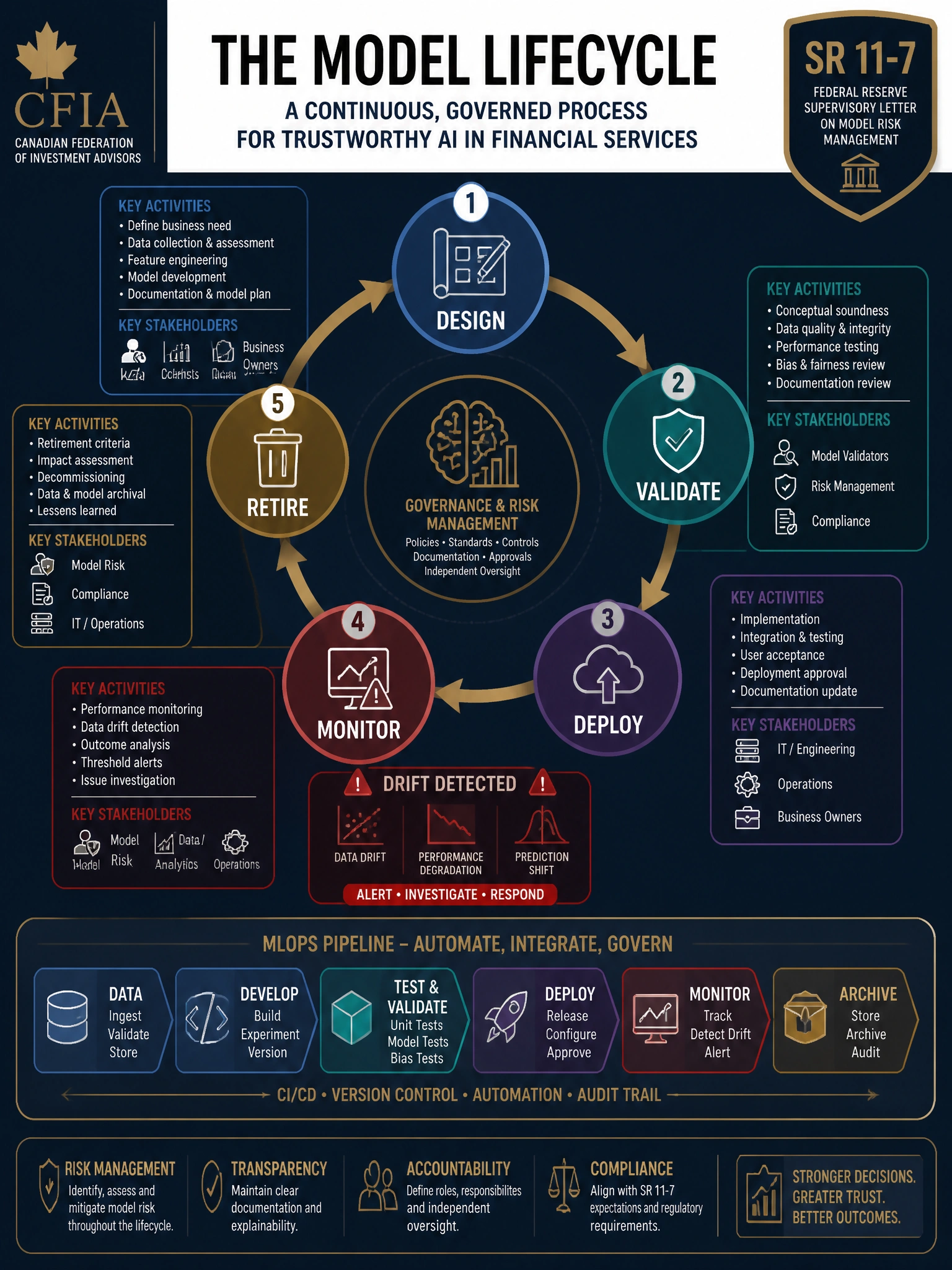
Model failures in production are rarely about the quality of the initial build — they're about what happens after launch. Think of it like an aircraft maintenance schedule: the plane doesn't fail because of a bad design on Day 1, it fails because drift, wear, and changing conditions went undetected. A Model Lifecycle Management framework is the equivalent of continuous airworthiness monitoring for your AI systems.
Full explanation below image
Full Explanation
Systematic AI model failures in buy-side environments almost universally trace to lifecycle management gaps rather than initial model quality. The Federal Reserve's SR 11-7 guidance on Model Risk Management explicitly identifies model monitoring, outcome analysis, and periodic validation as the highest-risk gaps in financial institution AI programs. Both failure modes described — erroneous trade signals and non-compliant communications — are classic production drift scenarios.
Model Lifecycle Management (MLM) frameworks address this through four integrated components: (1) Development-stage validation with out-of-sample testing, stress scenarios, and adversarial inputs; (2) Staged deployment gates requiring sign-off from model risk, compliance, and the business owner before production; (3) Real-time monitoring dashboards tracking prediction drift, data quality degradation, and business KPI deviation; (4) Automated retraining triggers and rollback procedures when drift thresholds are breached.
Hiring more data scientists addresses talent supply but not process — a larger team building models without lifecycle governance simply creates more unmonitored failure points at greater scale. Cloud consolidation reduces infrastructure complexity but doesn't address the fundamental governance gap; models fail due to distributional shift, not cloud heterogeneity.
Full manual review at every decision point (Option D) is operationally unscalable and defeats the efficiency rationale for AI deployment; it also introduces inconsistent human judgment as a new failure mode. Regulators expect automated controls proportionate to model criticality, not blanket human override.
For CFIA candidates: the operating model must encode MLM as a continuous function, not a one-time deployment event. The investment in monitoring infrastructure typically prevents losses 10-100x the cost of implementation through avoided model-driven trading errors and regulatory penalties.