
A global asset manager with $300B AUM is establishing a formal AI Governance Committee for the first time. The General Counsel and CTO are co-sponsoring the initiative. The committee must approve new AI models entering production, manage model risk inventory, and respond to regulatory inquiries about AI use. Which committee composition and charter structure best aligns with the model risk principles of SR 26-2 (which superseded SR 11-7 in April 2026) while remaining operationally effective for a complex investment firm?
Select an answer to reveal the explanation.
Short Explanation
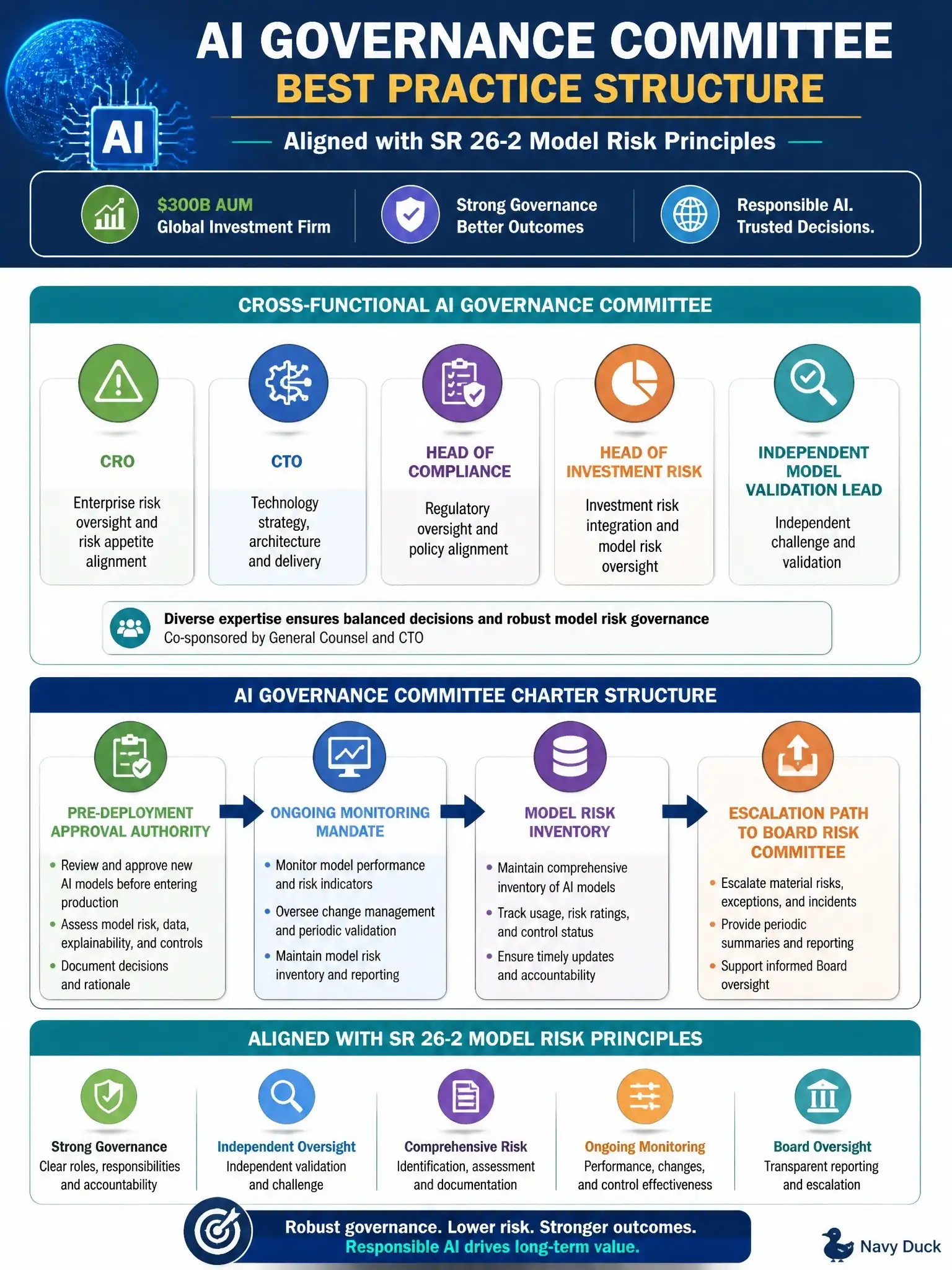
You want the committee that covers the whole cockpit: risk, technology, compliance, investment risk, and an independent validator who can actually say no. Give it approval before launch, an ongoing monitoring mandate, and a direct line to the Board Risk Committee.
Full Explanation
SR 26-2, issued in April 2026 by the Federal Reserve, OCC and FDIC to supersede SR 11-7, is written for banking organizations, but it remains the reference model for model governance across financial services. Its core ideas are effective challenge by objective experts with sufficient independence and the organizational standing to force change, clear roles with well-defined accountability and attention to conflicts of interest between development and validation, and validation generally before first use followed by ongoing monitoring. The cross-functional committee maps onto those ideas: the independent validation lead supplies effective challenge, the CRO, Head of Investment Risk and Head of Compliance cover financial and regulatory risk, the CTO covers technical risk, pre-deployment approval puts the gate before launch, and the monitoring mandate keeps watch afterward. Board escalation is not spelled out in SR 26-2, but board oversight of material risk is standard governance practice and gives serious issues visibility at the top. A committee of only technologists and data scientists reviewing after deployment lacks independence and misses compliance and investment risk. A committee run by the Head of Quant Research and focused on alpha performance is performance oversight, not risk governance. Outsourcing to an annual external certifier leaves drift unchecked for months and cannot transfer accountability, which stays with the firm's own management. Exam caveat: SR 26-2 is non-binding and excludes generative and agentic AI, so a charter covering those tools must rest on the firm's broader AI governance. In practice, check the charter for approval rights, escalation paths and the validator's reporting line.