
A systematic equity fund has deployed an AI system that generates position sizing recommendations for a $2B equity book. The head of portfolio construction is designing the human-AI decision boundary framework. The system performs well in normal market regimes but has limited back-test data covering liquidity crises. Which decision boundary design best preserves AI efficiency while maintaining appropriate human oversight for tail-risk scenarios?
Select an answer to reveal the explanation.
Short Explanation
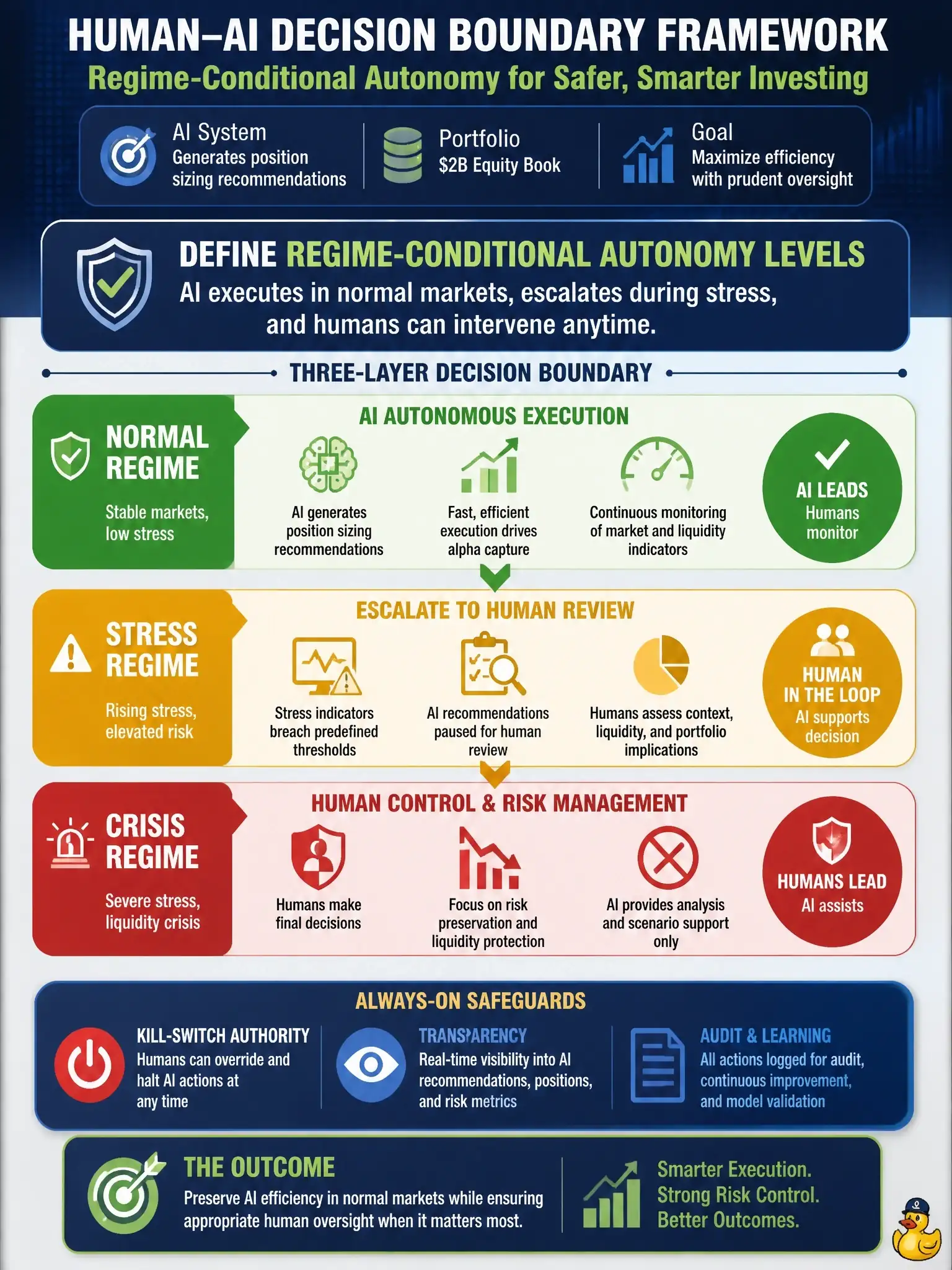
Think of it like aviation autopilot: let the artificial-intelligence system cruise in normal markets, but when stress indicators spike, humans take the wheel. You keep a kill-switch at all times so accountability never disappears. That preserves speed where the model is reliable and oversight where tail risk lives.
Full Explanation
The design of human-artificial-intelligence decision boundaries in investment management is a core challenge addressed by the model risk management principles of SR 26-2 (which superseded SR 11-7 in April 2026), the European Union artificial-intelligence Act's risk-tiered framework, and emerging SEC guidance on automated trading systems. The core principle across all three regulatory frameworks is that autonomy should be commensurate with model confidence and environmental conditions, and that human accountability cannot be fully delegated to an automated system.
Regime-conditional autonomy levels are the correct design because they resolve the fundamental tension between efficiency, which argues for more autonomy, and tail-risk management, which argues for more human oversight. The key insight is that the artificial-intelligence system's limitation is explicitly known: insufficient back-test data on liquidity crises. This is a documented model boundary, not a general deficiency. The appropriate response is to define a trigger, such as market stress indicators including VIX spikes, bid-ask spread expansion, or funding liquidity metrics, that shifts the human-artificial-intelligence interface from approving exceptions to approving executions. The kill-switch at all times preserves the chain of human accountability, consistent with SR 26-2's emphasis on clear roles and well-defined accountability.
Allowing the system to execute all trades autonomously within pre-approved position limits, with human review only triggered by compliance alerts, creates the risk that compliance-level alerts fire after positions have already been taken in a stress scenario, which is precisely when reversing them is most costly. That is model risk management failure. Requiring human approval for all trades regardless of size eliminates the efficiency gains that justify artificial-intelligence deployment in position sizing at all, because a $2 billion book with hundreds of positions cannot be human-approved for each rebalance. Routing all recommendations through a junior analyst team for validation before execution introduces human review bottlenecks without adding the relevant expertise: junior analysts reviewing systematic signals in real time cannot add meaningful judgment on regime detection. The NIST artificial-intelligence risk management framework Manage function specifically recommends dynamic autonomy levels calibrated to risk context, which aligns directly with regime-conditional autonomy.