
A traditional discretionary equity firm is undergoing a quantitative transformation, embedding ML-driven signals into portfolio construction for the first time. Senior PMs who have managed money for 20+ years are resistant to the initiative, arguing that 'models don't understand narrative' and frequently override AI-generated position recommendations. Six months in, the AI signals are being used on less than 15% of trades. Which change management intervention is most likely to increase meaningful adoption among senior discretionary PMs?
Select an answer to reveal the explanation.
Short Explanation and Infographic
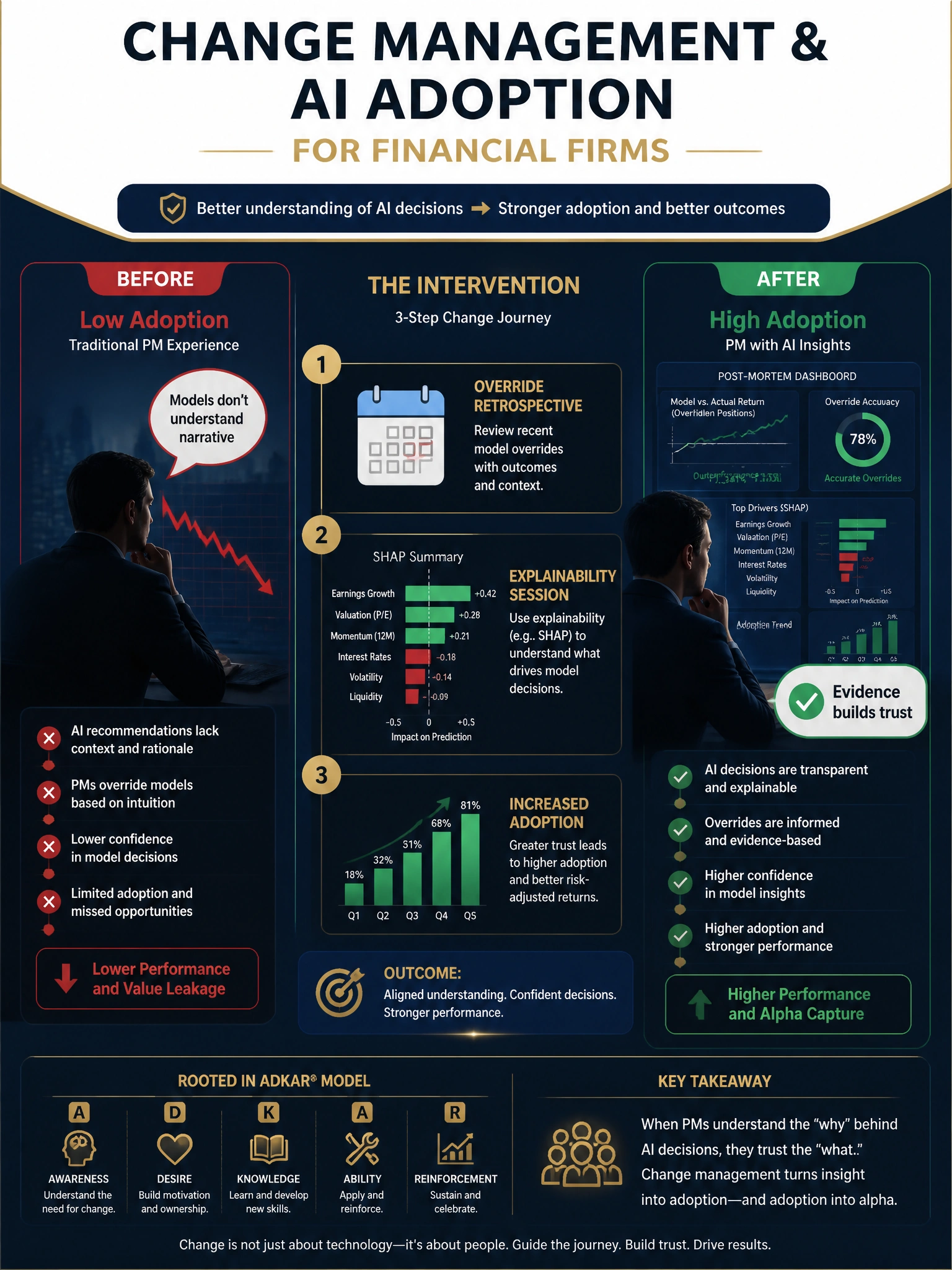
Forcing adults to change how they think doesn't work — showing them evidence does. When a senior PM can see a concrete post-mortem where their override cost the portfolio 40 bps, that's not an argument; it's data from their own domain. Pairing those retrospectives with explainability sessions — so PMs understand why the model flagged something — builds credibility rather than compliance. This is the difference between trust earned and trust mandated.
Full explanation below image
Full Explanation
Organizational change management in quantitative transformation contexts has been extensively studied in both the finance-specific literature (Kahn & Lemmon, 2016 on 'The Asset Manager's Dilemma') and general change frameworks like Kotter's 8-Step Model and Prosci's ADKAR. Resistance from senior investment professionals is almost universally rooted in epistemic distrust — they don't believe the model understands what they understand — and in loss aversion around their historical track record and identity.
The most effective intervention is evidence-based credibility building. A structured retrospective that links specific override decisions to subsequent trade outcomes, presented without blame but with factual P&L attribution, creates cognitive dissonance that is productive: PMs must reconcile their view that 'the model was wrong' with data showing the override underperformed. When combined with model explainability sessions — using tools like SHAP values, attention maps, or plain-language factor decompositions — PMs develop a working model of how the AI reasons, which reduces the 'black box' anxiety that drives much resistance.
Option A (compliance mandate) addresses behavior but not belief, and often generates hostile compliance — PMs look at the signal, dismiss it, and document a perfunctory review. This is worse than genuine non-adoption because it corrupts the override data needed to improve models. Option C (replacing PMs) destroys institutional knowledge, damages culture, and is operationally impractical for a firm with 20-year investment relationships. Option D (aggregate score) reduces information rather than increasing understanding — PMs who don't trust the model won't trust a black-box composite score either. The correct approach (B) is consistent with NIST AI RMF 'Govern' and 'Manage' principles, which emphasize that AI adoption requires building human understanding and trust through transparency, not compliance pressure.