
A systematic macro hedge fund is building out its AI capabilities and must hire for three newly created roles: an ML Infrastructure Engineer, a Quantitative Research Scientist, and an AI Product Manager. The CIO notes that the fund is losing candidates to Big Tech firms offering higher base salaries. Which talent acquisition strategy is most effective for attracting top AI talent to an investment firm when competing against technology sector compensation packages?
Select an answer to reveal the explanation.
Short Explanation and Infographic
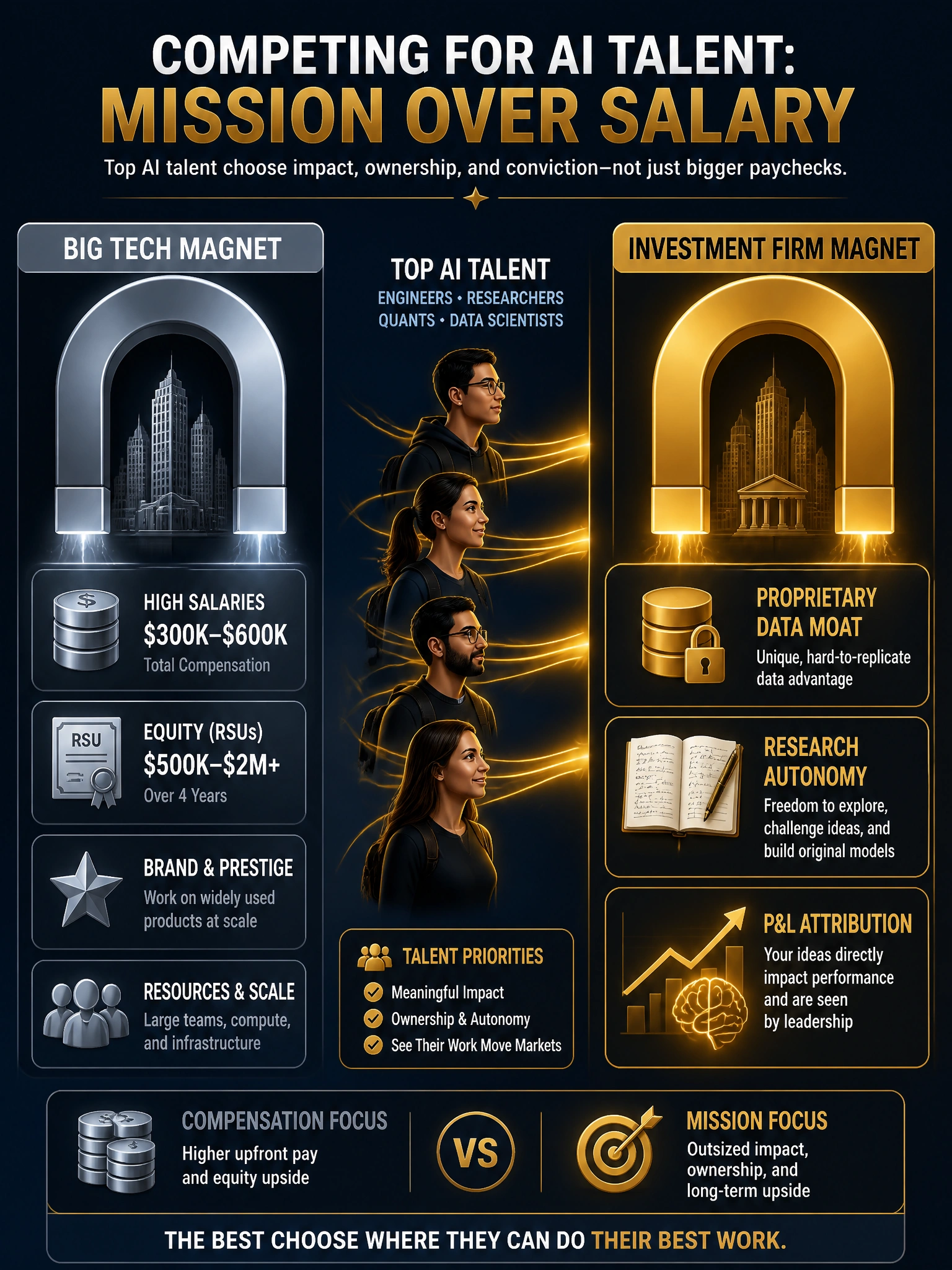
Competing on salary alone against Google or Meta is like trying to out-price Costco at retail — you won't win. The smarter play is to compete on dimensions Big Tech can't offer: access to unique proprietary datasets that don't exist anywhere else, direct measurable impact on real investment decisions, and the intellectual thrill of seeing your model make or lose real money. Top AI talent who care about impact and ownership will choose mission over marginal compensation when the mission is genuinely compelling.
Full explanation below image
Full Explanation
Research on technology talent mobility consistently shows that top-tier AI practitioners — particularly those at senior levels — make job decisions based on a bundle of factors beyond base compensation. While compensation must be competitive, it rarely needs to match Big Tech dollar-for-dollar if the firm can credibly offer three things: intellectual challenge from proprietary data access, research autonomy, and attribution of impact.
Investment firms possess a genuine structural advantage: they own proprietary order flow data, alternative datasets, and decades of return history that no technology company can replicate. Framing these as career differentiators — 'your models will run on data that doesn't exist outside this firm' — addresses the AI researcher's intrinsic motivation to work on novel, unsolved problems. P&L attribution, where an AI engineer can see their signal's direct contribution to fund returns, provides a feedback loop and recognition mechanism that most tech roles lack.
Option A (AUM prestige on job boards) fails because high-achieving AI candidates do not self-select for prestige signals — they respond to technical specificity and challenge. Option B (converting fee revenue to RSU equivalents) is financially impractical for most fund structures, requires complex securities compliance review, and still doesn't address the non-monetary reasons talent goes to tech. Option D (PhD-only hiring) arbitrarily excludes the largest pool of experienced AI engineers and creates a monoculture that reduces complementary skill diversity — MLOps engineers, for example, rarely come from PhD programs. The correct strategy (C) aligns with best practices in specialized talent markets documented by firms like Citadel Securities and Two Sigma, who have publicly emphasized data access and impact attribution as primary recruiting messages.