
A newly appointed CIO at a $120B multi-asset manager is tasked with building a three-year AI strategic agenda. The firm has strong fundamental research capabilities, a global data operations team, and an existing risk technology platform. The Board has approved a $50M AI investment budget. Which sequencing of the AI agenda priorities is most aligned with generating durable competitive advantage from AI in asset management?
Select an answer to reveal the explanation.
Short Explanation and Infographic
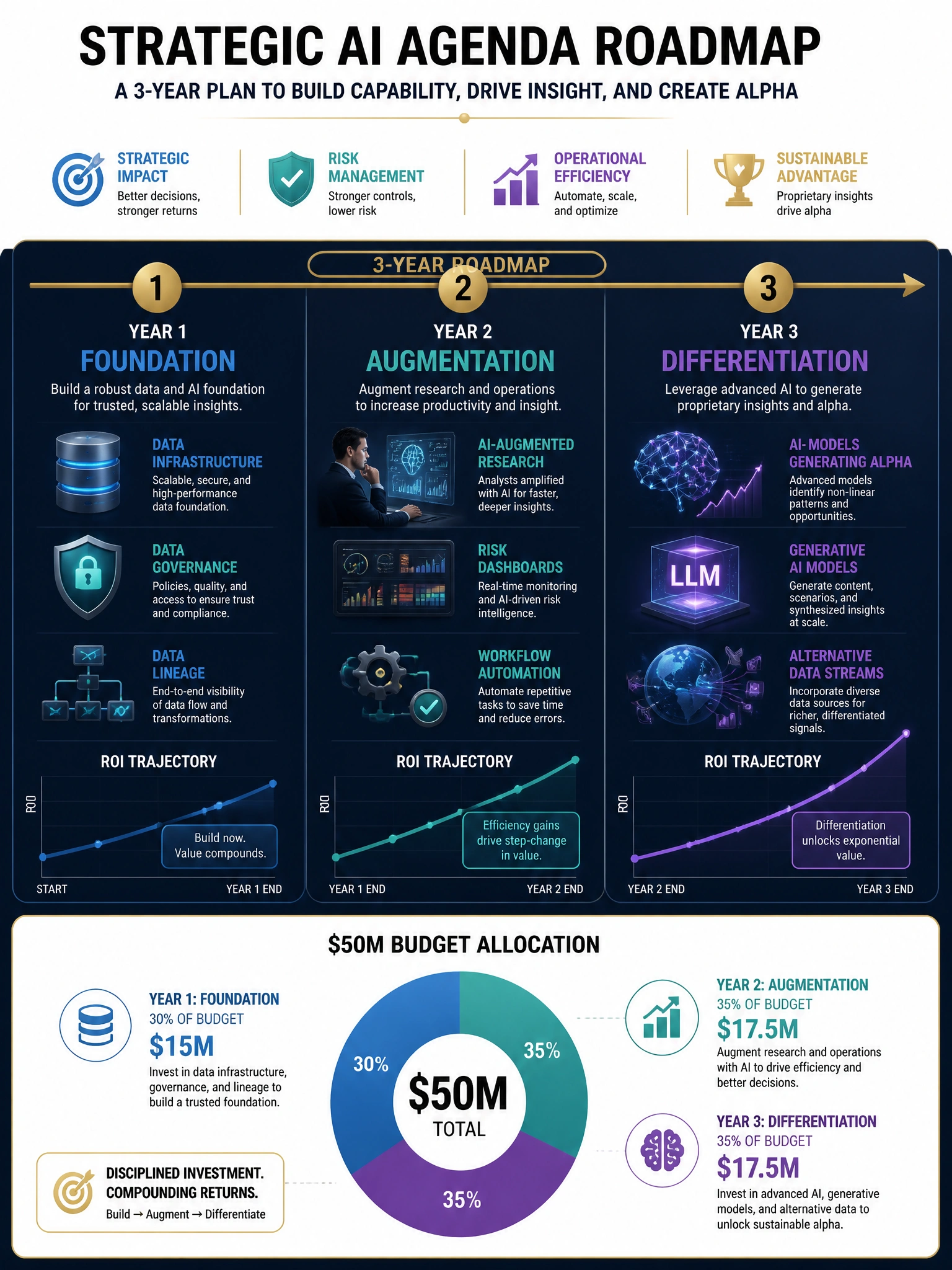
You can't build a skyscraper on sand — and you can't build durable AI advantage on messy data. The CIO who sequences data infrastructure first is playing the long game correctly: every AI system the firm will ever build runs on that foundation. Once the foundation is solid, augmenting existing research and risk workflows in Year 2 generates near-term ROI while the team learns. By Year 3, the firm has the data, the governance, and the operational experience to pursue genuine differentiation through proprietary models.
Full explanation below image
Full Explanation
The sequencing of AI investment in asset management has a well-documented pattern of failure when firms skip infrastructure and jump to visible deliverables. Client-facing chatbots (Option A, Year 1) may generate goodwill but do not build any defensible competitive position — they are easily replicated by competitors and do not improve investment outcomes. More critically, deploying generative AI before data governance exists creates regulatory and reputational risk, particularly under MiFID II requirements around model transparency and SEC AI-use disclosure expectations.
The correct sequence (B) follows the 'crawl-walk-run' framework that leading practitioners at BlackRock (Aladdin), Two Sigma, and D.E. Shaw have publicly described. Data infrastructure — clean, governed, accessible — is the prerequisite for every downstream AI application. Centralized feature stores, lineage tracking, and data quality monitoring in Year 1 reduce the rework cost of AI projects by an estimated 60-70% (McKinsey Global Institute estimates). Year 2's focus on augmenting existing workflows — research summarization, risk factor decomposition, trade surveillance — generates measurable ROI that justifies Year 3 investment and builds organizational AI fluency among investment staff. Year 3 proprietary model development is then built on a platform that can support it, with governance already in place.
Option C (hire engineers first, govern last) is a common failure mode — teams build models on unstandardized data, accumulate technical debt, and face costly remediation when models go live without governance review. Governance at the end is compliance theater, not risk management. Option D (license first, build later) defers the strategic question without creating proprietary data assets or internal capability — by Year 3 the firm knows what it wants but still depends on vendors. The NIST AI RMF 'Map' and 'Measure' functions reinforce that systematic foundation-building precedes trustworthy production AI.