
The CIO of Northpoint Wealth Management is constructing a business case for deploying an AI-powered client portfolio rebalancing system. The CFO requests that the ROI be expressed in quantifiable terms. Which approach to ROI measurement is most appropriate and defensible for AI investments in wealth management?
Select an answer to reveal the explanation.
Short Explanation and Infographic
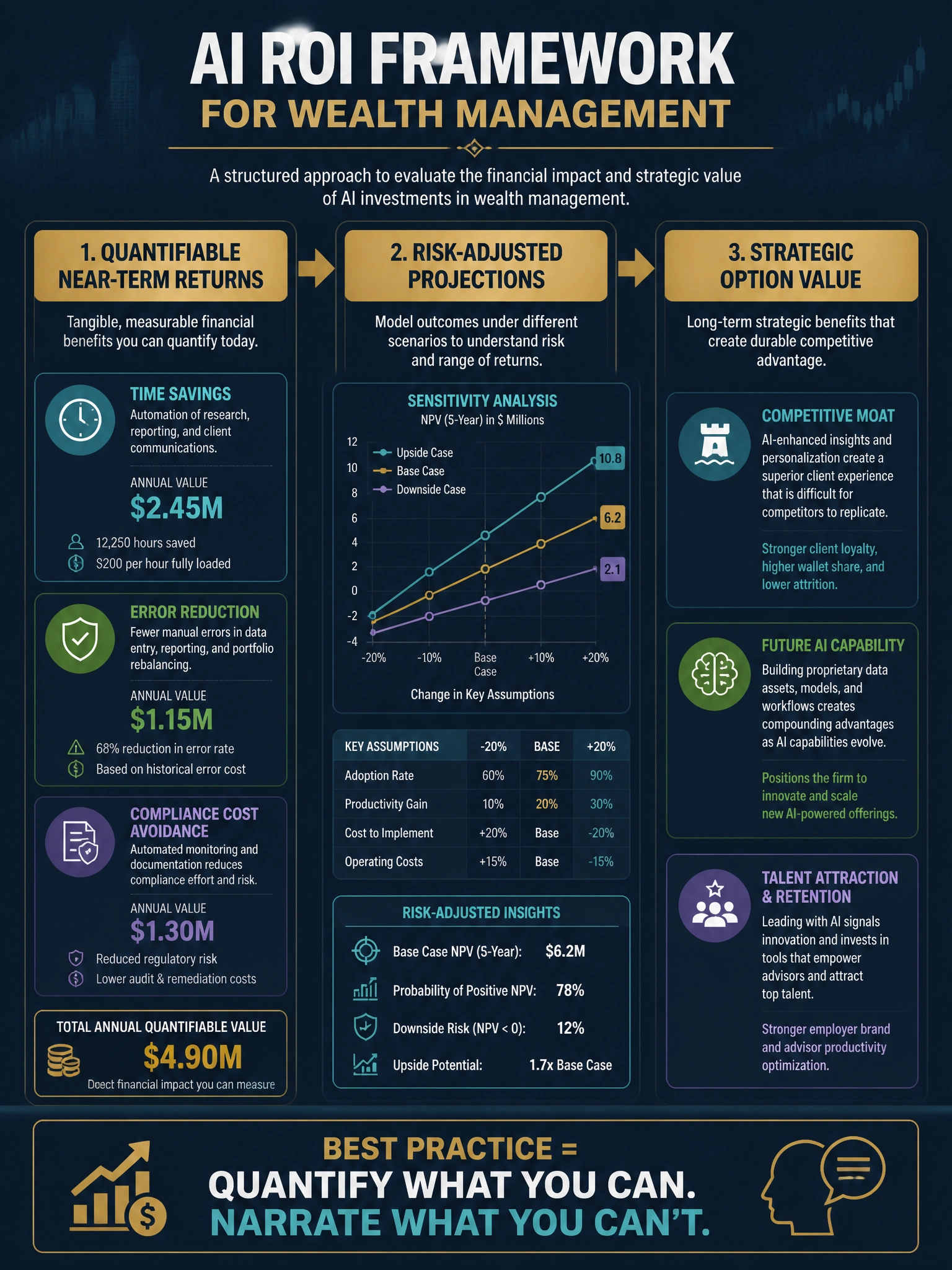
Building an AI business case on alpha projection is like selling a car based on its top speed — impressive but misleading and very hard to prove. The most defensible ROI for investment AI combines the things you can actually measure — time saved, errors avoided, compliance costs reduced — with an honest acknowledgment that some value, like future optionality and competitive positioning, isn't a number yet. That combination is what survives CFO scrutiny.
Full explanation below image
Full Explanation
AI investment ROI in wealth management operates across multiple value layers, and the business case must address each honestly. The most defensible framework decomposes ROI into quantifiable near-term returns and qualitative strategic option value.
Quantifiable returns include: analyst hours recaptured (rebalancing that took 4 hours now takes 40 minutes), error reduction costs (manual rebalancing errors generate compliance remediation costs), and compliance cost avoidance (automated audit trails reduce regulatory review labor). These are measurable, attributable to the AI system, and auditable.
Option A — alpha projection — is the most seductive and the most dangerous. Investment performance attribution is extraordinarily difficult to isolate to a single AI system. Markets change, and alpha from backtested models rarely survives live deployment at the same magnitude. Presenting alpha projections as the primary ROI case creates commitments the firm may be unable to fulfill, damaging AI credibility internally and externally.
Option C — relying on vendor case studies — introduces survivorship bias and attribution problems. Vendors publish their best outcomes with their best clients. Using these as primary evidence without independent modeling is analytically weak and will not withstand CFO-level scrutiny.
Option D — deferring ROI measurement — surrenders the internal narrative. Business cases require pre-deployment ROI estimates with post-deployment measurement gates. Waiting 24 months without a projected ROI creates budget vulnerability and allows skeptics to delay or cancel the initiative. The measurement framework should be established before deployment, even if outcomes are measured afterward.