
Castellan Fund Management is finalizing an SLA with an AI vendor providing real-time risk scoring for its high-frequency derivatives trading desk. The vendor proposes a 99.9% monthly uptime SLA with a 4-hour recovery time objective (RTO). The head of technology argues this is sufficient. The CRO objects. Which risk consideration most directly supports the CRO's objection?
Select an answer to reveal the explanation.
Short Explanation and Infographic
Here's the brutal math: a 4-hour RTO on a derivatives desk isn't just inconvenient — it's catastrophic. If the AI goes down at market open and the desk can't assess risk for four hours, positions can spiral before manual overrides catch up. The SLA looks great on paper until you realize 99.9% uptime allows downtime at the worst possible moment. Trading AI needs RTOs measured in seconds, not hours.
Full explanation below image
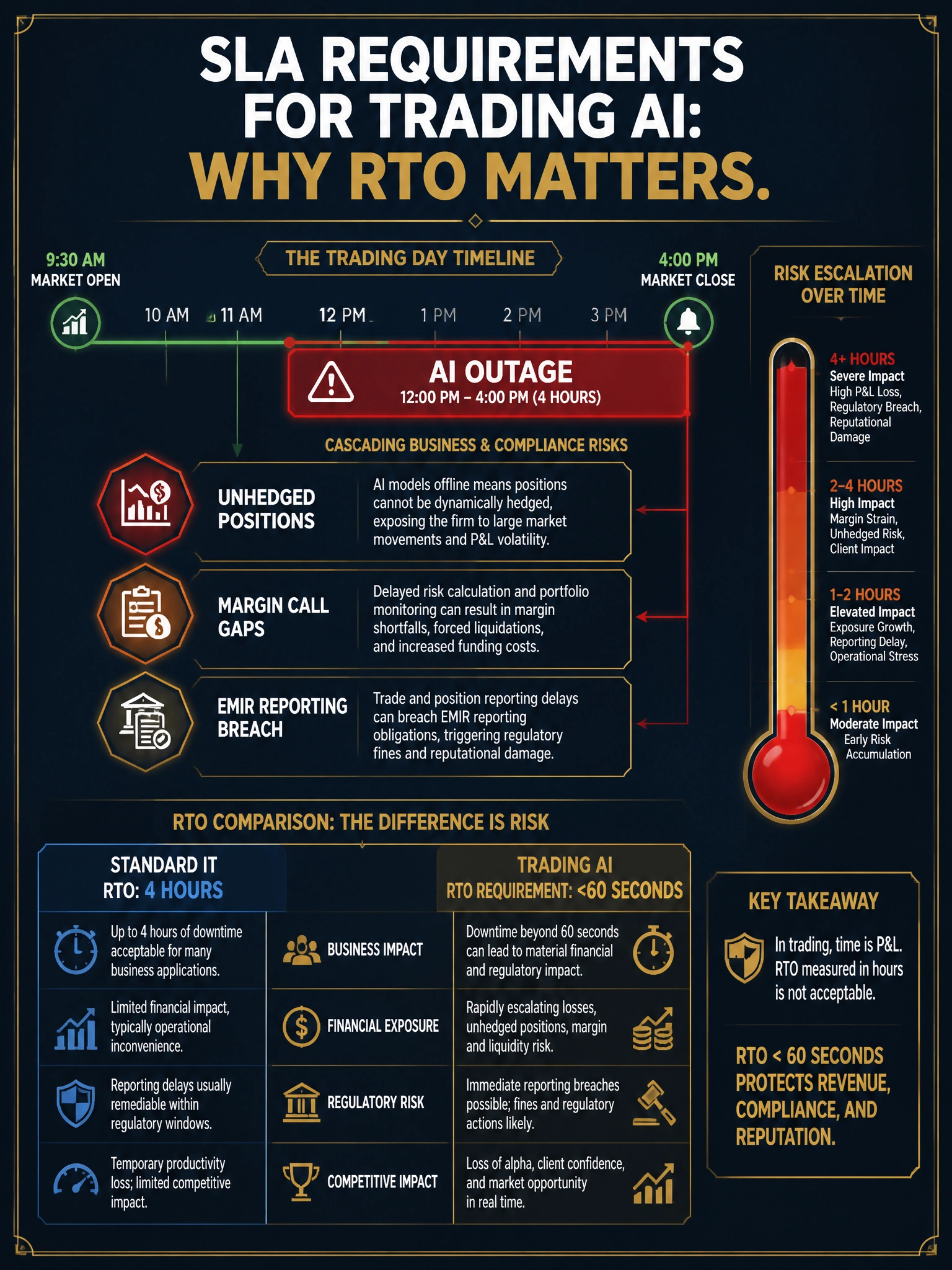
Full Explanation
The CRO's objection is grounded in the mismatch between the vendor's RTO and the operational tempo of a high-frequency derivatives trading desk. Recovery time objectives must be calibrated to the time horizon of the business function they support. A desk executing trades in sub-second intervals and holding delta-neutral positions that require continuous risk monitoring cannot tolerate a 4-hour gap in AI-driven risk scoring.
During an AI outage, the firm faces three compounding risks: (1) positions may become unhedged as the market moves without automated risk alerts; (2) margin calls may go undetected without automated monitoring; (3) real-time position reporting obligations under EMIR and Dodd-Frank may be disrupted, triggering regulatory breaches independent of any trading loss.
Option A correctly identifies the 43-minute downtime math but misframes the risk as coincidence-dependent. The CRO's concern is not about when downtime occurs — it is about the structural incompatibility of a 4-hour RTO with a real-time trading function. The 43-minute figure is secondary to the RTO problem.
Option C — demanding 100% uptime — is unrealistic and no credible vendor will offer it. The negotiation target for trading AI SLAs should be RTOs measured in seconds to low minutes with automatic failover, not a utopian 100% guarantee.
Option D fatally underestimates the dependency modern HFT desks have on automated risk systems. Manual risk assessment cannot operate at the speed or scale required, and the assumption of fallback capability is often untested.