
Halcyon Investment Management deploys an AI system that generates ESG factor scores for equity screening. An internal audit reveals the model systematically underscores companies in emerging markets relative to equivalent companies in developed markets, despite similar actual ESG performance — due to sparse data coverage in the training set. Which ethical principle has been violated, and what is the appropriate corrective action?
Select an answer to reveal the explanation.
Short Explanation and Infographic
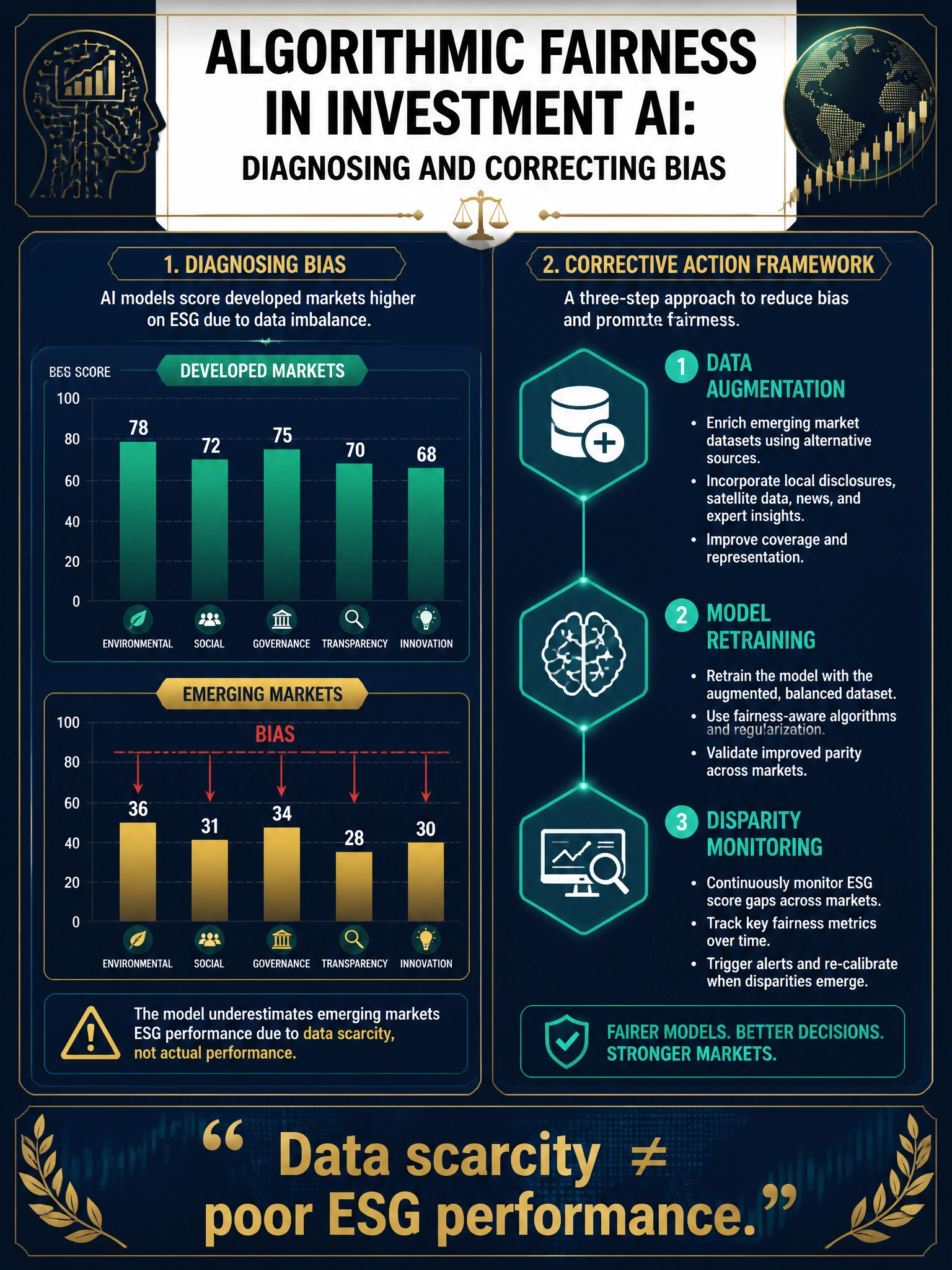
This is a textbook algorithmic fairness problem — the AI isn't measuring ESG performance, it's measuring data availability, and those two things are not the same. When your model consistently disadvantages one group of companies not because they perform worse, but because less data was collected on them, that's bias baked into the architecture. Disclosure doesn't cure bias; retraining with better data and monitoring for disparity does.
Full explanation below image
Full Explanation
The scenario describes a systematic disparity in AI outputs that is not attributable to actual differences in the subject matter but to differences in data coverage — a classic manifestation of algorithmic fairness violation, specifically geographic or representational bias.
Algorithmic fairness requires that AI systems produce outputs that are equitable across demographically and geographically distinct groups when those groups are otherwise equivalent. When an ESG scoring model penalizes emerging market companies due to sparse training data rather than genuine ESG performance gaps, the model is producing unfair outcomes that may lead to discriminatory capital allocation — a significant ethical and, increasingly, legal concern under sustainable finance regulations in the EU and UK.
The correct corrective action (option B) operates on two axes: upstream data remediation (augmenting training data with emerging market-specific ESG data sources, including local regulatory filings and alternative data) and downstream monitoring (tracking score disparity by geography on an ongoing basis to detect future drift).
Option A misidentifies the violation as a privacy issue. Privacy violations involve unauthorized data handling; this scenario involves model bias. Restricting access to scores doesn't fix the underlying bias — it suppresses a symptom while the cause remains.
Option C conflates explainability with fairness. Explainability tells you how a model reaches a decision. Fairness asks whether those decisions are equitable. Publishing the methodology while the bias persists simply makes the unfairness more transparent — it does not eliminate it.
Option D is a dangerous rationalization that regulators reject. Prospectus disclosure of data limitations does not provide ethical or legal immunity when the firm actively uses a biased model to make capital allocation decisions. The SFDR and EU AI Act both require active bias mitigation, not passive disclosure.