
Vantage Ridge Capital is choosing between two AI deployment models for its macro research platform: (A) calling a third-party large language model via API for natural language summarization of earnings calls, or (B) deploying an embedded fine-tuned model on-premises for the same task. The firm manages $18 billion in AUM with strict data residency requirements and a mandate that no client or portfolio data may leave the corporate network. Which deployment model is appropriate given these constraints?
Select an answer to reveal the explanation.
Short Explanation and Infographic
This one is a data residency question in disguise. When you call an external API, you're sending your prompts — which contain earnings call text tied to portfolio positions — to someone else's servers. Even with encryption, that data leaves your network, which violates the firm's explicit mandate. The embedded model stays inside the walls. Encryption in transit doesn't fix a data-residency violation.
Full explanation below image
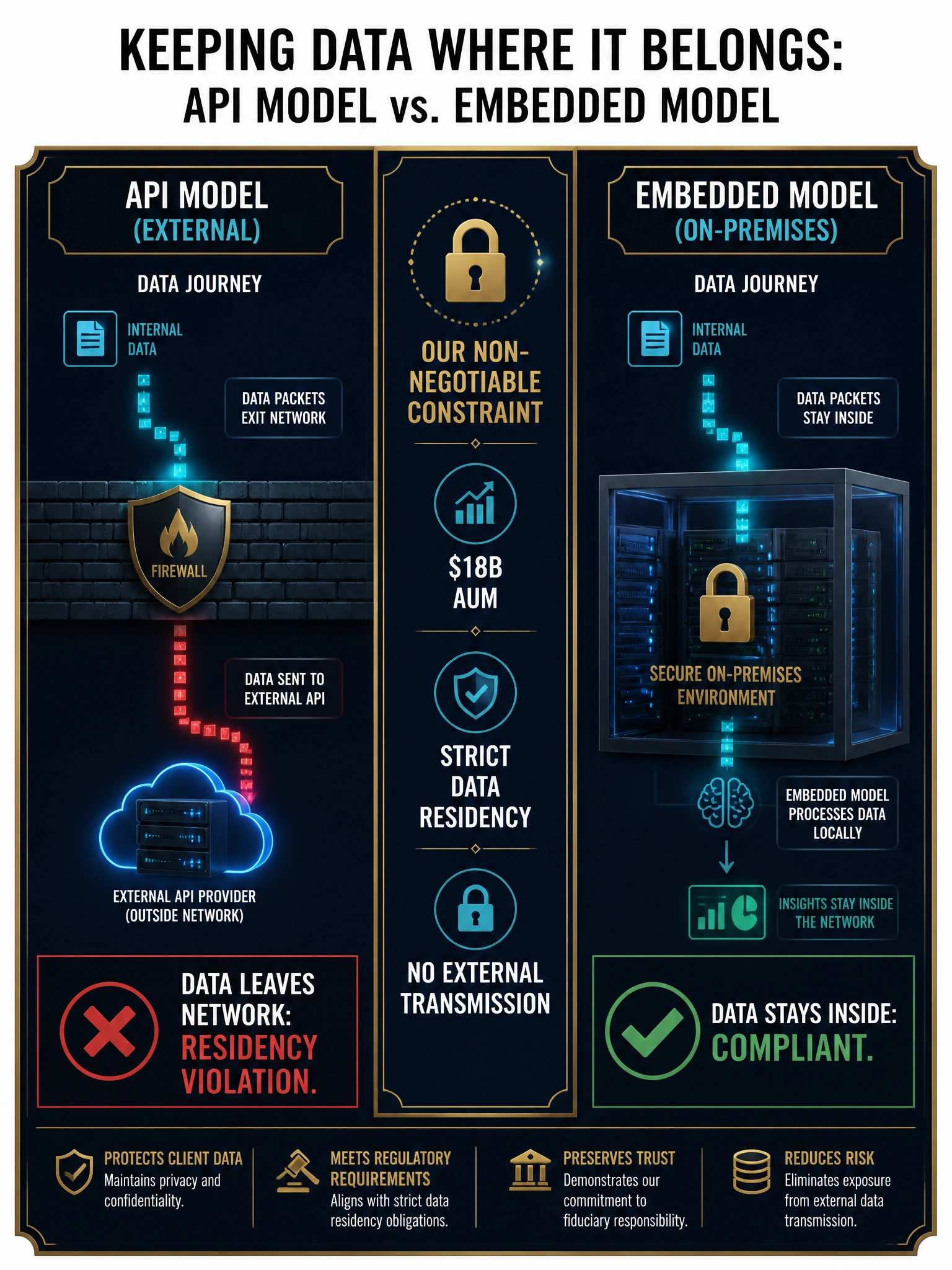
Full Explanation
Data residency requirements are a hard architectural constraint, not a preference. When a firm mandates that no client or portfolio data may leave the corporate network, any architecture that requires transmitting that data to an external endpoint — regardless of encryption — is non-compliant. API-based AI services, even from reputable vendors, receive the prompt as input on their infrastructure. If that prompt contains earnings call content associated with portfolio positions, it constitutes portfolio-related data in transit outside the network perimeter.
Option B (embedded on-premises model) is the correct choice because it keeps inference within the network boundary. The model runs on firm-controlled hardware, data never traverses the public internet, and the firm maintains full custody of both the model and its inputs/outputs.
Option A incorrectly treats operational convenience as a counterweight to a hard compliance constraint. Infrastructure management overhead is a valid TCO consideration but cannot override data residency law or firm policy.
Option C introduces a dangerous misconception: earnings call summaries linked to macro research are absolutely portfolio-related data, even if they don't contain personal client information. Firms that make this argument in front of regulators typically lose.
Option D — encryption in transit as a sufficient control — is a classic security conflation error. Encryption in transit protects data from interception during transmission but does not prevent the destination server (the API vendor) from receiving, processing, and potentially logging the data. It does not satisfy data residency requirements.