
Solaris Investment Partners wants to integrate three real-time data sources — Bloomberg market feeds, internal order management system (OMS) events, and alternative data from a satellite imagery vendor — into a centralized AI platform for equity signal generation. The CTO is evaluating data integration patterns. Which architecture best supports low-latency signal generation while preserving data lineage and enabling regulatory replay of AI-assisted trade decisions?
Select an answer to reveal the explanation.
Short Explanation and Infographic
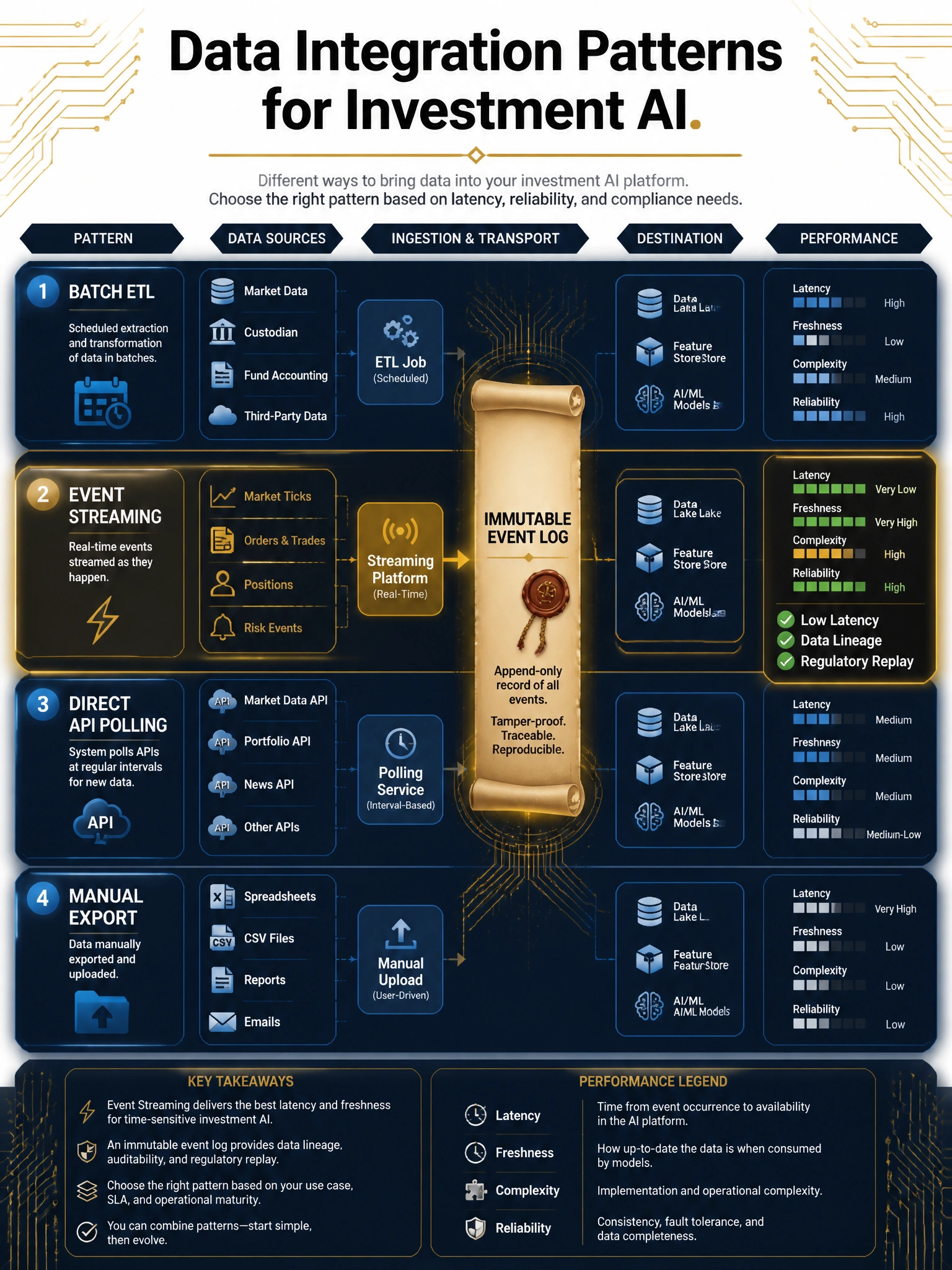
Think of a streaming event log as a DVR for your data — every tick, order event, and satellite reading is recorded in sequence, so you can replay exactly what the AI saw at 10:47:32 AM on any given day. Batch ETL can't do that; polling creates gaps and race conditions; manual exports introduce latency and human error. Only event-streaming gives you speed AND reproducibility.
Full explanation below image
Full Explanation
An event-driven streaming architecture with an immutable event log — commonly implemented via platforms like Apache Kafka or AWS Kinesis — solves the three core requirements simultaneously: low latency, data lineage, and regulatory replay.
Real-time market feeds require sub-second processing. Streaming architecture delivers events to the AI inference layer as they are produced, enabling microsecond-level signal latency that batch ETL (option A) categorically cannot match. Nightly batch consolidation introduces 12–24 hour data staleness — fatal for equity signal generation.
The immutable event log is the lineage mechanism. Every event is stamped with producer metadata, timestamp, and sequence number. This enables the firm to reconstruct exactly what data the model consumed at the moment of any AI-assisted decision — a direct answer to the regulatory replay requirement that both the SEC (Rule 17a-4) and MiFID II impose on electronic trading records.
Direct API polling (option C) introduces tight coupling between source systems and the AI layer, creates fan-out latency problems as sources multiply, and does not naturally produce a replayable record. Race conditions between concurrent polls can cause the AI to consume inconsistent snapshots.
Manual data exports (option D) are operationally untenable for a live trading environment and introduce human-induced latency and error that would undermine signal quality and audit integrity. This approach is incompatible with production-grade AI deployment.