
Apex Asset Management issues an RFP for an AI-powered portfolio analytics platform. The evaluation committee scores four vendor responses. Vendor A scores highest on UI/UX and integration speed. Vendor B scores highest on model explainability and regulatory audit trail features. Vendor C scores highest on pricing and onboarding timeline. Vendor D scores highest on raw prediction accuracy benchmarks from internal backtests. From an RFP evaluation standpoint, which scoring dimension should carry the greatest weight for a firm operating under fiduciary and MiFID II obligations?
Select an answer to reveal the explanation.
Short Explanation and Infographic
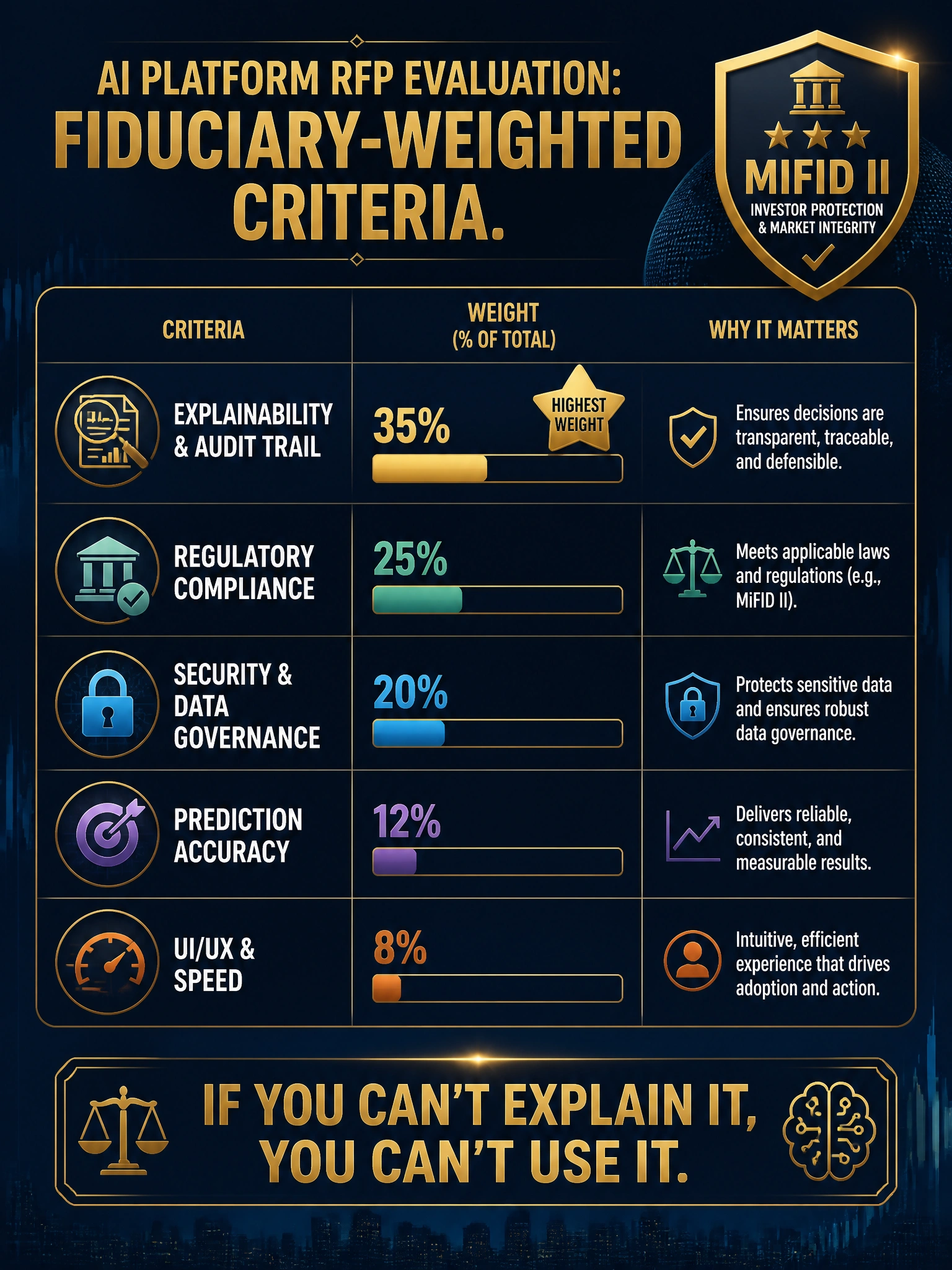
Imagine buying a race car that goes 200 mph but has no speedometer and no brakes — vendor backtests are exactly that. Under MiFID II and fiduciary law, the firm must be able to explain every investment decision influenced by AI. If regulators knock and you can't show your work, your prediction accuracy becomes irrelevant. Explainability and audit trail are the foundation everything else sits on.
Full explanation below image
Full Explanation
Under MiFID II Article 25 and fiduciary duty frameworks, investment firms must be able to demonstrate that recommendations and decisions are suitable for clients and can be reviewed post hoc. An AI platform that produces excellent predictions but cannot generate an audit trail of how it reached those predictions exposes the firm to regulatory sanction regardless of performance.
Model explainability (option B) is therefore the highest-weight criterion because it governs whether the platform can legally be used in a client-facing or decision-influencing capacity at all. Firms must document inputs, model logic, and outputs for supervisory review. Without this, even a high-performing platform is a liability.
UI/UX and integration speed (option A) influence adoption velocity and are important second-order factors, but they do not determine regulatory fitness. A beautiful, fast-to-deploy platform that fails an FCA audit creates more harm than a clunky but compliant one.
Pricing and onboarding speed (option C) are commercial considerations that belong in a TCO and business case analysis — not in the lead position for a compliance-sensitive RFP scoring rubric.
Vendor backtests (option D) are the most dangerous scoring dimension to over-weight because they are controlled by the vendor, use historical data, and rarely account for real-world slippage, regime changes, or overfitting. Prioritizing them over explainability inverts the risk hierarchy for a fiduciary institution.