
A Chief Risk Officer at a mid-sized investment bank is building an AI governance program and decides to adopt the NIST AI Risk Management Framework (AI RMF 1.0). The CRO wants to prioritize the function that helps the organization understand the context and risk profile of AI systems before committing to deployment. Which NIST AI RMF Core Function should be the CRO's starting point?
Select an answer to reveal the explanation.
Short Explanation
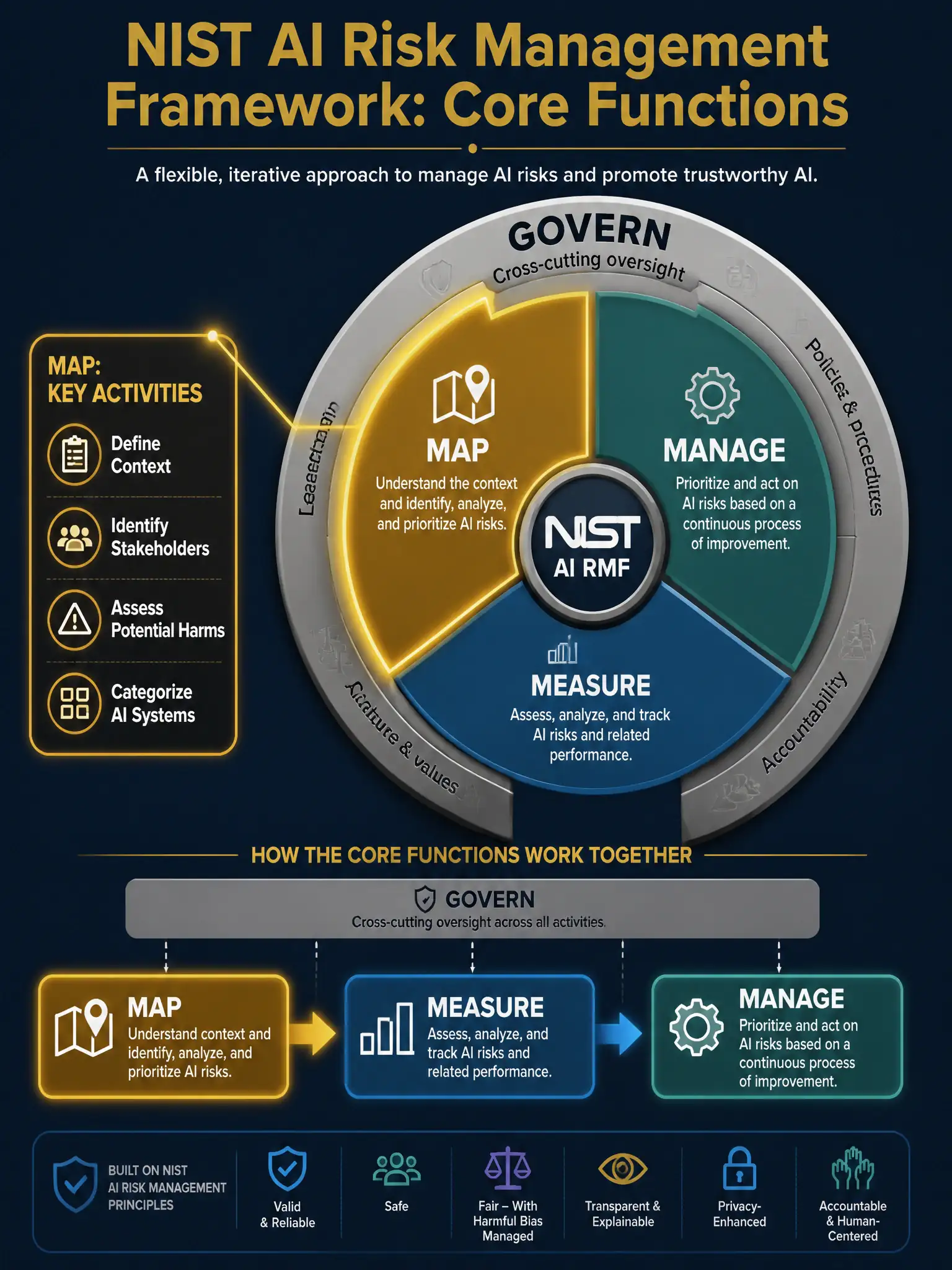
Think of NIST AI RMF like a building project: you survey the land before you design or build anything. MAP is that survey—it tells you what you're deploying, who it affects, and what could go wrong in context. You can't measure risk you haven't mapped, and you can't manage risk you haven't measured.
Full Explanation
The NIST AI Risk Management Framework (AI RMF 1.0), published in January 2023, organizes AI risk management activities into four Core Functions: GOVERN, MAP, MEASURE, and MANAGE. These functions are not strictly sequential—GOVERN is a cross-cutting function that operates continuously—but MAP represents the foundational context-setting step before risk quantification or treatment can occur.
MAP is the function through which organizations categorize AI systems by their intended use case, operational context, potential negative consequences (harms to individuals, organizations, or society), and the populations of people who may be impacted. In a financial services context, this means identifying whether a given AI system is used for credit decisions, fraud detection, trading, or client communications—and characterizing who bears risk if the system fails or produces biased outputs.
The correct choice is the one that says to categorize AI systems by their intended context, potential harms, and stakeholder impacts before deeper risk assessment, because the CRO's stated priority—understanding context and risk profile before deployment—directly aligns with MAP's purpose. Without MAP outputs, the other functions operate without adequate context.
The answer that says to immediately begin implementing risk treatment plans for identified AI risks is incorrect as the starting point. That approach describes MANAGE, which involves implementing risk treatment actions, monitoring, and incident response. These activities presuppose that risks have already been identified and assessed through MAP and MEASURE.
The answer that says to establish policies, accountability structures, and culture around AI risk at the organizational level is a plausible starting point for a governance program broadly, because GOVERN establishes the policies, roles, and culture that enable all other functions. However, GOVERN does not provide the context-specific risk profile of individual AI systems—that is MAP's role. The question asks about understanding a system's context and risk profile, which points to MAP.
The answer that says to apply quantitative and qualitative methods to assess the trustworthiness attributes of deployed AI systems describes MEASURE. MEASURE applies quantitative and qualitative techniques (including testing, evaluation, and red-teaming) to assess trustworthiness properties like accuracy, fairness, and robustness. MEASURE builds on the context established in MAP and is therefore downstream of the CRO's stated priority.
Financial institutions should treat MAP outputs as living documents that are revisited whenever the AI system, its use case, or the regulatory environment changes materially.