
An SEC-registered investment adviser uses an AI model to generate personalized portfolio recommendations for retail clients. The firm's compliance team is reviewing disclosure obligations under the Investment Advisers Act of 1940 and SEC guidance on AI. Which disclosure scenario would MOST likely trigger an SEC enforcement action for inadequate AI-related disclosure?
Select an answer to reveal the explanation.
Short Explanation
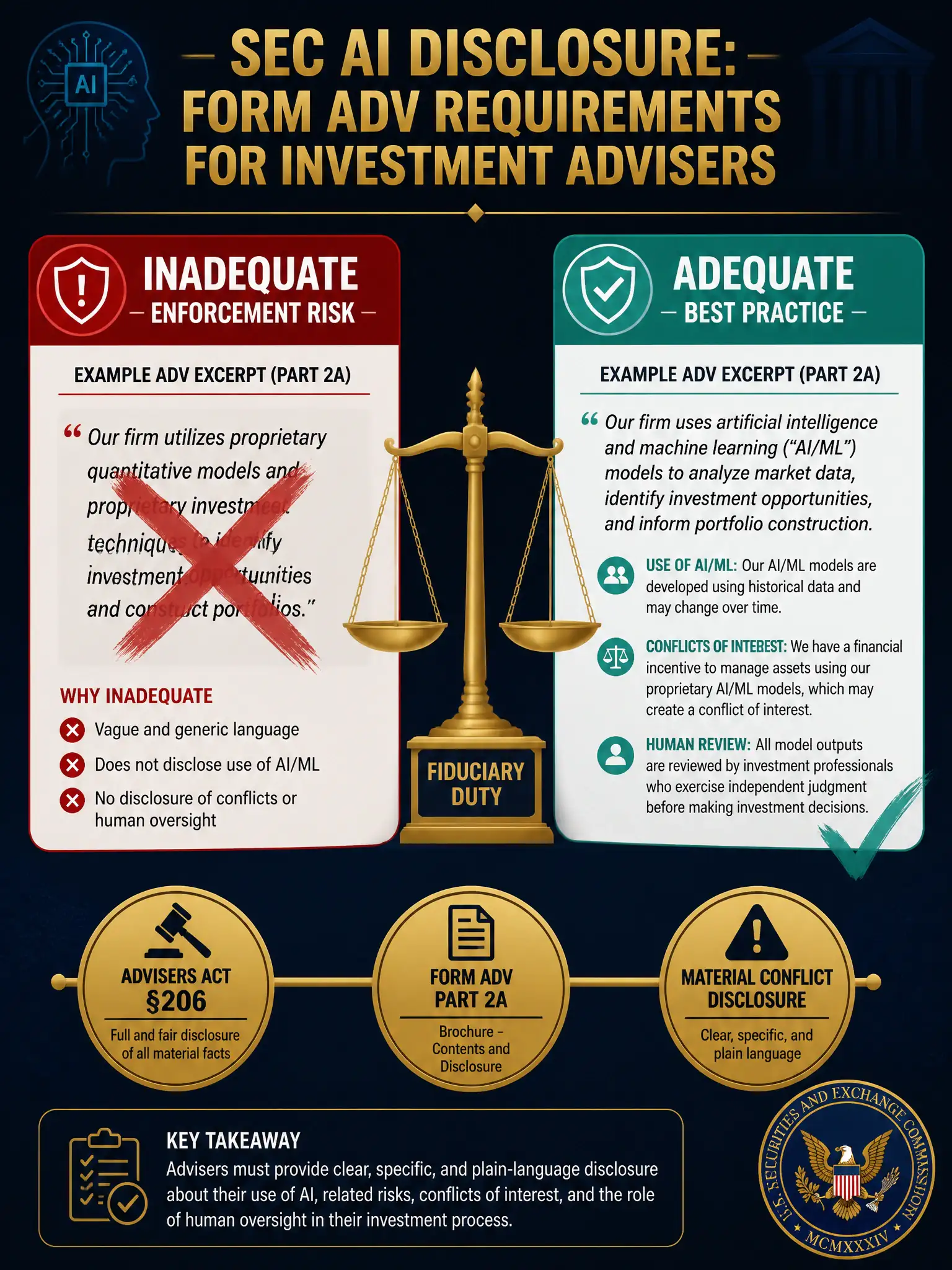
You can't call an AI system 'proprietary quantitative models' and hope nobody notices the conflict. The SEC wants you to say it's AI and flag when optimization might put firm revenue ahead of client suitability. That's the disclosure gap that draws enforcement.
Full Explanation
The SEC has pursued an active enforcement agenda around AI and algorithmic disclosures in investment advisory contexts. The Investment Advisers Act of 1940 Section 206 prohibits fraudulent or deceptive conduct, and Form ADV Part 2A requires advisers to provide full and fair disclosure of material facts, including conflicts of interest. In 2023, the SEC charged two investment advisers, Delphia and Global Predictions, for making misleading statements about their use of AI, specifically claiming to use AI capabilities they did not actually have. More broadly, SEC staff guidance and proposed rulemaking have signaled that generic disclosures such as 'quantitative models' are insufficient when AI systems are making or materially influencing client recommendations, and when those AI systems embed conflicts of interest, such as models that optimize for the firm's revenue rather than client best interest. The correct scenario is the one in which the firm discloses in Form ADV Part 2A that it uses 'proprietary quantitative models' without specifying that these models are AI-driven and without disclosing that conflicts of interest may arise if AI optimization targets firm revenue over client suitability. That scenario contains materially misleading language because 'proprietary quantitative models' rather than 'AI' fails to convey the nature of the technology, and it omits a material conflict of interest because the AI may prioritize firm revenue over client suitability. That combination violates the adviser's fiduciary duty under Sections 206(1) and 206(2) of the Advisers Act. The scenario in which the firm provides a plain-language summary in its client agreement explaining that an AI system assists advisers in portfolio construction and that human advisers review all recommendations describes adequate disclosure. The firm has used plain language, disclosed AI use, and noted human oversight, meeting best-practice standards for client communication. The scenario in which the firm discloses AI use in Form ADV Part 2A and provides a detailed description of how the AI ranks securities, including the data sources and rebalancing triggers, describes detailed, substantive disclosure that goes beyond minimum requirements and would not trigger enforcement. The scenario in which the firm sends annual disclosure updates to clients when material changes are made to the AI model's optimization objective describes material change notification, which aligns with SEC expectations for maintaining current and accurate disclosures. Annual updates for material model changes are consistent with SEC staff guidance on ongoing AI disclosure obligations. CFIA candidates should understand that the SEC applies a technology-neutral fiduciary standard: the form of technology, AI versus a spreadsheet, does not reduce disclosure obligations. If anything, AI systems with opaque decision logic and embedded optimization objectives require more, not less, disclosure.