
A London-based proprietary trading firm deploys a new high-frequency trading algorithm that uses a reinforcement learning model to optimize order placement across European equity venues. Under MiFID II Article 17, which control is MANDATORY before the algorithm is permitted to trade in live markets?
Select an answer to reveal the explanation.
Short Explanation
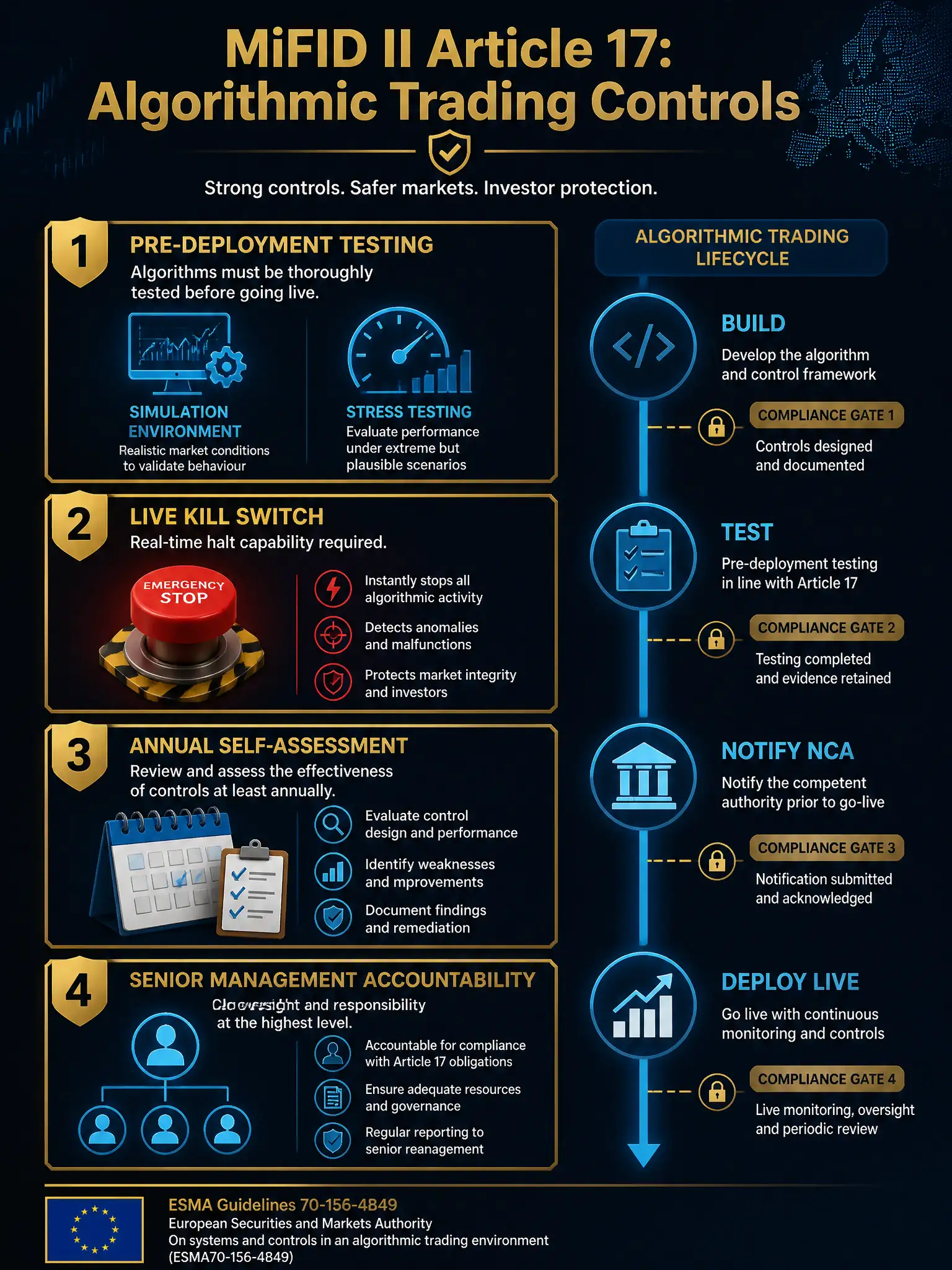
MiFID II Article 17 is basically the regulatory driver's test for algorithms: you have to prove it can handle the road before you let it loose in traffic. You need pre-deployment testing, real-time kill switches, and an annual self-assessment. No academic sign-off, ESMA prospectus, or venue approval is required.
Full Explanation
MiFID II Article 17 (Algorithmic Trading) establishes mandatory requirements for investment firms engaging in algorithmic trading in European financial markets. The regulation applies to any firm that uses computer algorithms to automatically determine trading parameters such as timing, price, and quantity with minimal human intervention.
The mandatory pre-live requirements under Article 17 and the associated ESMA Guidelines on Algorithmic Trading (ESMA 70-156-4849) include: (1) pre-deployment testing of algorithms in a test environment that simulates live market conditions, (2) post-deployment stress testing covering high-volume and high-volatility scenarios, (3) annual self-assessment of the firm's algorithmic trading systems against the MiFID II obligations, (4) real-time monitoring of algorithms with the ability to immediately cancel or withdraw orders (kill switch functionality), and (5) governance frameworks ensuring senior management is accountable for algorithmic trading risk. The control requiring pre-deployment testing including simulation in the live market environment, real-time kill switches, and annual self-assessment of the algorithm's compliance with MiFID II obligations captures the core mandatory controls.
The control requiring review by a third-party academic institution to confirm its effectiveness against benchmarks is incorrect. MiFID II does not require third-party academic review. Validation must be conducted by the firm's own risk management or by an independent internal function, not by external academics.
The control requiring submission of a prospectus to ESMA disclosing the trading strategy and expected daily volume is incorrect. There is no MiFID II requirement for investment firms to file a prospectus with ESMA disclosing trading strategy details. Prospectus requirements under EU law apply to securities issuances, not trading algorithms. Algorithmic trading firms must notify their national competent authority (NCA), but this is a notification, not a prospectus filing.
The control requiring written approval from each trading venue's surveillance team confirming the algorithm will not cause market disruption is incorrect. Trading venues (e.g., Euronext, Deutsche Börse) have their own access controls and market surveillance under MiFID II Article 48, but these operate independently. Venues cannot grant or deny approval to individual algorithms through a written approval process. Firms access venues through membership/participant agreements, and the regulatory obligation for algorithmic risk controls sits with the investment firm, not the venue.
Reinforcement learning systems present particular challenges under MiFID II because their behavior evolves over time, meaning a model that passed pre-deployment testing may behave differently after live market exposure. Robust kill switch design and continuous monitoring are therefore especially important for adaptive AI trading systems.