
A hedge fund uses a gradient-boosting model to generate daily equity trade signals. A compliance officer requests a post-hoc explanation for why the model recommended a large short position on a specific stock. The data science team proposes using SHAP (SHapley Additive exPlanations). Which statement BEST describes a key advantage of SHAP over LIME (Local Interpretable Model-agnostic Explanations) in this context?
Select an answer to reveal the explanation.
Short Explanation
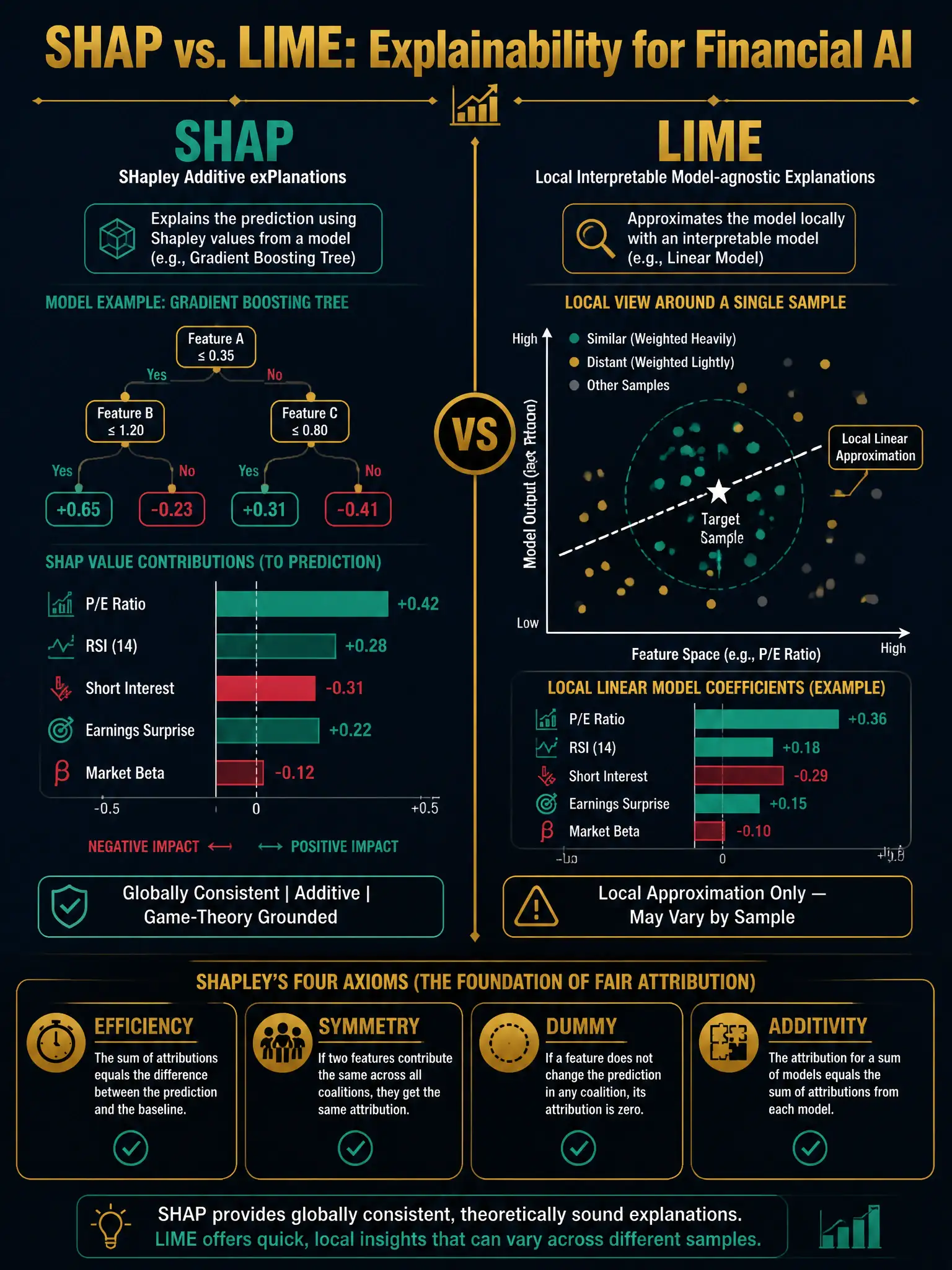
SHAP splits credit for the prediction like splitting the dinner bill fairly, so feature contributions add up and stay comparable across trades. You'll need that consistency when compliance audits why the model shorted the stock. LIME can change its story when comparing similar trades.
Full Explanation
The best description is that SHAP values are globally consistent and satisfy mathematical fairness properties—efficiency, symmetry, dummy, and additivity—so feature contributions sum to the predicted output relative to a baseline and are comparable across observations. SHAP, developed by Lundberg and Lee, grounds feature attribution in cooperative game theory. Efficiency means attributions sum to the difference between the model output and a baseline. Symmetry means features with identical contributions receive identical attributions. Dummy means features that never affect the output receive zero attribution. Additivity means SHAP values from sub-models can be combined. These properties make SHAP explanations mathematically rigorous and directly comparable across predictions, which is critical when explaining trade recommendations to compliance officers or regulators. LIME, developed by Ribeiro et al., works by training a simple surrogate model, typically linear, in the neighborhood of a specific prediction. While LIME is computationally flexible and intuitive, it lacks global consistency: the same feature can receive different explanations for two very similar inputs depending on how the local neighborhood is sampled. That inconsistency creates problems in regulated contexts where explanations must be reproducible and auditable. The claim that SHAP produces explanations that are always 100% faithful to the model's internal logic, whereas LIME approximations can introduce bias, is incorrect because neither SHAP nor LIME provides 100% faithful explanations for complex black-box models. TreeSHAP is exact for tree-based models, but kernel SHAP, the model-agnostic form, is still an approximation. The distinction is not absolute faithfulness but mathematical consistency. The claim that SHAP is significantly faster to compute than LIME, making it preferable for real-time, low-latency trading applications, is incorrect. SHAP, especially kernel SHAP for non-tree models, is typically more computationally expensive than LIME, not faster. TreeSHAP is fast, but it is architecture-specific. The claim that SHAP requires no assumptions about the underlying model architecture, while LIME is restricted to linear models, is incorrect. Both SHAP and LIME are model-agnostic post-hoc explainability methods. LIME does not require linear models; its local surrogate can be any interpretable model. The key difference is not architecture-agnosticism but consistency guarantees. In financial AI governance, regulators increasingly expect model explanations to be consistent and auditable. SHAP's game-theoretic foundation makes it more defensible in supervisory examinations, ECOA adverse action notices, and MiFID II best execution documentation.