
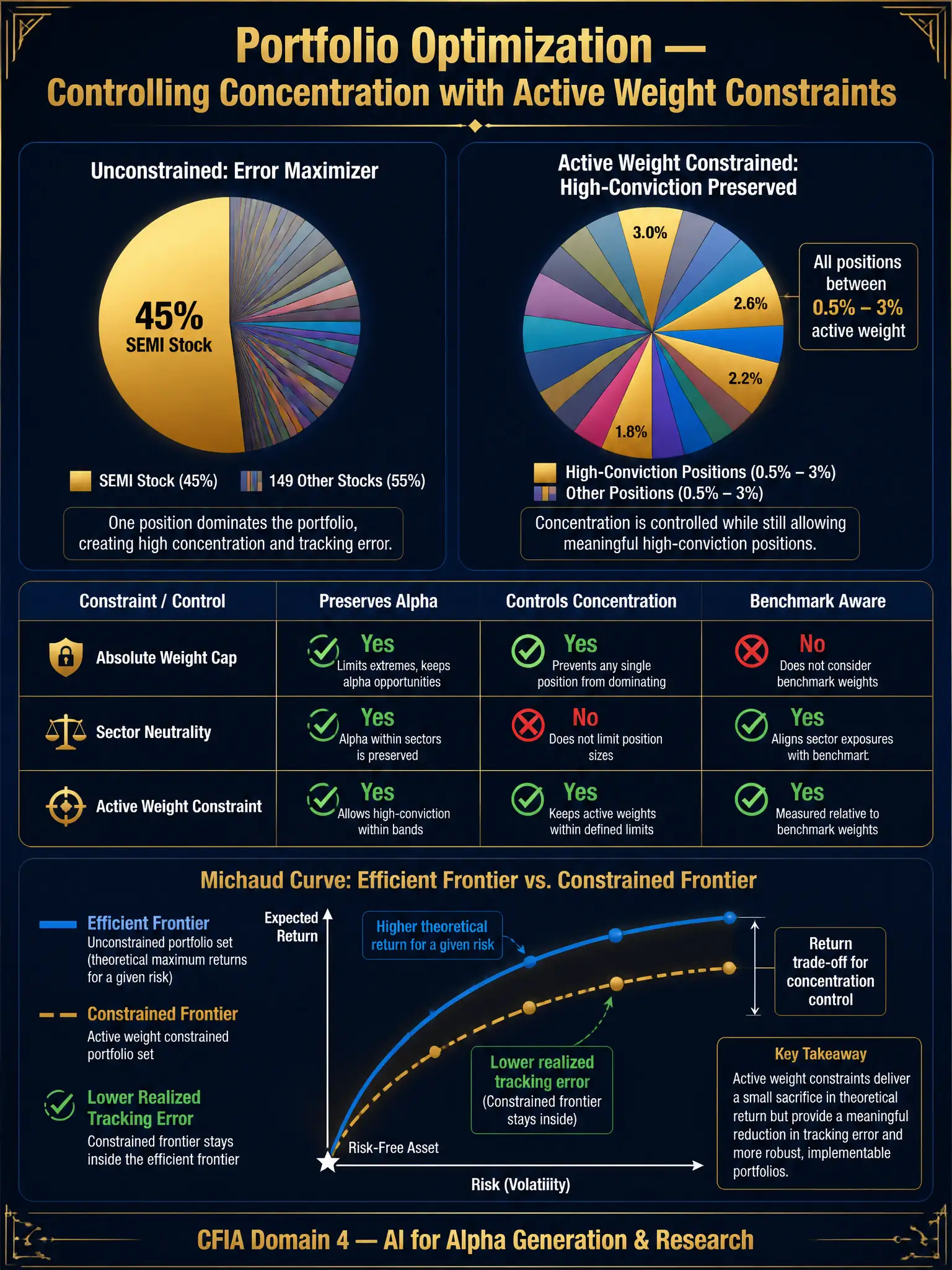
A systematic portfolio manager uses a mean-variance optimizer enhanced with an ML-predicted alpha vector to construct a 150-stock long-only equity portfolio. The optimizer is unconstrained except for a budget constraint. The resulting portfolio allocates 45% to a single semiconductor stock with the highest predicted alpha. Which constraint addition BEST addresses the concentration risk while preserving the optimizer's ability to express high-conviction alpha views?
Select an answer to reveal the explanation.
Short Explanation
The optimizer is doing exactly what you told it to do: chase expected return and treat your alpha signal like gospel. Cap active weight versus benchmark and let tracking error expand moderately, so your best ideas still get overweighted without blowing up concentration.
Full Explanation
The 45% single-stock concentration is a classic symptom of unconstrained mean-variance optimization, which Michaud (1989) famously described as an 'error maximizer.' When alpha estimates have any uncertainty — and machine-learning-predicted alphas always do — the optimizer amplifies small errors in the return forecast into extreme portfolio weights. The equal-weight allocation across all 150 stocks approach is the nuclear option that discards all alpha information. It eliminates concentration but removes the entire purpose of the machine-learning alpha model, making the exercise pointless. The absolute single-stock weight cap plus sector neutrality relative to a benchmark approach imposes a hard absolute ceiling, such as 5% of portfolio, and forces the portfolio to match benchmark sector weights. This is overly conservative: it prevents the manager from exploiting genuine sector-level alpha and may actually create hidden tracking error if sectors are constrained to benchmark weights while individual stock weights vary within them. The maximum single-stock active weight constraint with moderately expanded tracking error is correct because it allows the semiconductor stock to hold, for example, 3% more than its 2% benchmark weight — a 5% active overweight that is meaningful without catastrophic concentration. The tracking error flexibility allows the manager to express high-conviction views across multiple stocks without being forced into artificial sector neutrality. This is consistent with how institutional long-only mandates are typically structured using commercial optimizers like Axioma or Barra. The Bayesian alpha shrinkage toward zero approach is a valid risk management technique that reduces alpha uncertainty by blending machine-learning predictions with a prior toward zero. However, run alone on an unconstrained optimizer, it would merely reduce the 45% position to, say, 30% — still catastrophically concentrated. Shrinkage addresses estimation error but does not substitute for an explicit concentration constraint. Best practice combines Bayesian shrinkage of the alpha vector with active weight constraints and a transaction cost penalty in the objective function.