
A CIO is evaluating whether to deploy a large language model (LLM) to assist fundamental equity analysts in synthesizing 10-K filings, analyst reports, and industry data into investment memos. A senior analyst raises three concerns: (1) LLMs may hallucinate financial figures, (2) the model's training cutoff means it lacks recent data, and (3) LLMs cannot replicate proprietary channel checks with management. Which response BEST characterizes how LLMs should be positioned within a fundamental research workflow?
Select an answer to reveal the explanation.
Short Explanation
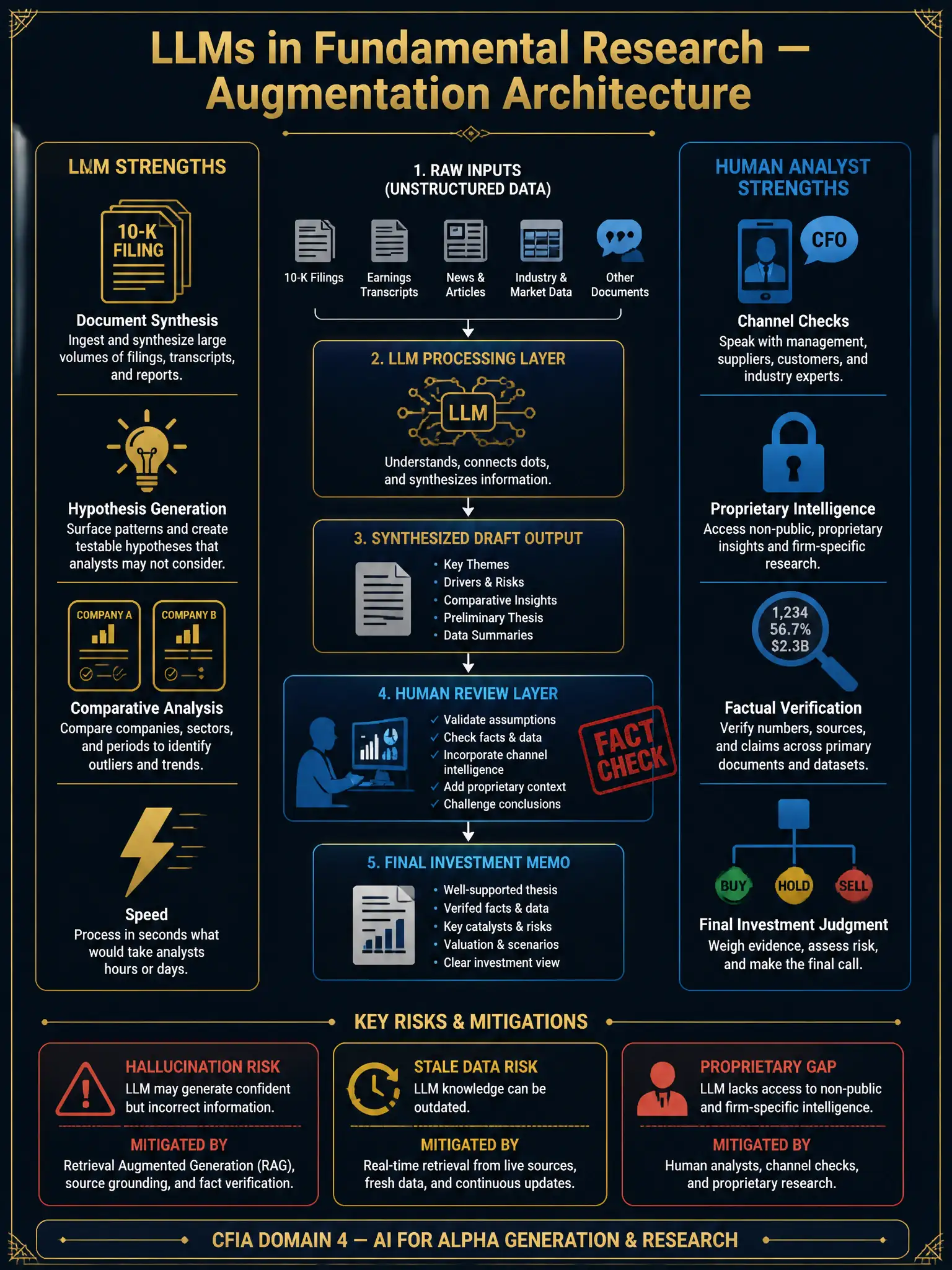
Think of an LLM as a fast research assistant that can synthesize documents and spot patterns, but it can still make up numbers and can't do channel checks. You should use it to augment your analysts, not replace them, and keep humans responsible for verification, proprietary intelligence, and the final investment call.
Full Explanation
The three concerns raised by the senior analyst are all legitimate but do not constitute a blanket disqualification of LLMs from research workflows. Each concern maps to a specific architectural or process mitigation:
(1) Hallucination of financial figures: This is a real and well-documented risk. Mitigation includes retrieval-augmented generation (RAG), which grounds model responses in cited source documents, and post-hoc verification workflows where analysts cross-check all numerical outputs against primary sources. RAG reduces but does not eliminate hallucinations; human verification remains mandatory for any financial figure used in an investment memo.
(2) Training cutoff / stale data: This is addressable through real-time data integration via RAG pipelines connected to financial databases, live SEC filings, and news APIs. Most enterprise-grade LLM deployments in investment management include retrieval layers for this reason.
(3) Proprietary channel checks: This is the strongest objection and is not addressable by any LLM architecture. An LLM cannot call a retail store manager, conduct supplier interviews, or attend an industry conference. This irreplaceable human intelligence differentiates fundamental research and remains the domain of experienced analysts.
The best characterization is therefore that LLMs should be deployed as augmentation tools for information synthesis and hypothesis generation, while human analysts retain responsibility for factual verification, proprietary intelligence, and final investment judgment. This position accepts the productivity gains from automated document synthesis while preserving the controls and judgment that make fundamental research reliable.
The response treating all three concerns as fatal and demanding zero hallucinations before any deployment incorrectly treats these risks as binary dealbreakers rather than manageable constraints, ignoring the substantial productivity gains documented by firms that have deployed LLM research tools with appropriate guardrails.
The response calling for full replacement of junior analyst report synthesis tasks overstates RAG's ability to eliminate hallucinations and incorrectly implies LLMs can replicate proprietary intelligence gathering. Replacing junior analysts entirely also creates compliance and liability exposure if incorrect LLM outputs are not reviewed before use.
The response restricting LLMs only to non-financial tasks such as meeting summaries and email drafting is an overly conservative posture inconsistent with the current practice of institutional investors including BlackRock, J.P. Morgan, and Goldman Sachs, all of which have deployed LLM-assisted research tools with human-in-the-loop governance frameworks.