
An investment team is evaluating three alternative data sources to build a consumer spending signal for U.S. retail equities: (1) anonymized credit/debit card transaction panels from a fintech aggregator, (2) satellite imagery of retail parking lots processed by a computer vision model, and (3) scraped social media post counts mentioning brand names. Which characteristic MOST distinguishes a high-quality alternative data signal from noise in this context?
Select an answer to reveal the explanation.
Short Explanation and Infographic
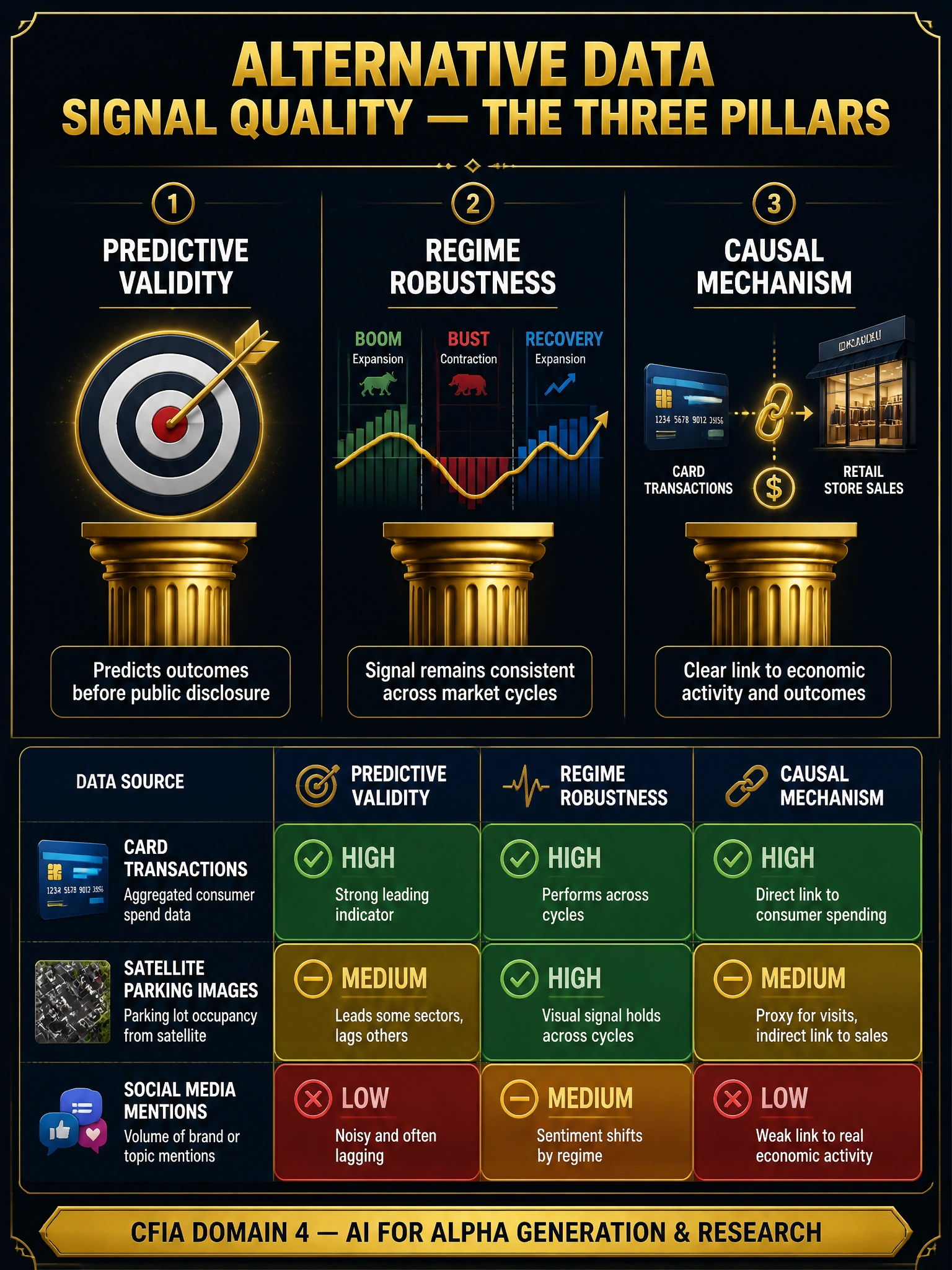
Think of a great alt-data signal like a weather vane that actually points into the wind — it has to predict something real (future sales), hold up across seasons (multiple regimes), and make logical sense (causality). Proprietary access, premium pricing, and 'unstructured' labels are marketing, not alpha. The holy trinity of alternative data quality is predictive validity, regime robustness, and a causal story that won't fall apart under due diligence.
Full explanation below image
Full Explanation
A high-quality alternative data signal must satisfy three interconnected criteria: predictive validity, regime robustness, and causal grounding. Predictive validity means the signal has demonstrable correlation with future outcomes (e.g., same-store sales or earnings surprises) measured out-of-sample and before those outcomes are publicly disclosed. Regime robustness means the relationship holds across varying market conditions — recessions, expansions, rising and falling consumer confidence — rather than being a curve-fit to a benign historical window. Causal grounding provides a logical mechanism (e.g., card transaction volume tracks actual consumer spending, not just social sentiment) that makes the signal credible to CIOs and reduces the risk of spurious correlation.
Option A is incorrect because exclusivity is temporary; alpha from proprietary data typically decays as the vendor sells access to more clients, and index funds are irrelevant to signal quality.
Option C is incorrect because vendor history length and pricing reflect data infrastructure, not signal validity. A five-year dataset can still be entirely in-sample if the researcher mined it aggressively.
Option D is incorrect because the structured vs. unstructured distinction is a data-type classification, not a quality indicator. Unstructured social media data is often the noisiest of the three sources listed; differentiation from consensus does not imply predictive power.
In practice, alternative data evaluation frameworks at institutional firms include out-of-sample Sharpe ratio tests, decay analysis by holding period, and legal/compliance review of data collection methods — especially for consumer transaction data governed by CCPA and GDPR.