
A quantitative analyst at a long/short equity fund wants to extract alpha signals from earnings call transcripts. She applies a transformer-based NLP model to score management sentiment on a 500-company universe. During backtesting, the strategy shows a Sharpe ratio of 1.8 over the past three years. Before deploying capital, which methodological concern should she MOST prioritize investigating?
Select an answer to reveal the explanation.
Short Explanation and Infographic
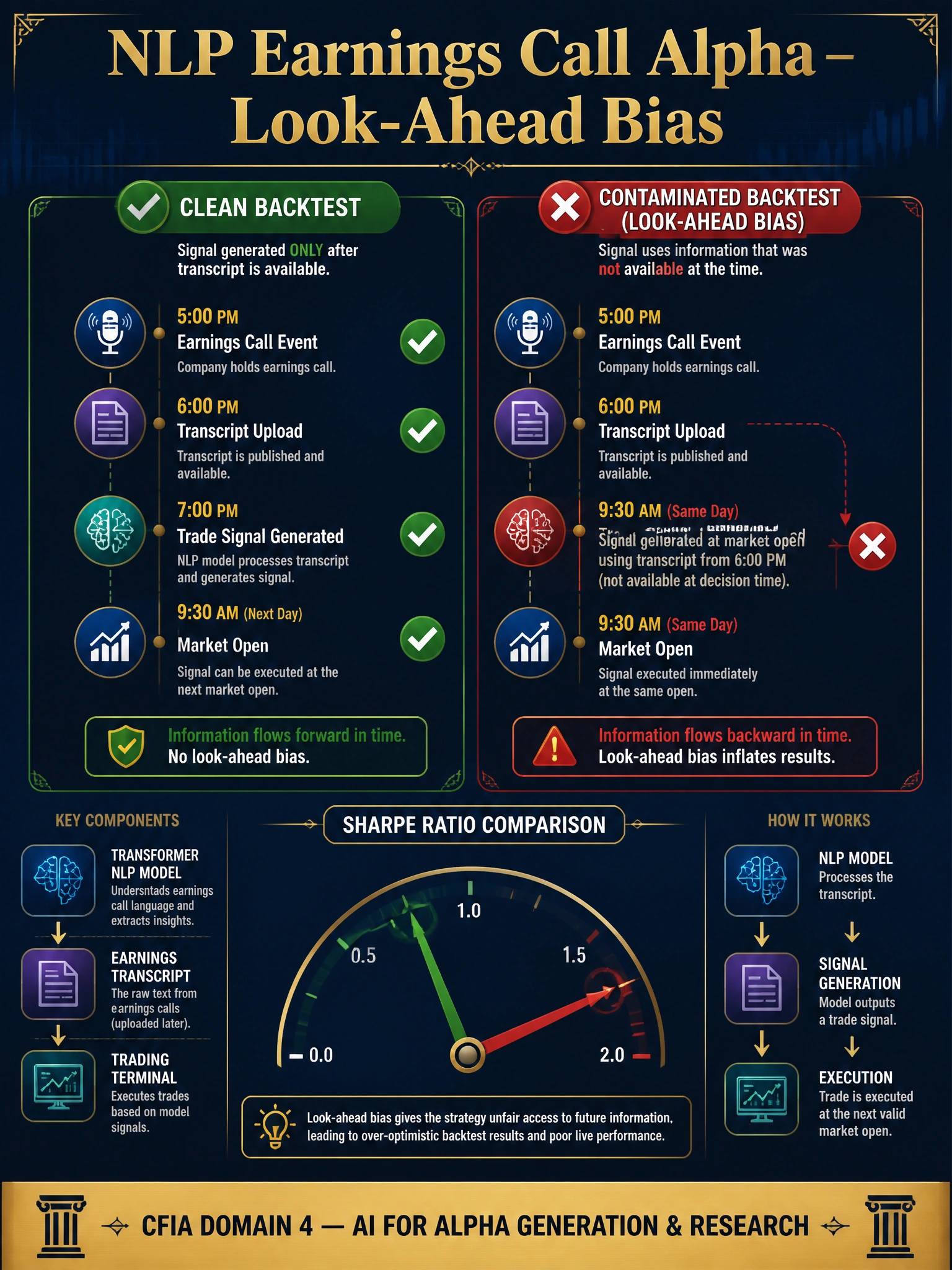
Think of it like replaying a football game but letting yourself know the final score before making 'in-game' calls — that's look-ahead bias, and it's the silent killer of earnings NLP backtests. Transcripts are often uploaded to vendor databases hours or days after the call ends; if your backtest assumes you traded on them before they were available, your stellar Sharpe ratio is a mirage. The other concerns are real but secondary to this fundamental data-timing issue.
Full explanation below image
Full Explanation
Look-ahead bias is the most critical flaw to rule out before any earnings NLP strategy goes live. Earnings call transcripts are typically released to data vendors 1–4 hours after the call, but final corrected versions may not be available until the next business day. If the backtest engine timestamps trades at market open on earnings day but the transcript wasn't accessible until hours later, every simulated trade exploits information that was not actually tradeable — artificially inflating the Sharpe ratio.
Option A (pre-training corpus) is a legitimate model quality concern but is secondary in priority. A general-purpose model like BERT or RoBERTa can still capture meaningful sentiment signals; the data-timing issue is a harder, structural flaw that invalidates the entire backtest regardless of model quality.
Option B (survivorship bias in the transcript archive) is a genuine concern for universe construction, but earnings transcript databases typically include delisted companies' historical filings. The analyst should verify this, but it is a lesser risk than the look-ahead bias embedded in the timing assumption.
Option D (cross-sectional normalization) is a sensible portfolio construction step, but it is a refinement to signal quality, not a validity threat. Even a perfectly normalized signal is worthless if the underlying backtest is contaminated by future information.
In practice, the analyst should obtain precise data-availability timestamps from the transcript vendor and enforce a minimum delay (e.g., T+1 trade execution) in the backtest engine before claiming any result as investable.