
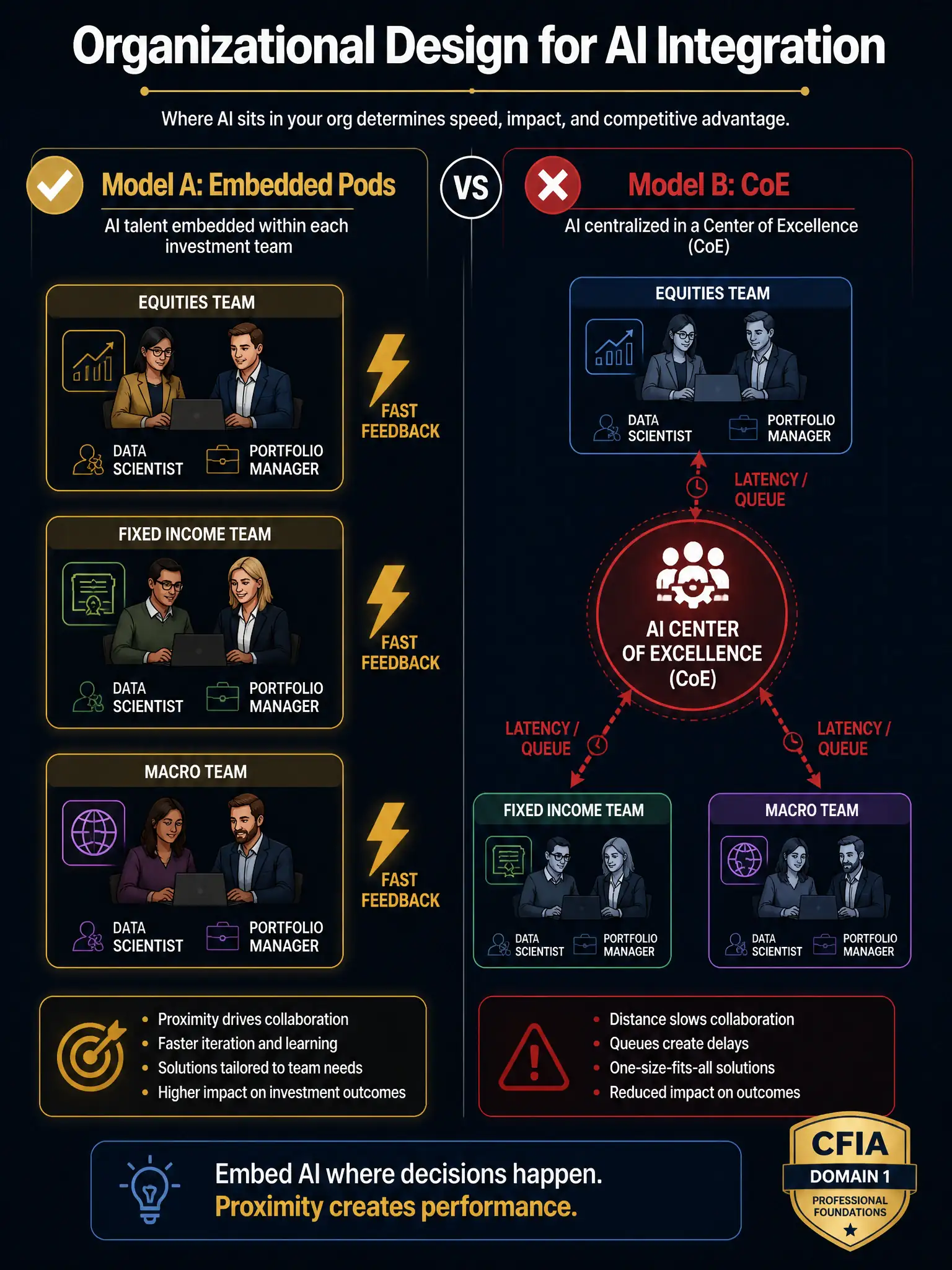
A $50B multi-asset investment firm is redesigning its organizational structure to accelerate AI adoption. The CIO is choosing between two models: Model A embeds data scientists and ML engineers directly into each investment team (equities, fixed income, macro) as permanent pod members reporting to the sector head. Model B centralizes all data science talent in a standalone AI Center of Excellence (CoE) that services requests from investment teams on a project basis. Which organizational design better supports sustained AI integration in the investment process, and why?
Select an answer to reveal the explanation.
Short Explanation
You want your data scientists sitting with the people making investment decisions, not stuck in a ticket queue. That proximity speeds feedback loops and helps models reflect real market intuition. Centralized AI shops can build tools, but they usually slow the work that actually makes money.
Full Explanation
The tension between centralized AI centers of excellence and embedded team models is one of the most consequential organizational design decisions for investment firms undergoing AI transformation. Research from McKinsey, Andreessen Horowitz, and academic literature on data science team structures consistently points to embedding as the superior model for application-layer AI work in knowledge-intensive domains.
The core argument for embedded pods rests on feedback loop velocity. When a data scientist sits next to a portfolio manager during morning meetings, attends earnings calls, and debates signal interpretation in real time, the resulting models encode genuine investment logic rather than statistical artifacts. The portfolio manager can immediately flag when a model's output contradicts known market microstructure, and the data scientist can iterate within days rather than waiting weeks in a central queue. This tight coupling produces what practitioners call 'investable AI' — models whose outputs make intuitive sense to the humans who use them.
The center-of-excellence structure has legitimate advantages for foundational infrastructure, such as data pipelines, model governance frameworks, and shared compute, but as a primary delivery mechanism for investment-facing AI it typically fails because of prioritization conflicts, context loss during project handoffs, and the inability of centralized engineers to develop the tacit domain knowledge that separates good signals from spurious correlations.
The choice of the center-of-excellence design on the basis that centralized teams build reusable infrastructure and avoid duplication of effort across asset classes is only partially correct: those infrastructure benefits are real, but infrastructure is not the bottleneck for sustained investment integration. The choice of the center-of-excellence design on the basis that it gives the CIO direct line authority over all AI talent and reduces governance risk conflates governance authority with organizational effectiveness; direct line authority does not improve model quality. The choice of the embedded-pod design on the basis that embedding engineers eliminates the need for a technology budget review because costs move to the investment P&L is factually incorrect: embedding changes cost allocation, but it does not remove the approval requirement.