
A quantitative hedge fund has deployed an AI system that generates trade recommendations with an average 63% win rate over three years of live trading. The fund's head of risk wants to implement a formal human-AI decision rights framework. She is considering four governance structures for trade execution. Which structure best balances human accountability with the demonstrated predictive capability of the AI system?
Select an answer to reveal the explanation.
Short Explanation
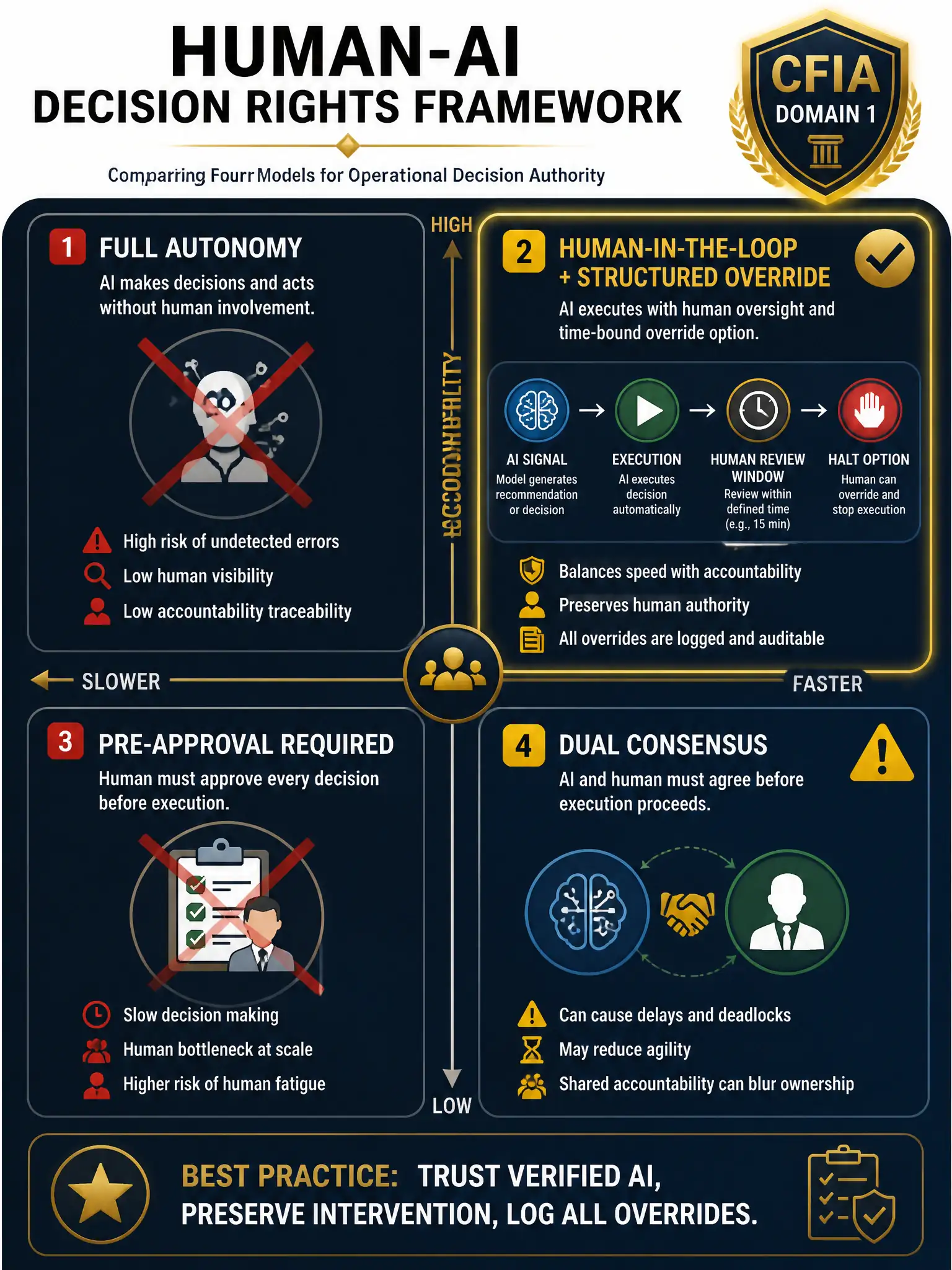
Think of it like autopilot on a commercial aircraft: the plane flies itself, but a pilot with full visibility can intervene if something looks wrong. With a proven 63% win rate, you let the system execute trades, but you review and can halt execution in a defined window and log every override so you can spot bias. That preserves speed while keeping human accountability.
Full Explanation
Human-AI decision rights frameworks are a core competency for AI-Native investment firms. The field distinguishes three primary governance modes: human-in-the-loop (human can intervene before or during execution), human-on-the-loop (human monitors and can override after the fact), and full autonomy (no human in the execution chain). The fourth hybrid mode requires dual consensus. The human-in-the-loop-with-structured-override structure is correct because it matches the risk-return profile of the situation. The 63% win rate over three years is statistically significant and warrants trusting the system with execution authority — requiring pre-approval would add latency that erodes the alpha. However, full autonomy, where the system executes all trades within predefined risk limits without human review, is inappropriate because no system maintains consistent accuracy across all market regimes, institutional governance frameworks almost universally require human accountability for investment decisions, and the fund cannot learn from its own mistakes without a human feedback mechanism. The structured override window preserves intervention capability while allowing speed. Critically, the requirement to log and review override patterns is not bureaucratic overhead — it is the mechanism by which the fund identifies whether humans are systematically adding value or systematically degrading performance. Research in the human-AI teaming literature (Dietvorst, Dietvorst & Logg, 2015; algorithm aversion studies) shows that humans often override correct AI recommendations out of behavioral bias. Logging overrides creates the data needed to detect and correct this pattern. The human-on-the-loop-with-exception-flagging structure, as written, has the approval sequence reversed — humans approve every trade before execution while the AI flags which trades it would reject, which is actually human-on-the-loop pre-approval, not exception flagging, and it sacrifices the speed advantage entirely. The hybrid-consensus structure has the perverse effect of converting disagreement — often the most informative signal — into inaction, which eliminates a significant portion of potential trades and biases the portfolio toward low-conviction situations where human and model happen to agree.