
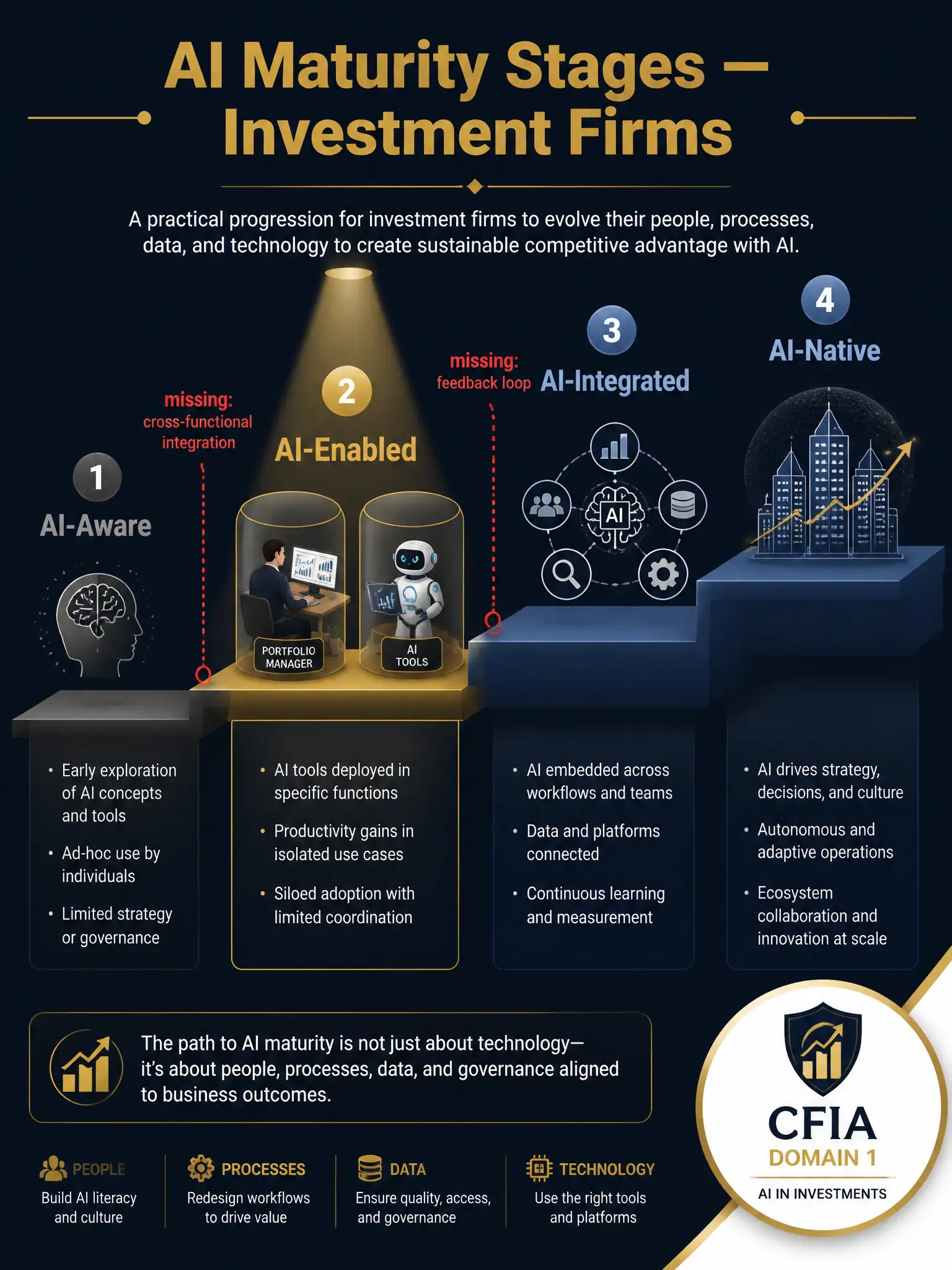
A large active equity manager is conducting an internal AI maturity assessment. Their data science team has built and deployed over 20 machine learning models for alpha signal generation, but portfolio managers still override model recommendations at their discretion without a systematic feedback loop. Risk and compliance continue to operate on entirely separate legacy systems with no AI integration. Based on this description, how would you best classify this firm's AI maturity stage?
Select an answer to reveal the explanation.
Short Explanation
Think of AI maturity like a car with cruise control versus a self-driving car. Having cruise control doesn't make your car autonomous — and having ML models that PMs can ignore doesn't make a firm AI-Native. This firm has real models in production, so they're past the pilot stage, but no cross-functional integration and no feedback loop means they're solidly in the AI-Enabled territory.
Full Explanation
The AI maturity framework for investment firms typically spans four stages: AI-Aware (exploring or piloting), AI-Enabled (AI augments specific functions in production), AI-Integrated (AI embedded across multiple functions with feedback loops), and AI-Native (AI shapes the core investment thesis and operating model in real time with humans and machines co-deciding). This firm has moved past the Aware stage because it has over 20 models in production for alpha generation, which is real deployment. However, the critical indicators that prevent a higher classification are: first, portfolio managers override model recommendations without a structured feedback mechanism, meaning the firm cannot learn from those overrides systematically; second, risk and compliance remain on legacy systems with zero AI integration, which signals a fragmented rather than integrated architecture. An AI-Integrated or AI-Native firm would have closed feedback loops where PM overrides are captured as labeled training data, risk models communicate with portfolio construction models, and the overall investment process is redesigned around human-AI teaming rather than human-optional-AI. The absence of these elements is disqualifying for the higher stages. The best classification is AI-Enabled because the firm uses AI to augment decisions in one function but lacks cross-functional integration and systematic human-AI feedback loops. The AI-Native claim that the firm qualifies because it has deployed production ML models directly within the investment process is wrong because production deployment of models in one function alone does not constitute AI-Native status — that stage requires the investment thesis itself to be co-produced by human and machine in real time. The AI-Aware claim that the firm is still in the pilot phase and has not moved any models into production is wrong because the firm is clearly past piloting. The AI-Optimized claim that the firm has optimized its core process around ML signals even if legacy back-office systems remain is wrong because 'AI-Optimized' is not a standard stage in the canonical framework, and even if it were, the disconnected risk and compliance systems and lack of feedback loop would disqualify this firm.