
A team has an exploratory finding that two product categories show markedly different return rates. What is the appropriate next step if they want to act on it operationally at scale?
Select an answer to reveal the explanation.
Short Explanation
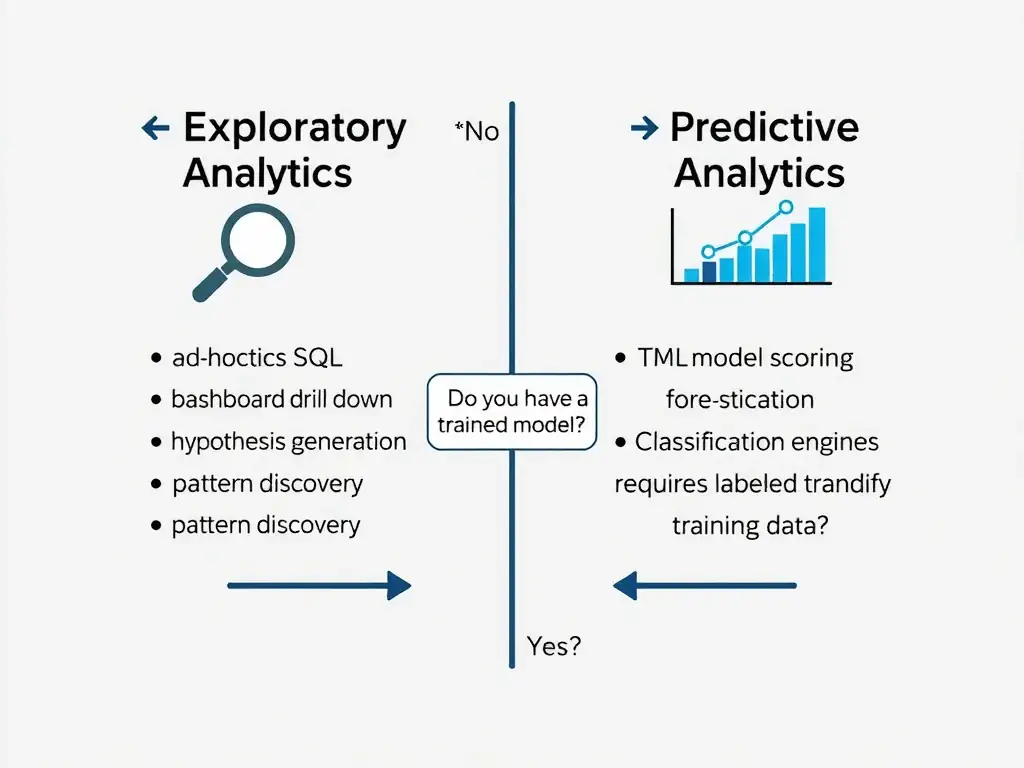
Exploration found the pattern; that's what it's for. Acting on individual orders is a different job—you need a target, a fitted model, and a validation number that tells you what it costs when the model is wrong.
Full Explanation
The correct approach is to formulate the exploratory finding as a predictive problem with a defined target and validate a model, because acting per-order requires estimating outcomes for individual cases. Exploration surfaces a pattern at aggregate level. Operational action on individual orders requires an estimate per case, which means defining the target, building features, fitting a model and validating it on held-out data so the error rate is known before decisions ride on it.
Publishing the exploratory chart as the operational rule is incorrect because an aggregate difference between two categories does not license a per-case rule. The pattern may be driven by a confound that the chart does not reveal.
Re-running the exploration on a larger engine to confirm the pattern before acting is incorrect because a larger engine returns the same result faster. Compute does not add statistical confirmation.
Ingesting the data again to ensure the exploratory result was not caused by federation latency is incorrect because federation affects latency, not correctness. A federated read returns the source's actual rows.
For the exam, remember the progression: exploration finds the pattern, prediction operationalises it, and validation is what makes the second step safe.