
Which statement best reflects how deployment choices should be made for watsonx.data?
Select an answer to reveal the explanation.
Short Explanation
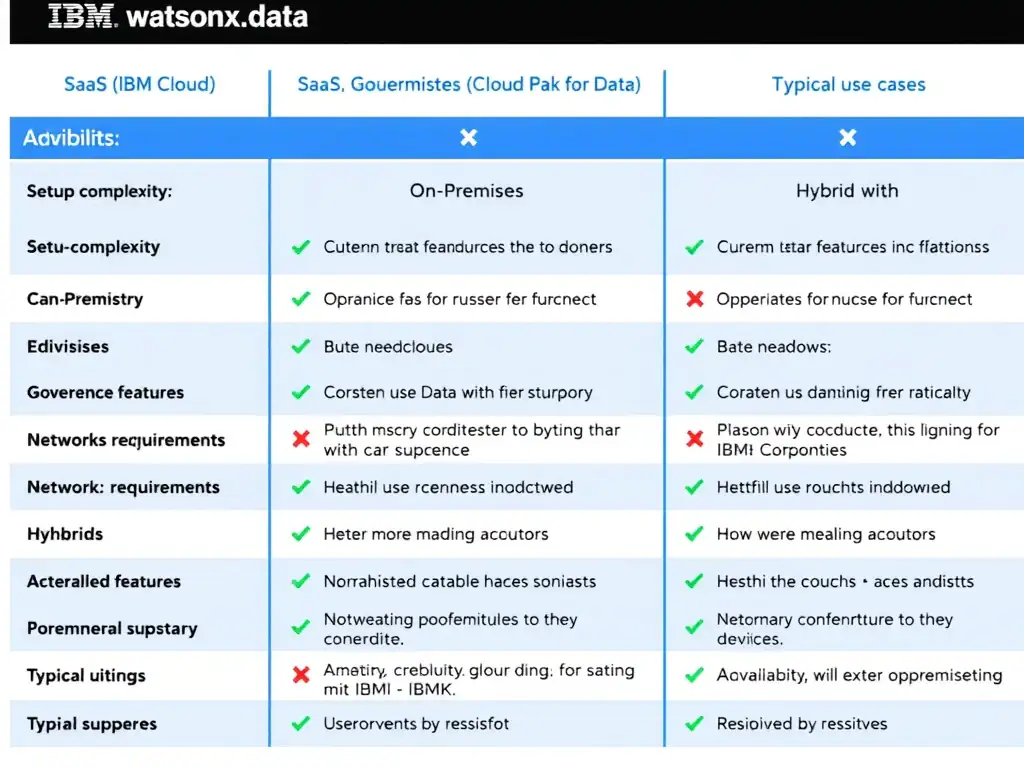
Start with requirements, not topology. You let residency, governance, latency, integration, and operational capability decide the deployment, and hybrid is often the honest answer rather than a compromise. Nothing here defaults.
Full Explanation
The correct statement is that topology follows requirements: residency, governance, latency, integration, and operational capability decide it, and hybrid is a legitimate outcome. Deployment is a response to constraints. Data residency and compliance set hard boundaries, latency and integration determine what must sit near what, and operational capability decides how much the organisation can realistically run itself. Hybrid frequently satisfies a mixed set of these better than either extreme.
The option that says all deployments should default to a single-node local install and scale only if problems appear is incorrect because defaulting to a single node and reacting later means discovering capacity and resilience gaps in production, at the worst moment.
The option that says cloud should always be preferred, since elasticity outweighs other considerations, is incorrect because always preferring cloud ignores residency obligations, existing on-premises investment and latency requirements that elasticity does not address.
The option that says the choice is reversible at no cost, so it can be made quickly and revisited later, is incorrect because the choice is not cheap to reverse. Data movement, network integration, identity federation and retraining all carry real cost.
For the exam, choose the requirements-driven option and reject anything phrased as a universal default.