
Which statement best describes the role of object storage in a watsonx.data deployment?
Select an answer to reveal the explanation.
Short Explanation
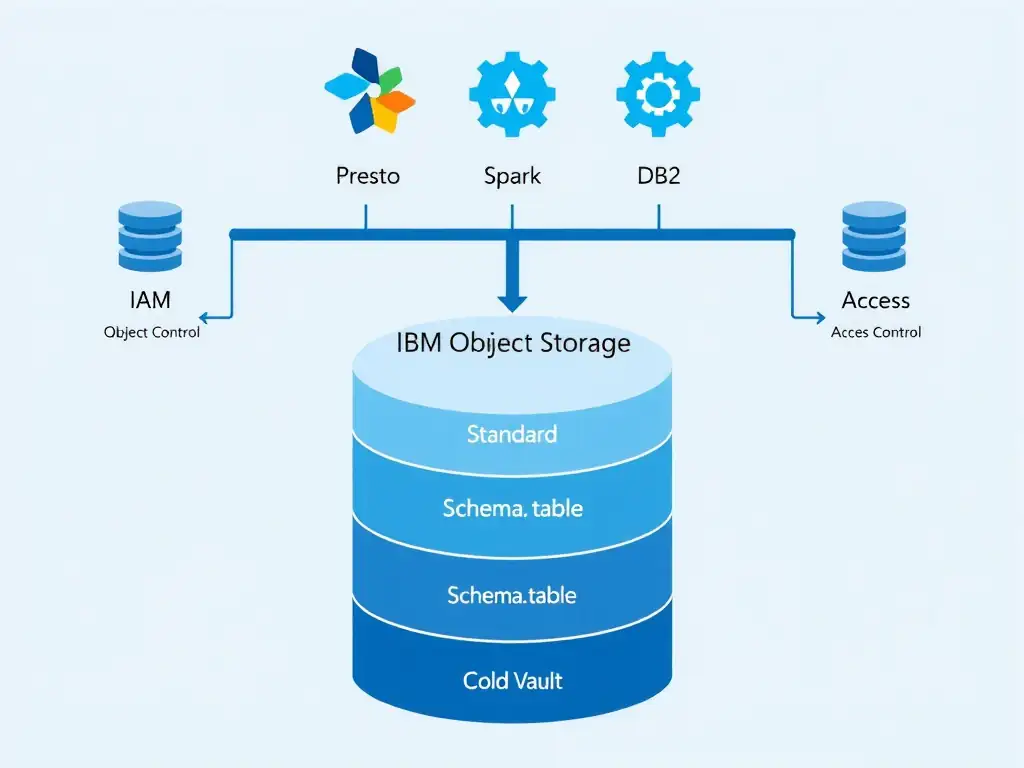
Object storage is where your lakehouse data actually lives. It gives you durability and scale, while catalog and governance layers add meaning and control. It isn't staging, archive-only, or a mounted filesystem.
Full Explanation
The correct statement is the one describing object storage as the durable, scalable system of record for lakehouse data, with metadata and access control supplied by layers above it. Object storage is where lakehouse data persists authoritatively. Its contribution is scale, durability, and cost; the meaning of that data comes from catalog metadata, and control over it comes from governance. The staging-area description is incorrect because engines read the data files in place. Treating storage as a staging area for engine-local copies would reintroduce per-engine duplication. The archive-tier description is incorrect because active tables live on object storage too. Tiering within object storage is a separate cost decision, not a boundary between active and archived data. The POSIX-compatible filesystem description is incorrect because object storage is not POSIX. Flat keys, immutable objects, and no directory semantics are exactly why open table formats sit above it. For the exam, be ready to reject all three of these mischaracterisations - staging, archive-only, and filesystem - since they recur across the fundamentals domain.